
Selesnya Commander Guide: Tokens, Counters and Going Wide
By MTG Master EditorialPublished Updated 8 min read
Selesnya is green and white, and if Rakdos likes making sure everything dies, Selesnya usually has the opposite problem: you end up with so many creatures that you start running out of space on the table.
Tokens, +1/+1 counters, enchantments, lifegain, creatures that make other creatures bigger… Selesnya is very good at building a board and turning it into something increasingly difficult to stop.
But don’t mistake that for boring or simple.
Depending on your commander, Selesnya can play tokens, go-wide, +1/+1 counters, enchantress, lifegain, Voltron, creature toolbox, hatebears or even combo.
The common theme is usually building something. Your board starts relatively innocent, then suddenly every creature is bigger, you’re making five tokens per turn and someone has to find a board wipe very quickly.
How Does Selesnya Play?
Green and white complement each other extremely well in Commander.
Green gives you ramp, big creatures, card advantage tied to creatures, +1/+1 counters and excellent ways to destroy artifacts and enchantments.
White gives you removal, board wipes, protection, tokens, lifegain and some of the best answers in the format.
Together, they give you one of the best color combinations for building a strong creature-based board.
Play a creature.
Make two tokens.
Put counters on all of them.
Double the number of tokens.
Give everything +3/+3.
Attack.
That’s a very Selesnya way of solving a problem.
What Is Selesnya Good At?
Tokens and Going Wide
This is probably the first thing most people think about when they think of Selesnya.
Why play one creature when you can make twenty?
Token decks want to create lots of small creatures and then turn them into a real threat with anthem effects, counters or cards that multiply your tokens.
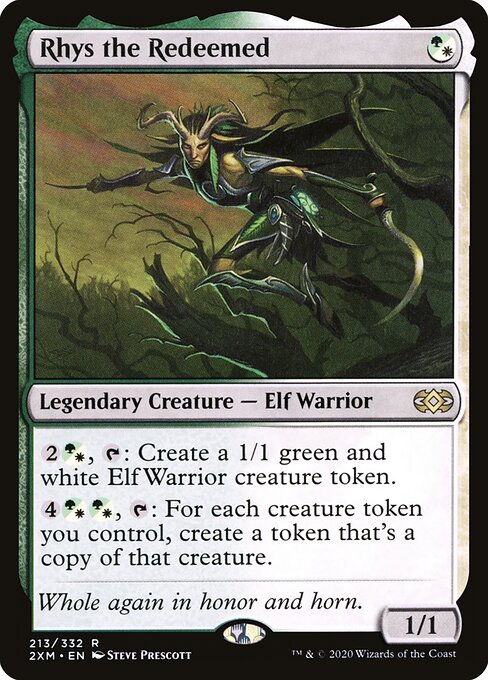
Rhys the Redeemed is one of the classics. He starts innocently enough making tokens one at a time, but once you have a decent board his second ability creates a copy of each creature token you control, doubling your token army.
Emmara, Soul of the Accord is another good example of how Selesnya can turn simple actions into more creatures. Whenever Emmara becomes tapped, you get a 1/1 Soldier token with lifelink.
The danger with these decks is that the board can get ridiculous very quickly.
Which, to be fair, is usually the idea.
+1/+1 Counters
Selesnya is also excellent at putting counters on creatures and then finding increasingly stupid ways to multiply them.
You can start with a few small creatures and end up with a board full of 10/10s surprisingly quickly.
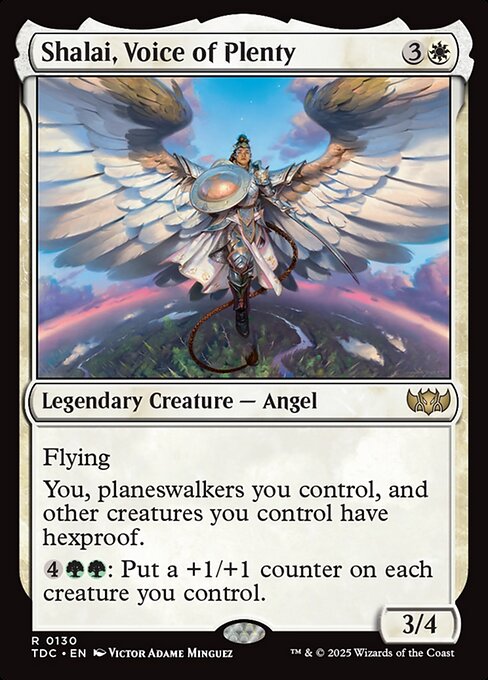
Shalai, Voice of Plenty fits here nicely: her activated ability puts a +1/+1 counter on each creature you control. She also gives you, your planeswalkers and your other creatures hexproof, helping protect what you’re building.
Hamza, Guardian of Arashin goes in another direction, reducing the generic part of your creature spells’ costs based on how many creatures with +1/+1 counters you control.
Counters are particularly good if you like watching your board grow turn after turn instead of trying to win with one explosive combo.
Although, of course, Selesnya can combo with counters too.
Enchantments
Green and white together have access to some of the best enchantment support in Commander.
An enchantress deck usually wants to keep playing enchantments and getting value every time it does.
Draw cards.
Make tokens.
Gain life.
Generate mana.
Make your creatures bigger.
And then play another enchantment and do it all again.
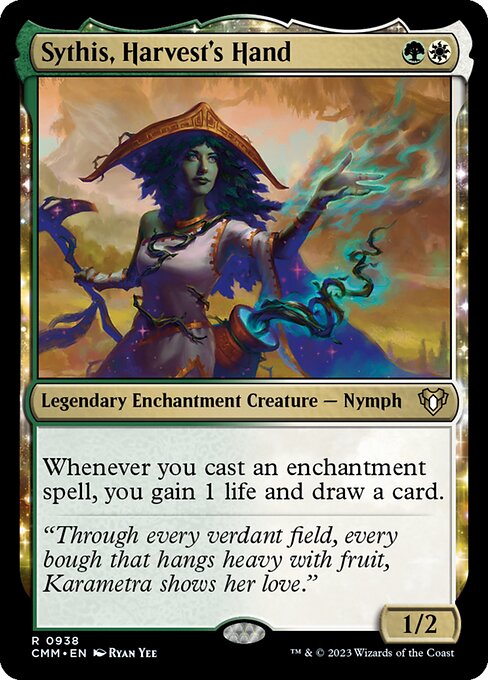
Sythis, Harvest’s Hand is probably the clearest example.
Every enchantment spell you cast triggers an ability that gains you a life and draws you a card. Simple ability, ridiculous value once the deck starts moving.
Sythis is also a good example of why Selesnya isn’t necessarily just “play creatures and attack.” An enchantress deck can be a complicated engine with lots of pieces interacting with each other.
Lifegain
White already likes gaining life, and green gives you plenty of creatures and effects that can benefit from it.
The important thing here is that gaining life isn’t really a strategy by itself.
Going from 40 to 90 life is nice.
But if that’s all your deck did, eventually somebody is still going to kill you.
Good lifegain decks turn those extra lives into something useful: cards, tokens, counters or direct win conditions.
Trelasarra, Moon Dancer is a nice example. Every time you gain life she gets bigger and lets you scry, so the lifegain actually moves your game plan forward.
Creature Toolbox
This is one of the sides of Selesnya I really like.
Green can search for creatures extremely well, while white has access to creatures that answer all kinds of different problems.
That means you can build a deck where your creatures aren’t just attackers. They’re your toolbox.
Need artifact removal?
There’s a creature for that.
Need enchantment removal?
Creature.
Need graveyard hate?
Probably another creature.
Need to protect your board?
Yes, there’s a creature for that too.
Captain Sisay is one of the classic commanders for this kind of strategy, letting you search for legendary cards and giving you access to exactly the piece you need.
Big Creatures and Combat
And sometimes you don’t need fifty tokens.
Sometimes one enormous creature is enough.
Green gives Selesnya access to big creatures and ramp, while white gives you protection and ways to make combat much more dangerous.
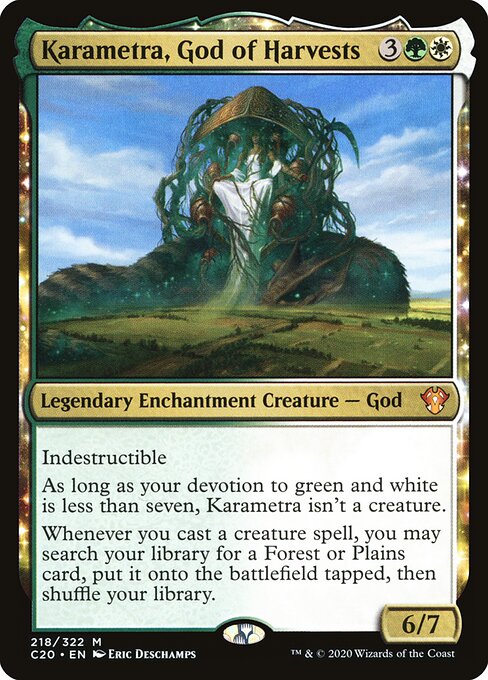
Karametra, God of Harvests rewards you for doing something you’re probably already doing: casting creature spells. In return, she lets you search for a Forest or Plains card and put it onto the battlefield tapped, building your mana base.
Selesnya can be very good at playing fair Magic.
The problem for your opponents is that Selesnya’s version of “fair” can eventually mean attacking with twelve 15/15 creatures.
What Is Selesnya Bad At?
One of the biggest dangers is becoming too dependent on your board.
You’ve spent six turns creating creatures, doubling tokens, adding counters and building this beautiful army.
Then someone casts a board wipe.
That’s Commander.
Protection and recovery are extremely important in Selesnya. Cards that give your board indestructible, phase it out or otherwise protect your creatures can be the difference between winning and basically starting the game again on turn seven. Choose the right protection: indestructible won’t stop exile or forced sacrifice, and hexproof won’t stop a wipe that doesn’t target.
Another problem can be card advantage.
Green and white have much better card draw than they did years ago, but you still need to build around it.
If your hand is empty after dumping ten creatures onto the battlefield, you’re putting a lot of faith in nobody having that board wipe.
How Does Selesnya Usually Win?
Combat.
Not always, but very often.
Create lots of creatures, make them bigger and attack.
Token decks overwhelm the table with numbers.
Counter decks turn normal creatures into huge threats.
Voltron decks build one creature that can kill players by itself.
Enchantress decks can assemble engines that generate enormous amounts of value and eventually find a combo or a way to overwhelm the table.
Selesnya also has plenty of combos available, especially involving tokens, counters, creatures and enchantments.
But if you’re building a normal Selesnya deck, there’s a pretty good chance that at some point you’re going to look at your board and think:
“Okay… I think I can kill someone now.”
What Does a Selesnya Deck Need?
The biggest mistake I’d avoid is putting too many cards into the deck that only work when you’re already winning.
If you already control fifteen creatures, another card that gives all your creatures +2/+2 looks fantastic.
But what does that card do after somebody destroys your board?
You need ramp, card advantage, interaction and protection just like every other Commander deck.
Luckily, Selesnya is very good at most of these things.
Green gives you excellent ramp.
White gives you excellent removal.
Both colors can destroy artifacts and enchantments.
And together you have access to some of the best protection spells for keeping your board alive.
The important part is finding the right balance between building your board and making sure you can actually keep it.
Is Selesnya for You?
I’d look at Selesnya if you enjoy seeing your board get bigger and stronger as the game progresses.
It’s especially good if you like:
- Creating lots of tokens
- +1/+1 counters
- Creature-based decks
- Enchantments
- Lifegain
- Combat
- Building large board states
- Protecting and improving your creatures
- Having answers to artifacts and enchantments
- Turning small creatures into ridiculous threats
If you hate keeping track of tokens, counters and twenty different permanents, some Selesnya decks may drive you completely insane.
And yes, you may need more dice.
Probably a lot more dice.
Building Your First Selesnya Commander Deck
Start by deciding what you actually want your creatures to do.
“Creatures” isn’t really a strategy.
If you’re playing tokens, you need ways to create them, ways to benefit from having lots of them and ways to finish the game once you’ve built your army.
If you’re playing +1/+1 counters, you need creatures that benefit from counters and cards that make those counters matter.
If you’re playing enchantress, don’t fill half the deck with random creatures just because you’re in green and white. Your enchantments are the engine.
And whatever version you’re building, don’t forget protection.
Selesnya can create some absolutely ridiculous boards.
The difficult part isn’t always creating them.
It’s making sure they’re still there when your next turn starts.
That’s probably the best way I’d describe Selesnya:
Build something bigger than everyone else’s, protect it, and eventually turn it sideways.
Ready to test your Selesnya deck?
Analyze your list to check whether your ramp, card draw and protection can support the board you want to build.