
How to Build a Stax Commander Deck: Control Resources, Slow Opponents, and Win
By MTG Master EditorialPublished Updated 22 min read
There are plenty of ways to make your opponents unhappy in Commander.
You can destroy their creatures, counter their spells, steal their permanents, or attack them with an enormous army.
And then there's Stax.
Instead of answering every threat individually, Stax tries to make it difficult for opponents to execute their strategies in the first place.
Maybe their spells cost more mana. Maybe they can only cast one spell per turn. Perhaps their lands don't untap normally, or they suddenly can't activate abilities they were relying on.
And while everyone is trying to figure out how to play around those restrictions, you're developing your own plan.
At least, that's how it's supposed to work.
Because there's another version of Stax where nobody can do anything, including you, and the game continues for another hour without anybody getting closer to winning.
I've seen enough Commander games to understand why Stax has a reputation.
But I also think it's a genuinely interesting strategy when built properly.
Stax isn't just about preventing people from playing Magic. It's about understanding which resources matter, choosing the right restrictions, and building a deck that can function better than your opponents under those conditions.
And there's one thing I consider particularly important.
If you're going to slow down the entire table, you should have a plan to win.
What Exactly Is Stax in Commander?
Stax is a strategy based on restricting resources, limiting actions, and making it harder for opponents to develop their game plans.
Instead of waiting until somebody plays something dangerous, you use permanents that change what players can do.
For example, imagine you control these three cards:
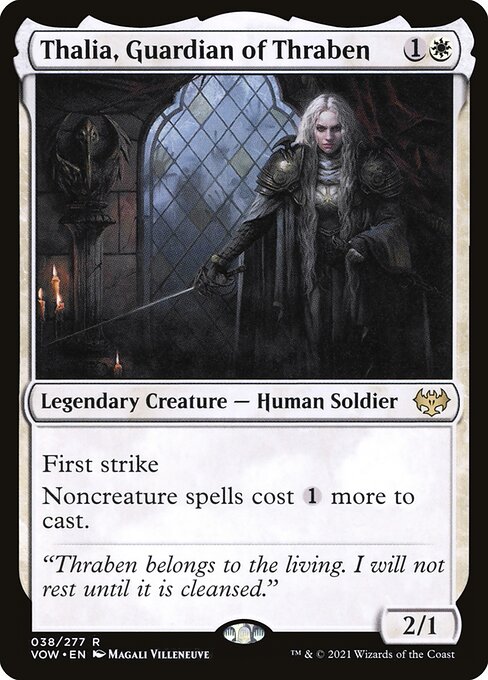
Rule of Law
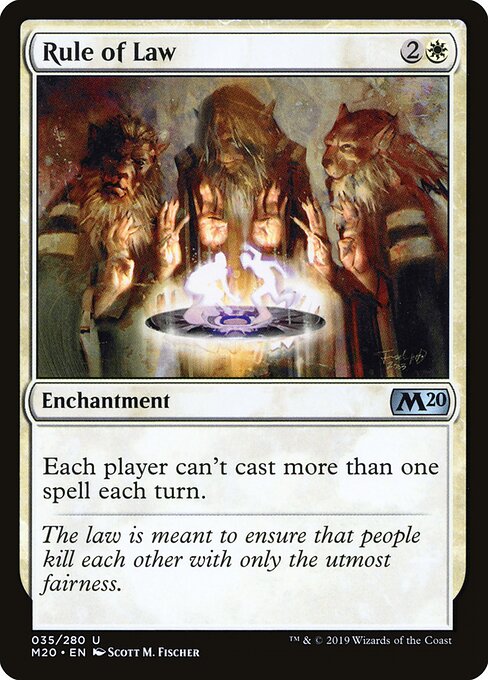
Thalia, Guardian of Thraben
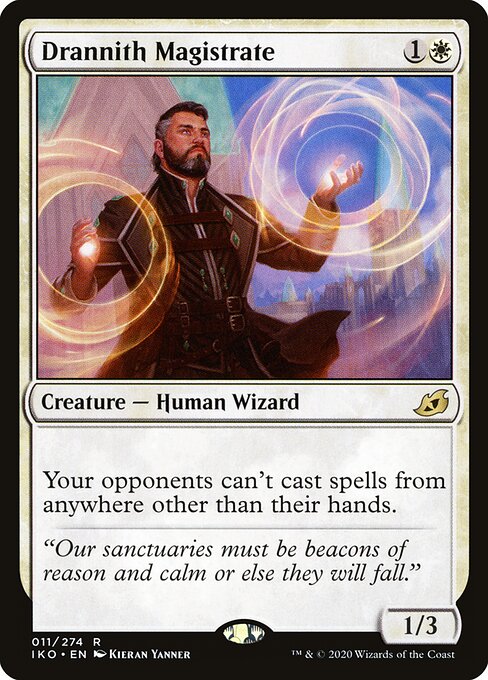
Drannith Magistrate
Rule of Law prevents each player from casting more than one spell per turn.
Thalia makes noncreature spells cost one additional generic mana.
And Drannith Magistrate prevents your opponents from casting spells from anywhere other than their hands, including casting their commanders from the command zone.
None of those cards is particularly threatening through combat.
But together, they can make life very difficult for decks that want to cast several cheap spells, rely heavily on their commanders, or assemble combinations of cards quickly.
That's how Stax works.
You're changing the rules of engagement before your opponents can fully execute their plans.
But notice something important.
Rule of Law and Thalia affect you too.
If your own deck needs to cast four spells every turn, you've probably created just as many problems for yourself.
A good Stax deck isn't simply a collection of restrictive cards.
It's a deck designed to operate under its own restrictions.
Stax, Control, and Pillowfort Aren't Exactly the Same
These strategies sometimes overlap, but I think it's worth understanding the differences.
A Control deck usually responds to threats.
Someone casts a dangerous creature, and you remove it. An opponent tries to win with a combo, and you counter an important spell.
You're managing what happens during the game.
Stax takes a different approach.
Instead of countering the third spell your opponent casts, you might play Rule of Law so they can't cast that third spell at all.
And Pillowfort focuses more on protecting yourself.
Cards like Ghostly Prison or Sphere of Safety make attacking you difficult or expensive.
That doesn't necessarily prevent opponents from developing their strategies or attacking somebody else.
Of course, the categories aren't completely separate.
A Stax deck can include counterspells and removal.
A Control deck might play a few Stax pieces.
And an Enchantress deck might combine Pillowfort with restrictions that affect the entire table.
The difference is what your deck is primarily trying to accomplish.
For Stax, the objective is to control the pace of the game by limiting what other players can do.
Choosing the Right Stax Commander
I think commander selection is particularly important here.
Some commanders naturally make opponents' spells more expensive.
Others let you untap permanents, avoid certain restrictions, or turn a slowed-down game into a victory.
What I'd look for is a commander that gives you an advantage under the rules you're imposing.
Grand Arbiter Augustin IV: Everything Costs More. Except Yours.
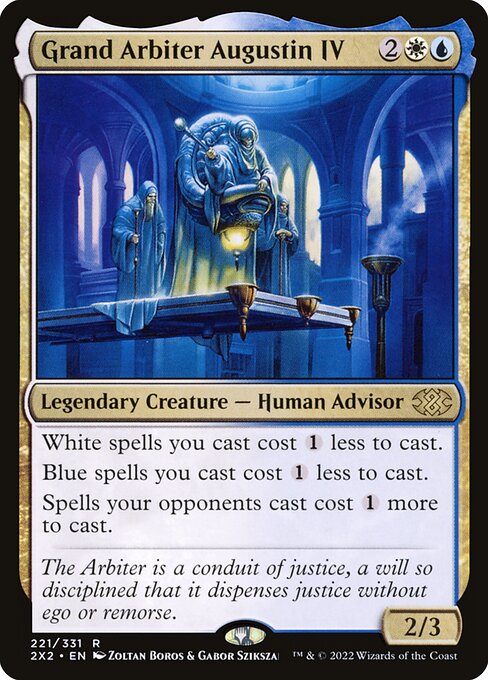
Grand Arbiter Augustin IV is probably one of the most recognizable Stax commanders.
Your white spells cost one generic mana less.
Your blue spells cost one generic mana less.
And your opponents' spells cost one additional generic mana.
A spell that's both white and blue benefits from both of your cost reductions.
Those reductions only remove generic mana from the cost: they do not replace colored mana symbols. Your colorless spells receive neither reduction.
That creates a clear advantage.
Your opponents have to spend more resources to develop their boards, while many of your own spells become cheaper.
And because Grand Arbiter is in Azorius colors, you have access to counterspells, removal, card draw, and several powerful restriction effects.
What I like about Grand Arbiter is that the strategy is straightforward.
You're trying to make your own development more efficient while making everybody else's development more expensive.
The downside is that your commander becomes a very obvious target.
Nobody enjoys paying extra mana for every spell simply because your commander is sitting on the battlefield.
So I'd expect removal.
Quite a lot of it.
Derevi, Empyrial Tactician: Untapping Is a Powerful Advantage
Derevi, Empyrial Tactician is another classic choice.
Whenever Derevi enters the battlefield, or a creature you control deals combat damage to a player, you may tap or untap a target permanent.
That opens up some interesting possibilities.
You can untap lands to generate more mana, tap opposing permanents, or use your creatures to gain additional advantages during combat.
And because Derevi has a Bant color identity, you have access to several types of ramp, interaction, and resource-denial effects.
One particularly interesting detail is that Derevi can be put directly onto the battlefield from the command zone using her activated ability.
That's not casting her, so it doesn't use the normal commander tax.
The ability costs 


 . It does not use your spell allowance under Rule of Law, and Drannith Magistrate does not stop it, because neither effect prohibits that activated ability. Other restrictions on activated abilities can still stop it.
I like commanders that have an unusual way to operate around restrictions.
But Derevi still needs a well-built deck.
Simply including a few effects that prevent lands from untapping won't guarantee victory.
You need ways to develop your own resources and eventually finish the game.

Hokori, Dust Drinker: The Land Problem
Hokori, Dust Drinker is a much more direct resource-denial commander.
While Hokori is on the battlefield, lands don't untap during their controllers' untap steps.
Instead, each player untaps one land they control at the beginning of their upkeep.
That's a serious restriction.
In a format where players often want to cast expensive spells and develop enormous boards, limiting available lands can completely change the game.
But there's a problem.
Hokori affects you too.
If your deck depends entirely on lands for mana, you might find yourself struggling just as much as your opponents.
That's why I'd want reliable nonland mana sources, a low enough mana curve, and a way to turn that restriction into a winning position.
I wouldn't choose Hokori unless I genuinely wanted to build around resource denial.
It's not the kind of commander I'd casually add to a deck without thinking about the games it creates.

Yasharn, Implacable Earth: Stop Sacrifice-Based Strategies
Yasharn, Implacable Earth offers a different kind of Stax.
When Yasharn enters the battlefield, you can find a basic Forest and a basic Plains and put them into your hand.
But the more interesting part is its static ability.
Players can't pay life or sacrifice nonland permanents to cast spells or activate abilities.
That affects several popular Commander strategies.
Treasure tokens can't be sacrificed to activate their normal mana abilities.
Many sacrifice outlets stop working.
And some powerful effects that use life as a cost become unavailable.
I like Yasharn because it's a good example of a restriction that targets a particular kind of gameplay rather than simply making everything more expensive.
But remember that the ability affects you as well.
If you're playing lots of Treasures or sacrifice engines, Yasharn might be working against your own deck.
Also, it doesn't stop every sacrifice effect. A spell that makes players sacrifice creatures as part of its resolution works differently from sacrificing something to pay a cost.
It does not itself forbid sacrificing a land as a cost. However, fetchlands that also require paying 1 life cannot be activated: that life payment is prohibited.
Those details matter.

Winota, Joiner of Forces: Stax With a Very Aggressive Plan
Winota, Joiner of Forces is particularly interesting because she can combine restrictive permanents with a fast creature strategy.
Whenever a non-Human creature you control attacks, Winota can find a Human creature among the top six cards of your library and put it onto the battlefield tapped and attacking, with indestructible until end of turn.
That means you can develop your battlefield without casting those Human creatures normally.
This works under Rule of Law because putting a Human onto the battlefield is not casting it. But a creature entering attacking was not declared as an attacker, so it does not trigger its own ‘whenever this creature attacks’ abilities.
And some Humans provide useful Stax effects.
Drannith Magistrate, Thalia, Guardian of Thraben, and other disruptive creatures can fit into certain Winota builds.
What makes this interesting is that you aren't simply slowing opponents down.
You're also attacking and building a dangerous board.
Personally, I think that's an important lesson from Winota.
A Stax deck becomes much more effective when its restrictions support an actual winning strategy.

Tax Effects: Make Everything More Expensive
One of the most common forms of Stax is taxing.
You play cards that make your opponents spend additional mana to do things they would normally do for less.
Thalia, Guardian of Thraben and Sphere of Resistance are good examples.
Thalia taxes noncreature spells.
Sphere of Resistance makes all spells cost one additional generic mana.
Thorn of Amethyst makes noncreature spells cost more.
Those additional costs may look small.
But early in the game, one extra mana can make a significant difference.
A player who expected to cast a mana rock and a removal spell during the same turn might suddenly be able to cast only one of them.
And if you combine multiple tax effects, those costs can accumulate.
But I'd be careful about adding too many cards that do essentially the same thing.
If your opponents have fifteen lands in play, a single extra mana might not slow them down much.
And if your own spells are getting taxed too, you're potentially making your deck less efficient.
I like tax effects that interfere with the strategies I expect to face while allowing my own deck to function reasonably well.
That's much more useful than simply making everything expensive.
Rule of Law Effects: One Spell Is Enough
This is one of the most interesting types of Stax.
Rule of Law prevents each player from casting more than one spell per turn.
Arcane Laboratory has a similar effect.
And Eidolon of Rhetoric provides the same restriction on a creature.
These cards can be devastating against decks that want to cast several spells in one turn.
Spellslinger and Storm strategies are obvious examples.
But the restriction also affects ordinary Commander decks that rely on casting several cheap spells to develop.
There's something important to remember, though.
Rule of Law affects you too.
If your deck needs to cast several spells every turn, you're going to have a problem.
That's why these effects work particularly well when your strategy relies on permanents already on the battlefield.
Activated abilities, combat, and some other ways of generating value can continue functioning without requiring you to cast additional spells.
For example, if your commander produces tokens through an activated ability, you can keep developing your battlefield even under Rule of Law.
Deafening Silence is another interesting option.
It prevents each player from casting more than one noncreature spell per turn, but doesn't impose that same limit on creature spells.
That can be particularly useful in creature-heavy decks.
And one rules detail worth remembering: copying a spell directly on the stack normally doesn't count as casting another spell.
Rule of Law limits spells being cast, not every spell copy that might appear on the stack.
The limit applies on each player’s turn and counts spells cast before the restriction entered. A countered spell still counts; if an effect has you cast a copy of a card, that casting counts too.
Resource Denial: Winter Orb and Other Difficult Cards
Some Stax effects are much more restrictive than adding one mana to a spell.
Winter Orb is a classic example.
As long as Winter Orb is untapped, players can't untap more than one land during their untap steps.
That's an enormous restriction in Commander.
Imagine having eight lands on the battlefield but only being able to untap one during your untap step.
Suddenly, casting a six-mana creature becomes much more difficult.
And if another player has mana rocks or other nonland sources of mana, they might be much less affected.
That's why Winter Orb can be so powerful in the right deck.
But it's also why it's dangerous to include without thinking.
If you don't have a way to operate under the restriction, you've simply slowed yourself down.
Static Orb is another example: while it remains untapped, it limits each player to untapping no more than two permanents during their untap step.
These cards require careful deck construction.
I wouldn't include them simply because they're powerful Stax cards.
I'd include them only if my deck has a reliable advantage under their restrictions and a realistic way to win.
One interesting detail about Winter Orb is that its restriction only applies while it's untapped.
With an appropriate effect that lets you tap the Orb before your untap step, you can avoid its restriction for that step.
The previous player’s end step is the usual last opportunity, because no player receives priority during the untap step. If the Orb starts that step tapped, you can untap it alongside your lands without it restricting that same step.
But you can't simply tap Winter Orb whenever you want. You need another card or ability that actually allows you to do it.
Those interactions are part of what makes Stax an interesting deckbuilding challenge.

Build Around Your Own Restrictions
This is probably the most important part of constructing a good Stax deck.
Don't start by choosing twenty powerful restrictive cards and hope everything works together.
Start by asking what your own deck will still be able to do.
If you're playing Rule of Law, perhaps you should focus on creatures, activated abilities, token generation, or repeatable permanents rather than casting lots of spells every turn.
If you're playing Winter Orb, you might want mana rocks, low-cost spells, or ways to untap important permanents.
If you're playing Yasharn, don't build your mana engine around sacrificing Treasures.
And if you're taxing noncreature spells with Thalia, remember that your own noncreature spells become more expensive too.
This is where I think Stax becomes genuinely interesting.
You're not simply restricting the table.
You're designing a deck where those restrictions hurt your opponents more than they hurt you.
The more naturally your strategy functions under those conditions, the less you need to force complicated interactions.
And I generally prefer that approach.
A good Stax piece should support the deck you're already building, not create a new problem you need five other cards to solve.
Mana and Ramp: You Still Need to Play Magic
It's easy to focus on denying opponents resources and forget about developing your own.
But a Stax deck still needs mana.
In fact, I'd pay particular attention to the mana base because some of your own restrictive effects can make recovering from a slow start more difficult.
Mana rocks can be excellent when you're using effects that restrict land untapping.
Creature-based mana can work well in decks that tax noncreature spells.
And conventional land ramp is still useful if your restrictions don't interfere with it.
The important part is matching your mana package to your Stax effects.
For example, a deck that uses Winter Orb can benefit from mana rocks that continue untapping normally.
But a deck using restrictions on artifacts or activated abilities might need a different approach.
I also wouldn't overload the deck with expensive spells.
If your goal is to slow opponents down while developing your own board, having a reasonable mana curve is extremely important.
You don't want to spend five turns restricting everyone's resources and then discover you can't cast your own win conditions.
That's one of the easiest ways to make a Stax game last far longer than it needs to.
Card Advantage: Make Progress While Everyone Else Struggles
This is another important part of the strategy.
You can make opponents' spells expensive, limit their mana, and restrict their actions.
But if you're only drawing one card per turn and doing nothing else, you're not necessarily gaining an advantage.
You're just making the game slower.
I'd want repeatable sources of card advantage that function under my restrictions.
In Azorius, cards like Rhystic Study, Mystic Remora, and other card-draw engines can help, depending on your build.
Creature-based Stax decks might prefer creatures that draw cards when they attack or enter the battlefield.
And some commanders naturally provide enough value to keep the deck moving.
The important part is having a reason why time benefits you more than it benefits your opponents.
If your deck needs six additional turns to assemble a winning position while opponents are struggling to cast spells, that's fine.
But if you need those six turns and still don't know how you're going to win, something is missing.
I'd rather include one fewer restrictive effect and another useful draw engine than build a deck that runs out of resources alongside everybody else.
Interaction and Protection Still Matter
Stax doesn't mean you're immune to your opponents' strategies.
A single removal spell can destroy an important restriction and open the game again.
And if your entire plan depends on keeping one particular permanent alive, opponents will eventually identify it as a priority target.
That's why I'd still include conventional removal, counterspells where appropriate, and some protection.
In white, cards like Swords to Plowshares and Generous Gift remain useful.
Blue gives you counterspells and ways to protect important spells.
Green can remove artifacts and enchantments that interfere with your plan.
But be careful with your own restrictions.
If you control Rule of Law and you've already cast a spell this turn, you can't cast another spell that turn, even if you suddenly need to counter something.
That doesn't mean counterspells are useless in Stax.
It means you need to plan when you're going to spend your one spell.
And this is another reason I like activated abilities and repeatable interaction.
They can give you flexibility without requiring additional spells to be cast.
How Many Stax Pieces Should You Play?
I wouldn't try to reach a fixed number simply because it's a Stax deck.
Some commanders already provide a restrictive effect.
Others need several cards in the 99 to establish their strategy.
And a deck using a few well-chosen restrictions to protect an aggressive plan is very different from one built around a heavy resource-denial engine.
As a starting point, I might look at around 6–10 meaningful Stax pieces in a focused but not completely dedicated build, then adjust based on how consistently they appear and how much they interfere with my own strategy.
A heavier Stax deck may want more.
But I'd be careful about treating every tax, hate piece, or defensive enchantment as equivalent.
Rule of Law and Winter Orb change the game in completely different ways.
And two restrictive cards aren't necessarily better together simply because they're both considered Stax.
Sometimes one restriction interferes with your ability to take advantage of another.
I prefer choosing effects that attack specific weaknesses in opposing strategies while allowing my own deck to keep developing.
And I wouldn't sacrifice card draw, ramp, interaction, or actual win conditions just to add more Stax pieces.
How Does a Stax Deck Actually Win?
This is the question I'd answer before completing the deck.
Because restricting your opponents is not a win condition.
You can make spells expensive.
You can limit how many spells players cast.
You can prevent lands from untapping.
But eventually, somebody needs to win the game.
And preferably that somebody is you.
Win Through Creatures and Combat
This is one of my favorite approaches.
You use Stax pieces to slow the table down while gradually building a battlefield of creatures.
Some commanders make this easier than others.
Winota, Joiner of Forces can develop an aggressive board while putting useful Humans into play.
Derevi, Empyrial Tactician can use creatures attacking and dealing combat damage to generate additional value.
And even a more traditional Stax commander can include efficient creatures that become dangerous over several turns.
I like this approach because the game keeps moving.
You're not simply waiting for opponents to concede because they can't do anything.
You're attacking and working toward an actual victory.
Win Through Repeatable Engines
Another option is to use permanents that generate advantages every turn.
Maybe you're creating tokens.
Maybe you're drawing extra cards and slowly building an overwhelming board.
Or perhaps your commander provides recurring effects that eventually put you far ahead.
This can work particularly well with restrictions on spellcasting.
If opponents can only cast one spell per turn while your board generates several useful effects without casting anything, you'll gradually gain an advantage.
But I'd still make sure that the engine can finish games.
Accumulating resources indefinitely isn't the same as winning.
Win Through Combos
Some Stax decks use their restrictive effects to protect a compact combo.
The idea is straightforward.
You make it difficult for opponents to develop or interact, assemble your pieces, and eventually win.
That can be particularly effective in higher-power Commander.
But it's also something I'd think about carefully before building the deck.
If you're playing a casual table, locking down the game and then winning through the same combo every time might not be particularly enjoyable for everybody.
It depends on your group and what you agreed to play.
Personally, I prefer Stax decks where the restrictions help a clear strategy rather than becoming the entire strategy.
Playing Stax Without Turning Every Game Into an Hour-Long Lock
I think this deserves its own section.
Stax is a legitimate Commander strategy.
There's nothing wrong with playing restrictive cards, taxing resources, or forcing opponents to adapt their plans.
But the experience can be very different depending on how you build and play the deck.
There's a difference between slowing down explosive strategies and creating a board state where nobody can meaningfully progress.
And the second situation becomes particularly frustrating when the Stax player has no way to finish the game.
My approach would be simple.
If you're building a Stax deck for your regular group, make sure everybody understands roughly what kind of strategy you're bringing.
You don't need to reveal your entire decklist.
But if you're planning to play heavy resource denial, that's probably something worth mentioning before the game.
And once you're playing, know your cards.
Some Stax effects are complicated. Players may forget restrictions, pay incorrect costs, or misunderstand which abilities still work.
Explaining those effects clearly makes the game much smoother.
I'd also avoid spending unnecessary time thinking through actions that your own restrictions have already made impossible.
If you're playing Stax, you should probably know how your Stax pieces work.
Especially when you've got three opponents waiting.
Common Mistakes When Building Stax
There are several things I'd watch out for.
Too many restrictions and no win condition. Making the game miserable for everybody isn't the same as winning.
Locking yourself out. If your own deck can't function under your Stax pieces, you've built a problem for yourself.
Not enough card advantage. Slowing opponents down doesn't automatically mean you're getting ahead.
Ignoring your mana curve. You still need to cast your spells and develop your board.
Relying entirely on one permanent. If removing one card completely destroys your strategy, you need more resilience.
Not understanding which restrictions are symmetrical. Some effects hurt all players, including you.
Playing Stax pieces that don't meaningfully affect your opponents. A restriction is only useful if it interferes with something that matters.
And one more thing: don't add Winter Orb simply because it's a famous Stax card.
If your deck can't take advantage of it, you're probably just extending the game for no good reason.
Test Your Stax Deck Before Buying Everything
Stax is one of the archetypes where I'd be particularly careful about testing.
A decklist can look extremely powerful when you read each restrictive card individually.
But during actual games, you might discover that your own cards interfere with each other.
Perhaps your mana becomes too restricted.
Maybe you can't cast your own protection spells.
Or perhaps the deck is excellent at slowing down opponents but takes forever to develop a winning position.
That's why I'd test the deck before buying all the cards.
In MTG Master Deck Builder, you can build your Stax Commander deck, explore card synergies, and use the Deck Analyzer to review consistency, mana curve, interaction, resilience, and other aspects of the deck.
I'd pay particular attention to whether your ramp and card-draw packages actually work alongside the restrictions you've included.
The opening-hand simulator can help identify hands where you have several Stax pieces but no real development.
And the combo detection tools are worth checking if your strategy includes repeatable tap and untap effects, mana engines, or compact finishing combinations.
Of course, an analyzer can't fully predict how a Stax deck will affect a multiplayer table.
You'll discover that during real games.
But it can help identify structural problems before you invest money in a deck that slows everybody down, including yourself.
Is Stax the Right Archetype for You?
I think Stax is an interesting choice if you enjoy resource management, understanding opposing strategies, and making decisions about which actions matter most.
It rewards knowing how different decks work.
You need to recognize what your opponents are trying to accomplish and choose restrictions that interfere with those plans.
And when built properly, Stax can create games where small decisions become extremely important.
But it isn't for everyone.
If you enjoy fast, explosive turns and casting lots of spells, limiting what players can do might not be particularly appealing.
And if your regular group prefers relaxed games where everybody gets to develop their decks, heavy Stax might not be the best fit.
Personally, I think the most satisfying Stax decks are those that use restrictions to create an advantage and then do something meaningful with it.
You slow down the game.
You develop your battlefield.
You protect your important pieces.
And you eventually win.
Because if everybody has spent the last forty minutes looking at their lands and passing the turn, and you're still trying to figure out how to finish...
Well, perhaps you need a few fewer Stax cards.
And a few more win conditions.
Build Stax with a clear route to victory
Check that your mana, card advantage and win conditions work with your restrictions in Deck Builder.