
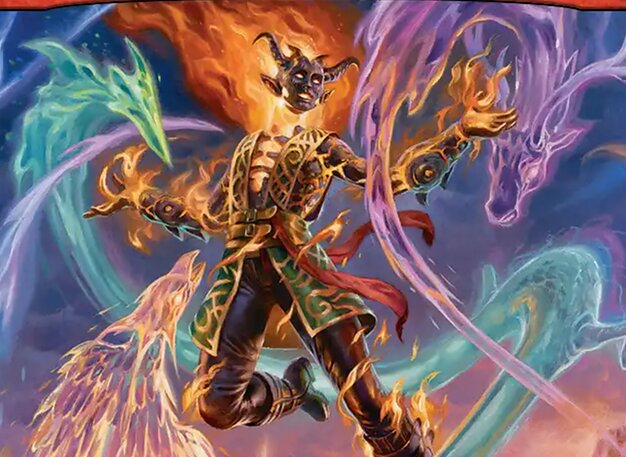
Ashling, the Limitless

 Commander
A five-color Elemental value engine that turns sacrifices into temporary copy bursts, with a late-game option to keep the best ones around.
Public decks: 7Bracket: 1


Card text
Legendary Creature — Elemental Sorcerer
Elemental permanent spells you cast from your hand gain evoke  as you cast them. (If you cast a spell for its evoke cost, it's sacrificed when it enters.)
Whenever you sacrifice a nontoken Elemental, create a token that's a copy of it. The token gains haste until end of turn. At the beginning of your next end step, sacrifice it unless you pay 


 .
.
Building around this commander?
Use MTG Master to build or analyze a Commander deck around this card, check consistency, and find weak spots before your next game.
Overview
- Build around casting Elemental permanents and leveraging Ashling’s built-in evoke option to convert mana into enter/leave value and sacrifice triggers.
- Ashling rewards sacrificing nontoken Elementals by replacing them with hasty token copies, letting you pressure life totals or reuse ETB effects immediately.
- Your end step becomes a key decision point: either cash in the token or pay {W}{U}{B}{R}{G} to keep it, which can shift you from value to board dominance.
- Typically plays like a midrange engine deck that can pivot into explosive turns once you have enough mana to evoke multiple Elementals and still protect your board.
- Because the commander is five-color, your fixing and ramp density heavily influence how consistently you can both deploy threats and pay the five-color upkeep.
- Most wins come from snowballing repeated copy triggers into an overwhelming battlefield or from chaining enough sacrifice-copy loops to outpace removal.
Common lines
- Cast an Elemental permanent, optionally using evoke to set up an immediate sacrifice that triggers Ashling and creates a hasty copy.
- Attack or extract immediate value from the token copy, then decide at end step whether it’s worth paying {W}{U}{B}{R}{G} to keep it.
- Use repeatable sacrifice outlets (if included) to turn otherwise temporary Elementals into consistent token pressure and value loops.
- Stabilize with larger Elementals, then convert board presence into a closing swing by creating multiple hasty copies in a single turn.
Strengths
- Converts “downside” sacrifices into upside by replacing nontoken Elementals with hasty token copies.
- Can generate sudden tempo swings: tokens gain haste and can impact combat immediately.
- Strong grind potential if you can repeatedly trigger sacrifices and selectively pay to keep the best copies.
- Flexible five-color access supports a wide range of interaction and support packages (assuming good fixing).
- Naturally resilient to some spot removal patterns since the plan often involves sacrificing your own creatures anyway.
Weaknesses
- Very demanding mana base: you often want both early fixing and the ability to pay {W}{U}{B}{R}{G} in the late game.
- Relies on nontoken Elementals; if your creature mix is diluted or your Elementals are answered before you can sacrifice them, the engine sputters.
- Tokens are temporary unless you pay the five-color cost, so you can lose board presence quickly after a big turn.
- Graveyard hate and exile-based removal can be awkward if your plan leans on sacrifice value and reusing bodies.
- Commander dependence: without Ashling, the evoke-and-copy plan loses a lot of its payoff.
Rule zero notes
- This commander can create bursty turns with multiple hasty token copies; clarify if your build aims for explosive chaining or a fairer midrange pace.
- Disclose whether you’re running repeatable sacrifice outlets to enable frequent copy triggers.
- Let the table know how consistent your five-color mana base is, since it affects how often you can keep token copies.
- If your list leans into looping sacrifice/value patterns, mention it up front so expectations match table speed.
- If you intend to close via combat swarms of hasty copies, note that the deck can produce sudden lethal pressure.
Matchups
Best into
- Midrange creature pods where hasty copies and repeated value can win combat-based games
- Removal-heavy tables where sacrificing your own creatures can blunt traditional 1-for-1 exchanges
- Slower pods that give you time to assemble fixing and reach the mana to pay {W}{U}{B}{R}{G} repeatedly
Struggles against
- Fast combo tables that end the game before your engine and fixing come online
- Heavy stax/tax shells that constrain casting multiple spells per turn or make five-color payments unrealistic
- Exile-sweeper metagames where both the original and your token plan can be cleaned up efficiently
Recent public decks
Dance with elements
Sep 8, 2026

TrueDemo...
Bracket 1
New Deck
Aug 3, 2026

Larssson...
Bracket 1
I pull out, hop out, air out, make it look sexy
Apr 27, 2026
J
J13HANKS
Bracket 3
Ashling
Mar 27, 2026
P
Play3736...
Bracket 1Deck Power 6.2
Ashling
Mar 13, 2026

Bragl
Bracket 1
Elemental
Feb 8, 2026
P
Play6740...
Bracket 1
New Deck
Feb 3, 2026
P
Play0145...
Bracket 5Deck Power 5.4
Staples
Browse all public decksFAQ
What is Ashling actually enabling?
Ashling gives your Elemental permanents an optional evoke cost and then turns nontoken Elemental sacrifices into hasty token copies, effectively converting sacrifice into extra bodies and extra value.
Do I have to pay {W}{U}{B}{R}{G} every turn?
No. You only pay it if you want to keep the token copy at your next end step; otherwise the token is sacrificed and you treat it like a temporary burst.
How does the deck usually win?
Most builds will win by snowballing repeated token-copy triggers into overwhelming combat steps, sometimes backed by ETB-based value from your Elementals.
What should I prioritize in deck construction?
Reliable five-color fixing and enough Elemental permanents to consistently trigger the commander, plus ways to control when your creatures get sacrificed.
Is Ashling more of a combo commander or a midrange commander?
It tends to read like a midrange engine that can have explosive turns, but how close it gets to “combo” depends on how hard you lean into repeatable sacrifice-and-copy lines.