
How to Build an Aggro Commander Deck: Attack Early, Keep the Pressure, and Win
By MTG Master EditorialPublished Updated 25 min read
Sometimes Commander games become a competition to see who can build the most complicated engine.
One player is drawing half their library. Another is preparing a graveyard combo. Someone else has six enchantments on the battlefield and needs a calculator to work out how much mana they can generate.
Meanwhile, you're attacking.
And attacking again.
And by the time everyone realizes they should probably do something about your creatures, one opponent is already dangerously close to losing.
That's the idea behind Aggro.
Instead of spending several turns preparing an enormous late-game strategy, Aggro tries to put pressure on opponents early and keep that pressure going until the game ends.
It sounds simple, but Commander makes aggressive strategies much more interesting than they might appear.
You're not trying to defeat one opponent with 20 life. You're facing three opponents who normally start with 40 life each.
That's a lot of damage.
And if you spend your entire hand building an aggressive battlefield only for someone to cast a board wipe, you might suddenly find yourself with nothing left.
So building Aggro in Commander isn't just about playing cheap creatures and attacking every turn.
It's about developing quickly, making your attacks matter, maintaining resources, and knowing when to commit to finishing the game.
And sometimes, knowing when not to attack.
Yes, even in Aggro.
What Makes a Commander Deck Aggro?
An Aggro deck is built around applying pressure as early and consistently as possible.
Usually, that means creatures, combat damage, and effects that reward attacking.
But not every Aggro deck looks the same.
Some play lots of small creatures and try to overwhelm opponents before they establish their defenses.
Others use creatures with powerful attack triggers, turning every combat into additional resources or damage.
Some focus on a few efficient threats that become increasingly dangerous, while others use extra combat phases to finish games.
What they have in common is that they're trying to force opponents to react.
Imagine one player is spending their early turns casting mana rocks and preparing to play a powerful six-mana commander.
Another is drawing cards and searching for combo pieces.
Meanwhile, you've already played three creatures and started attacking.
Those players now have a decision to make.
Do they continue developing their strategies, or do they spend resources dealing with your threats?
That's one of the biggest advantages of Aggro.
You're making opponents answer your game plan before they're ready to execute theirs.
But there's an important difference between being aggressive and simply attacking without thinking.
A good Aggro deck knows when to apply pressure, which opponents to attack, and how to avoid running out of resources.
Aggro in Commander Is Different From Aggro in Other Formats
This is something worth understanding before choosing your commander.
In a traditional one-on-one game of Magic, an aggressive deck might only need to deal 20 damage.
In a typical four-player Commander game, your three opponents start with a combined 120 life.
You don't necessarily have to personally deal all 120 damage. Opponents will attack each other, lose life to their own cards, and sometimes eliminate one another.
But the difference is still enormous.
A collection of efficient 2/2 creatures might be fantastic in a 60-card format.
In Commander, those same creatures need additional support to remain relevant against several opponents with larger life totals and access to board wipes.
That's why I prefer Aggro commanders that do more than simply attack efficiently.
Maybe they generate additional creatures.
Perhaps they create card advantage when attacking.
Or they make your combat damage affect multiple opponents.
And don't forget commander damage.
Dealing 21 combat damage with the same commander can eliminate a player regardless of their life total.
That's particularly useful for aggressive commanders that can become powerful attackers themselves.
But Aggro and Voltron aren't necessarily the same thing.
Voltron usually concentrates resources on one creature.
Aggro can use an entire army, several powerful attackers, or repeated combat triggers.
And while Aggro often overlaps with Tokens or Typal, the main objective is different.
You're not creating creatures just because your deck rewards you for creating them.
You're creating threats because you intend to use them to win.
Choosing the Right Aggro Commander
I like Aggro commanders that start contributing early or make attacking more rewarding.
A commander that costs seven mana and only becomes useful after attacking might be powerful, but it doesn't necessarily support an early-pressure strategy.
That doesn't mean expensive commanders can't work.
It means the rest of the deck needs to develop enough pressure while you're waiting for them.
Here are a few I'd consider.
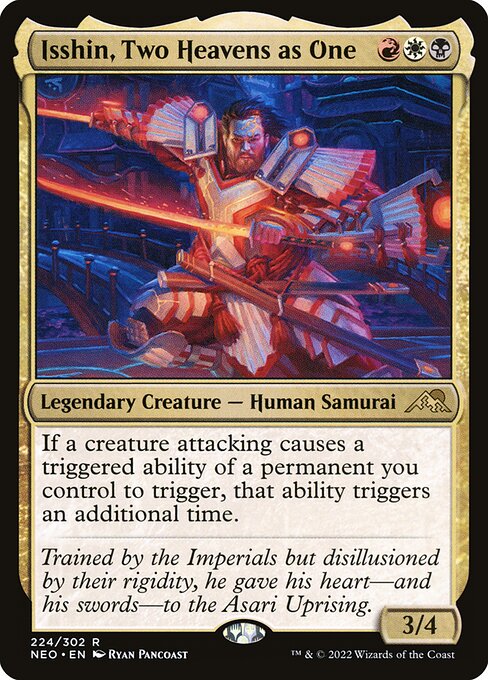
Isshin, Two Heavens as One: Twice the Attack Triggers
Isshin, Two Heavens as One is one of my favorite examples of an Aggro commander that rewards attacking.
His ability makes triggered abilities of permanents you control trigger an additional time when they're triggered by creatures attacking.
That includes many abilities that say things like "whenever this creature attacks" or "whenever you attack with one or more creatures."
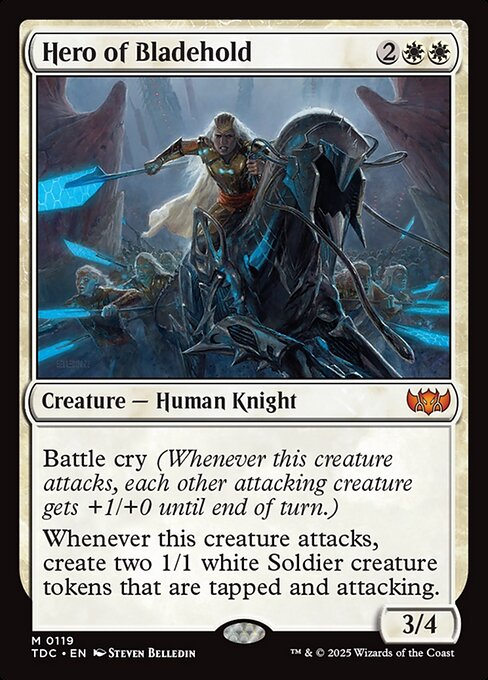
Imagine controlling Isshin alongside Hero of Bladehold.
Normally, when Hero of Bladehold attacks, it creates two 1/1 Soldier tokens tapped and attacking.
With Isshin, that ability triggers twice, creating four Soldiers instead.
And Hero of Bladehold's battle cry ability also triggers twice, giving your other attacking creatures an additional power boost.
Order the triggers so both Soldier-creating triggers resolve before either battle cry trigger. That way, all four tokens receive both bonuses.
That's a lot of additional pressure from a single attack.
What I like about Isshin is that you don't necessarily need enormous creatures.
You can build around efficient attackers with useful triggered abilities and let the commander multiply their value.
The drawback is that many of your strongest interactions depend on actually attacking.
If the battlefield becomes too dangerous or your opponents stop your attacks, you may struggle to generate the value you expected.
Winota, Joiner of Forces: Small Creatures Bring Big Threats
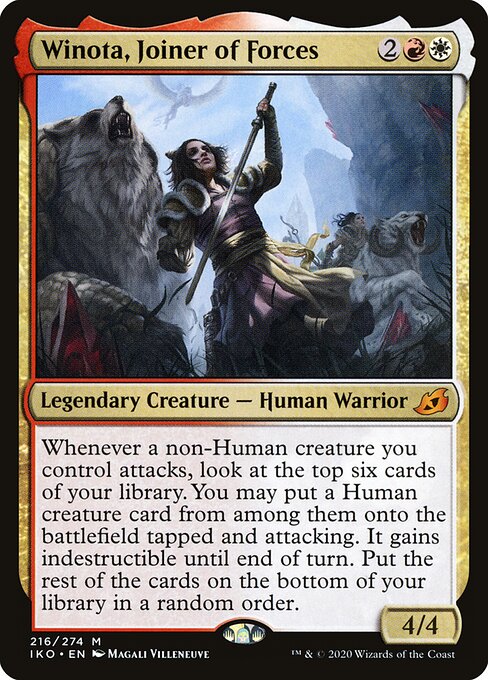
Winota, Joiner of Forces is another powerful Aggro commander, and she can become dangerous very quickly.
Whenever a non-Human creature you control attacks, you look at the top six cards of your library and may put a Human creature from among them onto the battlefield tapped and attacking.
That Human gains indestructible until end of turn.
And the ability triggers separately for each non-Human attacker.
Imagine attacking with three non-Human creatures.
You get three Winota triggers.
That's three opportunities to find Humans and put them directly onto the battlefield attacking, without paying their mana costs.
You can see how quickly things can get out of hand.
I like Winota because she turns small creatures into a way to deploy much more powerful threats.
But her deck needs a careful balance.
You want enough non-Humans to trigger the ability and enough useful Humans to find.
And remember that the Humans put onto the battlefield tapped and attacking weren't declared as attackers, so their own "whenever this creature attacks" abilities won't trigger from that entry.
Winota can become extremely powerful, so I'd also consider the power level of your regular group before building a heavily optimized version.
Anim Pakal, Thousandth Moon: Attacking Builds Your Army
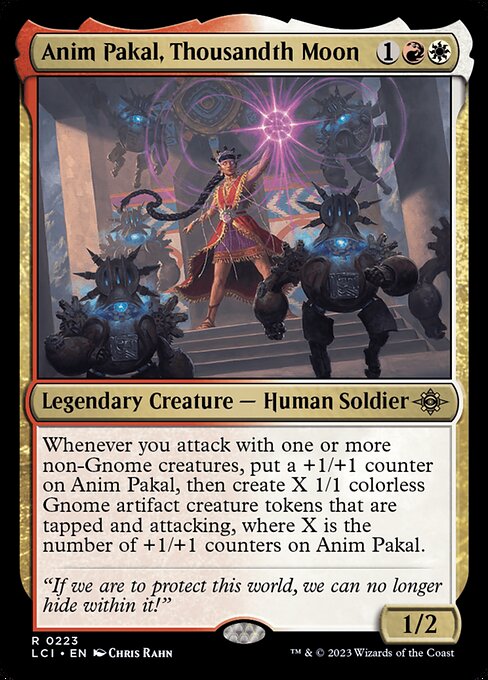
Anim Pakal, Thousandth Moon is a very interesting Boros commander.
Whenever you attack with one or more non-Gnome creatures, put a +1/+1 counter on Anim Pakal, then create a number of 1/1 Gnome artifact creature tokens equal to the number of +1/+1 counters on her.
Those Gnomes enter tapped and attacking.
At first, you might create only one token.
Then two.
Then three.
And if Anim Pakal survives several attacks, the numbers start growing quickly.
What I like is that your army develops through the thing an Aggro deck already wants to do.
Attack.
You're not spending every turn casting a separate token-producing spell.
Your combat steps are creating the creatures.
And because the Gnomes are artifact creatures, you can combine the strategy with artifact synergies if you want.
But I'd still include protection and card advantage.
If Anim Pakal gets removed repeatedly, you lose the engine that's making your attacks increasingly powerful.
Arabella, Abandoned Doll: Small Creatures, Serious Damage
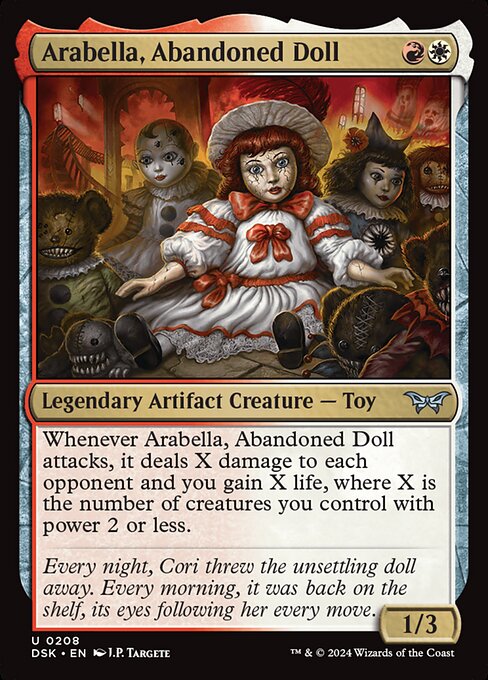
Arabella, Abandoned Doll is a great example of an aggressive commander that doesn't need enormous creatures.
Whenever Arabella attacks, she deals X damage to each opponent and you gain X life, where X is the number of creatures you control with power 2 or less.
Imagine you control Arabella and nine other creatures with power 2 or less.
That's ten creatures.
When Arabella attacks, her ability can deal 10 damage to each opponent and gain you 10 life.
And that's before normal combat damage.
What I find particularly interesting is that her ability doesn't need Arabella to deal combat damage.
She only needs to attack.
That makes her dangerous even when an opponent has blockers available.
But there's a detail worth remembering.
Her ability counts creatures with power 2 or less when it resolves.
If you give your small creatures large power boosts before that moment, some might stop contributing to the count.
So Arabella doesn't necessarily want the same type of aggressive support as every other commander.
Sometimes keeping creatures small is part of the plan.
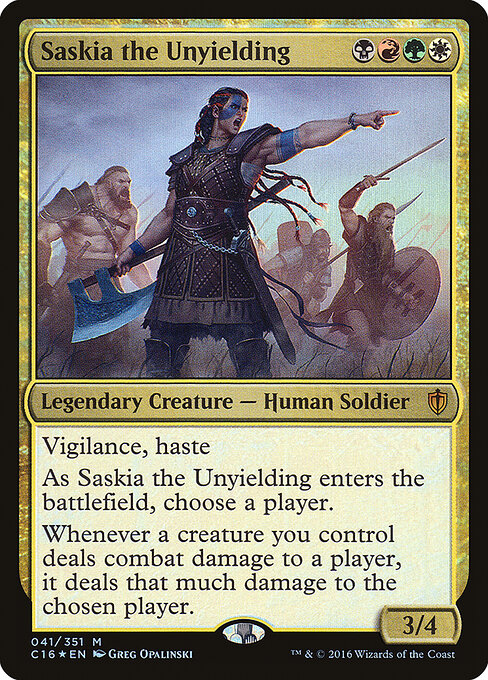
Saskia the Unyielding: Make Every Attack Hurt More
Saskia the Unyielding is another interesting choice if you want to play aggressive multiplayer Commander.
As Saskia enters, you choose a player. This choice is not an enters-the-battlefield trigger.
Whenever a creature you control deals combat damage to a player, that creature deals the same amount of additional damage to the chosen player.
That means you can attack one opponent while also pressuring another.
Imagine attacking one player with three creatures that each deal 3 combat damage.
That player receives 9 combat damage.
Saskia's ability can then cause those creatures to deal another 9 damage to the player you chose.
This is particularly interesting when one opponent is difficult to attack directly.
You can pressure the table through combat without needing every creature to attack the same player.
Saskia also has vigilance and haste, which are excellent for an aggressive commander.
The downside is the four-color mana base.
And because her strategy depends on combat damage actually connecting, you still need ways to get through blockers.
One rules detail: the additional damage from Saskia's ability isn't combat damage. Even if Saskia herself deals it, that extra damage doesn't count toward the 21 commander-damage threshold.
Giada, Font of Hope: Aggro With Angels
Aggro doesn't always mean playing lots of tiny creatures.
You can also build an aggressive deck around powerful flying threats.
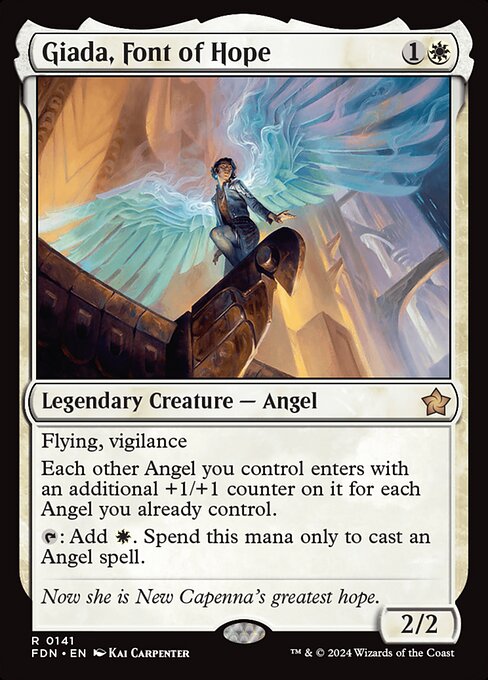
Giada, Font of Hope is a good example.
She costs only two mana, helps you cast Angel spells, and makes your other Angels enter with additional +1/+1 counters according to the number of Angels you already control.
That gives Angel decks a much smoother way to develop.
Instead of waiting several turns before playing your first meaningful creature, Giada helps you start building an increasingly dangerous flying army.
Cards like Youthful Valkyrie, Resplendent Angel, and Lyra Dawnbringer can fit naturally into that approach.
I like this version of Aggro because you're putting pressure on opponents through evasive creatures that keep getting stronger.
It's usually less explosive during the earliest turns than a deck full of one-mana creatures, but it can become very difficult to stop once several Angels are attacking.
And sometimes that's exactly the kind of Aggro deck you want.
Not every aggressive strategy needs Goblins.
Sometimes Angels do the job perfectly well.
Your Mana Curve Matters More Than You Think
One of the most important parts of Aggro is being able to develop your battlefield early.
If your first meaningful play happens on turn five, you're probably not putting much pressure on anybody.
I'd look carefully at the first three turns.
Can you cast something useful on turn one or two?
Can you develop another threat or accelerate your mana on turn three?
Does your commander contribute early enough to support the strategy?
That doesn't mean every Aggro deck needs twenty one-mana creatures.
Different commanders need different curves.
An Anim Pakal deck wants inexpensive creatures that can attack and trigger her ability.
An Isshin deck may want a combination of cheap attackers and more expensive creatures with powerful attack triggers.
And a Giada deck needs enough early development to support Angels that naturally cost more mana.
But I would avoid filling the deck with expensive creatures simply because they're impressive.
A six-mana creature might be fantastic.
Five of them in your opening hand probably aren't.
I like thinking of the mana curve as part of the deck's aggression.
If you can consistently spend your mana developing threats during the first few turns, your opponents have to start responding earlier.
And that gives you an advantage that a slower deck might not have.
Haste: Don't Give Your Opponents an Entire Turn to Prepare
Haste is particularly valuable in Aggro.
Normally, a creature you just cast can't attack or use abilities with the tap symbol until you've controlled it continuously since the beginning of your turn, unless it has haste.
That means opponents often get an entire turn cycle to prepare for your new threat.
And in a four-player Commander game, that's three players with opportunities to remove it.
Haste changes that.
Cards like Lightning Greaves, Swiftfoot Boots, Fervor, and Rhythm of the Wild can help your creatures become useful immediately, depending on your colors.
Rhythm of the Wild gives riot only to nontoken creatures: as one enters, choose a +1/+1 counter or haste. One instance of riot does not give both.
Imagine playing a creature with a powerful attack trigger.
Without haste, you may need to wait until your next turn to attack.
With haste, you can potentially generate that value immediately.
That's a significant difference.
But I wouldn't fill the deck with haste enablers without thinking about how many creatures actually need them.
Some commanders already have haste.
Others produce tokens tapped and attacking.
And some decks care more about keeping a board alive than attacking immediately.
Haste is an excellent tool, but it should support your strategy rather than simply increase the number of aggressive-looking cards in your deck.
Attack Triggers: Combat Should Generate More Than Damage
This is one of the things I like most about Aggro in Commander.
Your attacks can generate resources even before combat damage happens.
Cards like Hero of Bladehold, Sword of the Animist, and Etali, Primal Storm reward attacking in very different ways.
Hero of Bladehold creates more attackers.
Sword of the Animist searches for a basic land and puts it onto the battlefield tapped whenever the equipped creature attacks.
And Etali can provide access to spells from the top of each player's library when it attacks.
These effects make combat valuable even if your opponent has good blockers.
You're not relying exclusively on damage.
You're also developing mana, creating creatures, or gaining access to additional cards.
I particularly like attack triggers that solve common Aggro problems.
A deck that needs more mana can benefit from Sword of the Animist.
A deck that wants to build a wider battlefield can use token-producing attack triggers.
And a deck that struggles with card advantage can look for attackers that generate additional resources.
But read the abilities carefully.
A creature entering the battlefield tapped and attacking hasn't necessarily "attacked" for the purpose of attack triggers.
This matters with cards like Winota and Anim Pakal.
Those creatures are attacking, but they weren't declared as attackers, so they don't automatically generate additional "whenever this creature attacks" triggers.
It's an easy mistake to make when several effects are happening during combat.
Evasion: Your Creatures Need to Connect
Having a large army doesn't guarantee that your creatures will deal damage.
Your opponents have blockers.
And in Commander, those blockers can become very large.
If you're attacking with several 2/2 creatures and an opponent has a pair of 6/6 blockers, you might struggle to make meaningful progress.
That's why evasion is important.
Flying, trample, menace, and other abilities that make blocking difficult can help your threats connect.
Cards like Iroas, God of Victory can make attacking much safer while limiting how opponents can block your creatures.
Dolmen Gate can prevent combat damage to your attacking creatures, allowing them to survive many unfavorable combats.
And Akroma's Will can turn a developed creature board into a very dangerous attack, especially when you control your commander.
I like effects that make the whole army more effective rather than improving only one creature.
But I'd choose them based on the deck.
A Giada deck already has many flying threats.
A Goblin deck may need more help getting past blockers.
And a commander like Arabella can damage the entire table through an attack trigger without needing to connect in combat.
Different aggressive decks solve the problem in different ways.
Card Draw: Aggro Still Needs a Hand
One of the biggest misconceptions about Aggro is that you can ignore card advantage because you're trying to win quickly.
That might work occasionally.
But Commander games don't always end quickly.
And with three opponents, it's very easy to spend your hand developing a battlefield only to lose everything to one board wipe.
If you have no cards left, rebuilding becomes difficult.
That's why I like having reliable sources of card advantage.
Skullclamp can be excellent in Aggro decks that create lots of small tokens.
Welcoming Vampire can provide card draw when small creatures enter under your control, subject to its once-per-turn restriction.
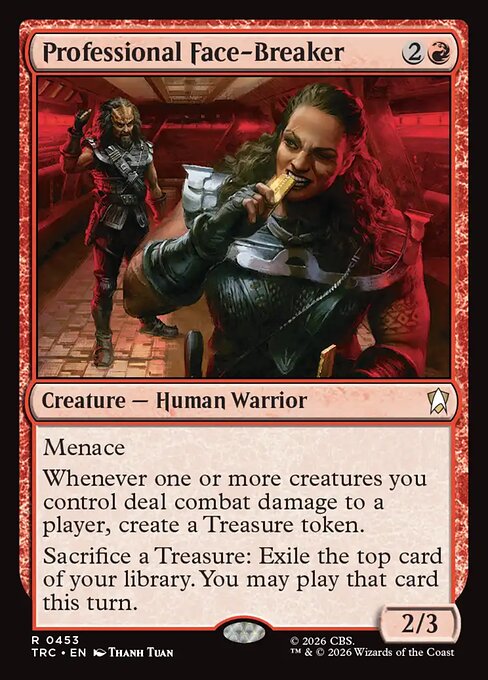
Professional Face-Breaker can generate Treasure tokens when your creatures deal combat damage to players and let you sacrifice Treasures for access to additional cards.
And Chivalric Alliance can reward attacking with multiple creatures.
These cards are interesting because they support things your deck already wants to do.
You're attacking, creating creatures, and applying pressure.
Meanwhile, you're generating the resources needed to keep doing it.
I prefer that approach to filling an aggressive deck with expensive draw spells that force you to stop developing your battlefield.
But I'd still include some ways to refill my hand after a bad turn.
Aggro needs to keep moving.
And that's difficult when you're drawing one card per turn while your opponents have seven.
Ramp: Being Aggressive Doesn't Mean Ignoring Mana
Aggro decks often have lower mana curves, but that doesn't mean they don't need ramp.
You still want to cast your commander early.
You may need to play several creatures during the same turn.
And some of your best finishers can be relatively expensive.
Cards like Sol Ring, Arcane Signet, and appropriate two-mana ramp options can help.
Green decks can use efficient land ramp.
White decks have their own tools for keeping up with opponents.
And red decks can benefit from Treasure generation or temporary mana acceleration.
The important part is having enough mana to maintain pressure.
I'd also pay attention to how much mana your deck needs after its first few turns.
An Aggro deck with a low curve and lots of card draw might be happy casting several small spells.
A deck that wants to play large Angels or powerful extra-combat effects has different requirements.
So I wouldn't copy the same ramp package from one aggressive deck to another.
Look at the actual cards you're playing.
And don't cut too many lands just because your deck is called Aggro.
Missing your third or fourth land drop isn't particularly aggressive.
It's just inconvenient.
Who Should You Attack First?
This is one of the most interesting questions in multiplayer Aggro.
In a one-on-one game, the answer is easy.
There's only one opponent.
In Commander, you have three.
And choosing where to send your attacks can make a huge difference.
I wouldn't automatically spread damage evenly between everybody.
If you deal five damage to each opponent, all three are still in the game and still developing their strategies.
Sometimes concentrating damage on one player makes more sense because it reduces the number of opponents you eventually have to face.
But there isn't a universal rule.
Maybe one player has an open battlefield and you can generate valuable combat triggers by attacking them.
Perhaps another is preparing a combo and needs to be pressured before they can win.
Or maybe one opponent has enough blockers to make attacking them a terrible idea.
I try to think about what each attack accomplishes.
Am I making progress toward eliminating someone?
Am I generating resources?
Am I forcing an opponent to spend removal or block with an important creature?
Or am I simply attacking because my creatures are untapped?
That last reason isn't always enough.
And remember that attacking one player can influence the politics of the table.
If you eliminate an opponent early, the remaining players may start treating you as the biggest threat.
Sometimes that's manageable.
Other times you've just made the next few turns much more difficult.
Aggro rewards pressure, but it also rewards knowing when to choose your battles.
Don't Overextend Into a Board Wipe
This is probably the most painful lesson for creature-based Aggro decks.
You start developing quickly.
Play a creature.
Then another.
Then three more.
Everything looks great.
You have twelve creatures, a powerful commander, and enough damage to threaten the table.
Then somebody casts Wrath of God.
And suddenly you're starting again with an empty hand.
That's why I think Aggro needs some discipline.
You don't always have to play every creature you draw.
If you already have enough pressure on the battlefield, sometimes holding back additional threats is the better decision.
That way, if an opponent wipes the board, you have something left to rebuild with.
Protection also matters.
Boros Charm, Flawless Maneuver, Heroic Intervention, and Teferi's Protection can help certain decks survive different kinds of removal, depending on their colors.
But they don't all work in the same way.
Indestructible can protect creatures from destruction, but it doesn't stop exile or sacrifice effects.
And sometimes you won't have the right protection available.
That's why I like combining protection with recovery.
A good Aggro deck should be capable of rebuilding after losing creatures.
Not necessarily instantly.
But quickly enough that opponents can't spend the rest of the game ignoring you.
Combat Finishers: Sometimes One Attack Needs to End the Game
Aggro decks can apply pressure gradually, but in Commander I like having a few ways to convert a reasonable battlefield into a decisive attack.
Otherwise, you might spend several turns dealing small amounts of damage while opponents slowly assemble much more powerful engines.
Cards like Overwhelming Stampede, Akroma's Will, and Beastmaster Ascension can help turn creatures into serious threats, depending on your colors and board state.
But not every finisher needs to increase power and toughness.
Sometimes an additional combat phase is even more valuable.
Extra Combat Phases
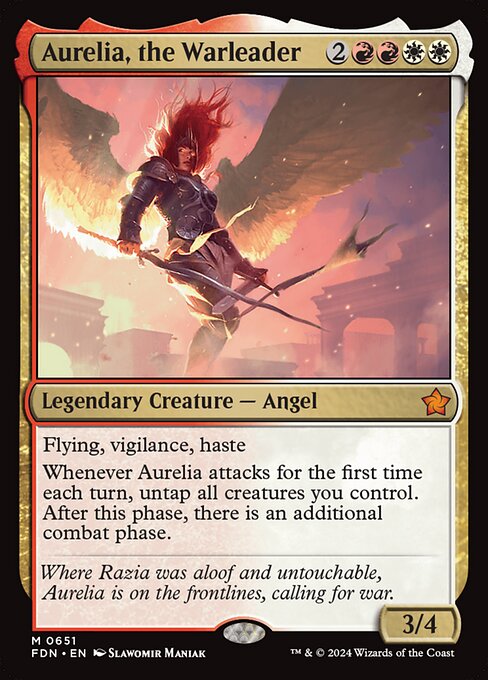
Aurelia, the Warleader is one of the most recognizable cards for aggressive combat strategies.
Whenever Aurelia attacks for the first time each turn, she untaps all creatures you control and gives you an additional combat phase after the current one.
That means you can attack again.
And if your creatures have attack triggers, the second combat can generate additional value too.
Other cards, like Relentless Assault and Seize the Day, can provide extra combat opportunities.
I like extra combats because they reward a battlefield you've already developed.
You don't necessarily need to cast more creatures.
You're using your existing threats more than once.
But timing matters.
Not every extra-combat effect untaps your creatures in the same way.
And not every effect can be used during combat.
Read the card carefully before assuming you'll be able to attack with everything again.
Damage Without Connecting
Some Aggro decks can also finish games through triggered damage rather than combat damage alone.
Arabella is a good example.
Her ability damages every opponent when she attacks, even if she's blocked afterward.
Impact Tremors can provide another route in decks that create lots of creatures.
And some commanders or other payoffs turn attacking, creating tokens, or dealing combat damage into additional damage.
I like having those effects as a secondary route to victory.
They make your deck less dependent on getting through an enormous defensive battlefield.
But I'd make sure they support the main aggressive strategy rather than becoming an unrelated collection of cards.
How Many Creatures Should an Aggro Deck Play?
I wouldn't use a fixed number for every Aggro commander.
A Winota deck wants a specific balance between Humans and non-Humans.
An Anim Pakal deck can generate a large number of creatures through its commander.
An Isshin deck wants enough attackers with useful combat triggers.
And a Giada deck may prefer fewer, more individually powerful creatures.
But in a creature-based Aggro deck, I'd usually want a substantial creature package.
Something around 25–35 creatures can be a reasonable starting point, adjusted for your commander, token generation, and mana curve.
Some builds will want more.
Others can use fewer if they generate a lot of creatures through noncreature spells or repeatable abilities.
But I wouldn't simply count creatures and assume the deck is aggressive enough.
You need to consider when those creatures enter the battlefield and what they actually do.
Thirty creatures that all cost five mana aren't going to apply early pressure.
And twenty cheap creatures that become irrelevant after turn four might not be enough either.
I prefer a curve that starts applying pressure early and still has meaningful threats later.
That's much more useful than chasing an exact creature count.
A Few Combat Rules Worth Remembering
Aggro decks interact with combat constantly, so knowing a few rules can prevent mistakes.
Attacking and dealing combat damage are different events. An ability that triggers when a creature attacks can resolve even if that creature is blocked later. An ability that requires combat damage to a player needs the damage to actually be dealt.
Creatures entering tapped and attacking weren't declared as attackers. They don't trigger abilities that require a creature to attack, although they're attacking creatures for other purposes.
Commander damage only counts combat damage from the same commander. Damage dealt by a triggered ability, like Arabella's ability or Saskia's additional damage, doesn't count as commander damage.
Trample doesn't mean unblockable. A blocked creature with trample can assign excess combat damage to the defending player after assigning enough damage to its blockers, following the combat damage rules.
Double strike can be devastating. A creature with double strike can deal combat damage in both the first-strike and regular combat damage steps, which is particularly dangerous when combined with power boosts or commander damage.
Extra combat phases don't automatically mean every creature can attack again. You need to check which creatures untap, whether they have haste, and what each extra-combat effect actually does.
These details become particularly important when your deck is generating tokens, doubling attack triggers, or creating multiple combat phases.
Common Mistakes When Building Aggro
There are a few things I'd watch out for.
Too many expensive creatures. If you can't start applying pressure until turn five, the deck may be too slow for the strategy you're trying to play.
No card advantage. Aggro can empty its hand very quickly, and a board wipe can leave you with nothing.
Attacking without a plan. Not every attack needs to be lethal, but it should accomplish something useful.
Ignoring protection. Creature-heavy decks are vulnerable to board wipes, especially when you commit too many resources.
Not enough ways to finish. Small creatures can generate early pressure, but you still need ways to deal meaningful damage later.
Too much focus on one opponent. Eliminating someone can be useful, but you need to consider what the other players are doing.
Assuming Aggro doesn't need interaction. Sometimes the fastest way to win is to remove the creature or enchantment that's preventing your attacks.
And one more thing.
Don't confuse playing aggressively with playing carelessly.
Sometimes holding back two creatures and attacking with five is much better than playing everything and losing it all.
Test Your Aggro Deck Before Buying Everything
Aggro is one of those strategies where the opening turns matter enormously.
A deck might look fantastic because it has several powerful combat finishers and creatures with excellent attack triggers.
But if your opening hands are consistently too slow, those cards might never get the chance to do their job.
That's why I'd test the deck before buying everything.
In MTG Master Deck Builder, you can build your Aggro Commander deck, explore combat synergies, and use the Deck Analyzer to review speed, consistency, mana curve, interaction, resilience, and other aspects of the deck.
I'd pay particular attention to early plays, the number of meaningful attackers, card advantage, and the mana needed to execute your finishing turns.
The opening-hand simulator is especially useful.
Try several hands and see whether you can realistically develop your battlefield during the first few turns.
A hand with three six-mana finishers might look impressive.
But it probably isn't doing much to pressure your opponents early.
If your deck includes attack-trigger engines, token generation, or extra-combat combinations, it's also worth checking the combo detection tools.
Some combat-focused interactions can become much more powerful than expected when you combine the right cards.
No analyzer replaces actual multiplayer games, of course.
It can't predict how opponents will block or which player will become the main threat.
But it can help identify structural problems before you spend money on a deck that doesn't actually play as aggressively as you imagined.
Is Aggro the Right Archetype for You?
I think Aggro is a great choice if you enjoy combat, developing threats early, and forcing opponents to make difficult decisions.
It's particularly satisfying when you build a deck that starts applying pressure before the rest of the table is fully prepared.
And I like that Aggro doesn't necessarily require complicated engines.
Sometimes a few efficient creatures, good combat synergies, and the right finishing spell are enough.
But Aggro isn't for everyone.
If you prefer building long-term value engines, controlling the stack, or waiting until you can assemble a powerful combo, constantly attacking might not be your favorite way to play.
And because Commander is multiplayer, aggressive decks need more resilience than they might initially appear to.
Personally, I think the most enjoyable Aggro decks are those that make combat meaningful throughout the entire game.
You start early.
You keep developing.
You force opponents to respond.
And when the opportunity appears, you commit to a decisive attack.
Not every game will end quickly.
But when your opponents are still carefully arranging their mana rocks and you announce that you're going to combat again...
Well, they might wish they'd played a few more blockers.
Build Aggro with pressure that lasts
Balance early threats, card advantage, mana and combat finishers in Deck Builder.