
Boros Commander Guide: Combat, Equipment and Attacking Again
By MTG Master EditorialPublished Updated 9 min read
Boros is red and white, and for a long time its reputation in Commander was pretty simple:
Play creatures.
Attack.
Run out of cards.
Hope everyone is dead before that becomes a problem.
That reputation wasn’t completely invented, but modern Boros is much better than that.
You still get excellent aggressive decks, obviously, but Boros now has strong card advantage, Treasure generation, Equipment strategies, tokens, Voltron, extra combats and commanders that can turn attacking into an actual value engine.
And attacking is still important.
Very important.
This is Boros, after all.
How Does Boros Play?
White gives you efficient creatures, protection, tokens, Equipment support, excellent removal and board wipes.
Red adds haste, direct damage, Treasures, impulse draw and ways to make combat much more explosive.
Together, they’re naturally good at being proactive.
Boros generally doesn’t want to spend ten turns doing absolutely nothing while assembling a beautiful engine.
It wants to put something onto the battlefield and start making people uncomfortable.
Sometimes that’s an army of tokens.
Sometimes it’s one creature carrying enough Equipment to require its own inventory sheet.
Either way, somebody is probably getting attacked.
What Is Boros Good At?
Equipment
If you like Equipment, Boros is one of the first color combinations I’d look at.
White has enormous amounts of Equipment support.
Red has plenty as well, especially when it comes to aggressive payoffs, Treasures and combat.
You can reduce equip costs, search for Equipment, move it around and get additional value whenever equipped creatures attack or deal damage.
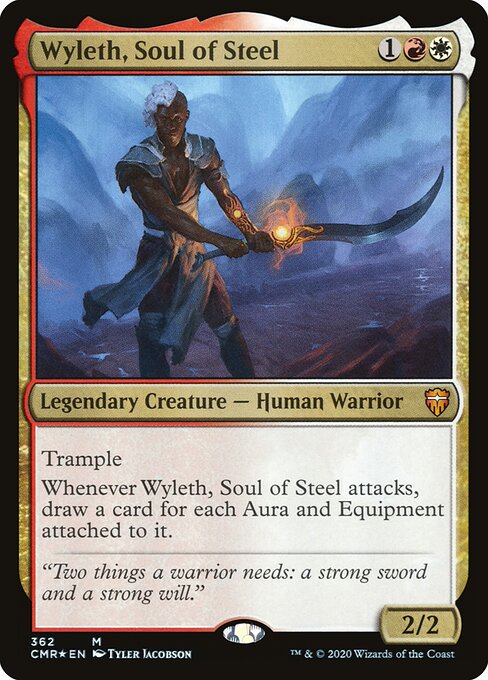
Wyleth, Soul of Steel is a perfect example.
Whenever Wyleth attacks, you draw a card for each Aura and Equipment attached to him.
So the thing you already wanted to do — put Equipment on your commander and attack — also solves one of the traditional problems of Boros.
Drawing cards.
Convenient.
Voltron
Equipment naturally leads us here.
Voltron decks concentrate resources onto one creature, usually the commander, and turn it into a serious problem.
Equipment.
Auras.
Counters.
Double strike.
Protection.
Evasion.
Then attack the same player until commander damage becomes relevant.
Boros is extremely good at this because white can protect the creature while red makes it hit harder and faster.
The important part is protection.
Building a 14/14 double strike commander is fantastic.
Watching someone remove it after you’ve attached six cards to it is slightly less fantastic.
Tokens
Boros is also very good at making lots of creatures.
White already has excellent token production and red adds Goblins, Soldiers, Spirits, Treasures and plenty of attack-based token generators.
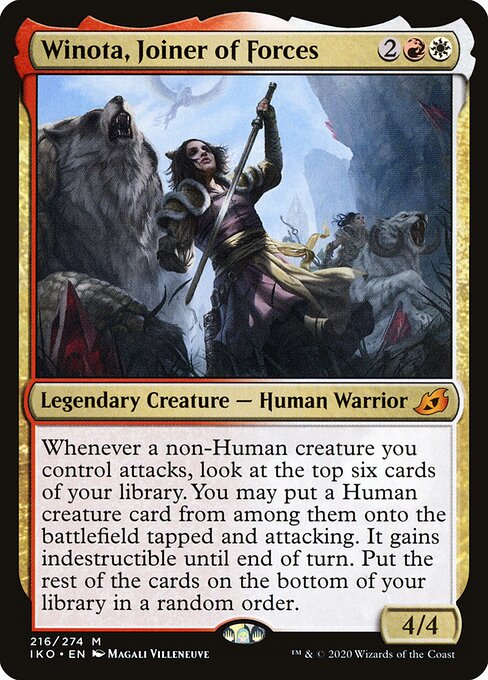
Winota, Joiner of Forces shows how ridiculous Boros can become when attacking with lots of creatures actually generates more creatures.
Attack with non-Humans.
For each non-Human creature you control that attacks, look at the top six cards of your library.
You may put a Human creature card from those cards onto the battlefield tapped and attacking; it gains indestructible until end of turn. The other cards go to the bottom of your library in a random order.
Those Humans can bring more effects with them. Entering attacking is not the same as being declared as an attacker: it does not trigger their own “whenever this attacks” abilities.
A fairly innocent battlefield can become completely unreasonable in one combat step.
Combat
Obviously.
Boros is one of the best color combinations for decks where combat itself is the engine.
You can get triggers when creatures attack.
Triggers when they deal combat damage.
Triggers when multiple creatures attack.
Triggers when your commander attacks.
Sometimes attacking creates tokens.
Sometimes it draws cards.
Sometimes it creates Treasures.
Sometimes it does all three.
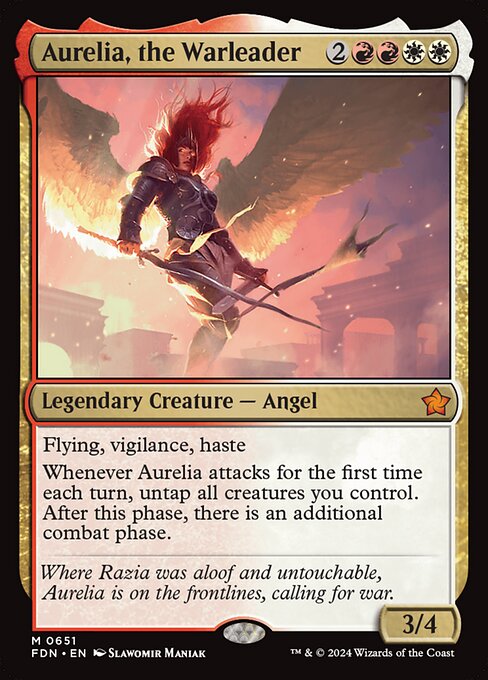
Aurelia, the Warleader takes the most Boros approach possible.
When Aurelia attacks for the first time each turn, untap all creatures you control and get an additional combat phase after the current one.
Untap your creatures.
Get another combat.
Attack again.
Very subtle.
Extra Combats
Why attack once when you can attack twice?
Or three times?
Red has many of the best extra-combat effects in Magic, and Boros has commanders and support cards that can take advantage of them extremely well.
Extra combats become especially dangerous when your creatures have attack triggers.
If attacking once gives you value, attacking twice gives you twice the value.
And if the extra combat effect can somehow be repeated…
Well, now we’re probably talking about a combo.
Double Strike
Boros loves double strike.
It’s good with large creatures.
It’s excellent with Equipment.
It’s ridiculous with combat-damage triggers.
And it’s particularly dangerous when commander damage is involved.
A commander with 11 power and double strike can eliminate a player in one attack if it deals combat damage to that same player in both damage steps: that is 22 damage, above the 21 accumulated from the same commander needed. A blocked creature without trample does not do this automatically.
That’s the kind of maths Boros enjoys.
Aurelia, the Law Above is another example of attack rewards, although she does not grant double strike. When any player attacks with three or more creatures, you draw a card; with five or more, Aurelia deals 3 damage to each of your opponents and you gain 3 life.
The more creatures that attack, the more value you start generating.
Tokens That Aren’t Creatures
Boros isn’t limited to creature tokens.
Treasures have become an important part of red, giving Boros access to much better mana acceleration than it historically had.
You can also build around Clues, Food and other artifact tokens depending on the commander.
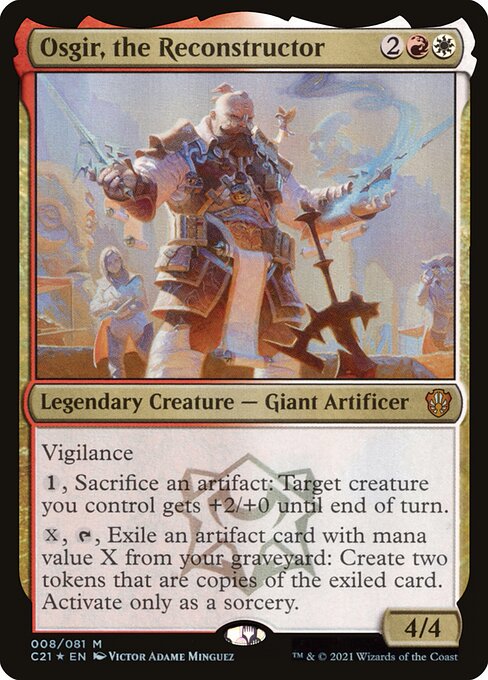
Osgir, the Reconstructor takes Boros in a completely different direction.
For one mana and sacrificing an artifact, Osgir gives a creature you control +2/+0 until end of turn. His other ability costs X mana, tapping him and exiling an artifact card with mana value X from your graveyard to create two token copies. You can activate that second ability only as a sorcery.
Suddenly Boros is playing graveyard recursion and artifact value.
Nobody said every Boros deck needs to attack with a Sword.
Although you still can.
Protection
This is something Boros does extremely well and people sometimes underestimate.
White has some of the best protection spells in Commander.
Indestructible.
Hexproof.
Phasing.
Protection from colors.
Blink effects.
Red also has a few tricks of its own.
This is especially important because Boros often commits heavily to the battlefield.
If your plan involves six creatures or a commander carrying four Equipment, protecting that board from a wipe can completely change a game.
Choose protection that suits your board: blink detaches Equipment and normally sends Auras to the graveyard, while phasing keeps attachments with the creature.
Sometimes the strongest thing you can do isn’t another threat.
It’s making sure the threats you already have survive.
What Is Boros Bad At?
Card advantage used to be the obvious answer.
It’s still something you need to think about, but Boros has far more options now.
Red has impulse draw.
White can draw from Equipment, small creatures, opponents doing certain things and various catch-up mechanics.
Many Boros commanders also generate cards directly.
You still shouldn’t assume the cards will magically appear.
Build card advantage into the deck deliberately.
Ramp is similar.
You don’t have green’s land acceleration.
But you do have mana rocks, Treasures and white’s ability to catch up when opponents have more lands.
The other major problem is overcommitting.
Boros likes putting things onto the battlefield.
That makes board wipes painful.
If you play every creature in your hand because you can, don’t be too surprised when somebody destroys all creatures.
Sometimes keeping two threats in your hand is better than having two more threats on the battlefield.
How Does Boros Usually Win?
I’ll give you one guess.
Combat.
Boros wins extremely well through normal combat damage and commander damage.
Go wide with tokens.
Go tall with Voltron.
Use double strike.
Create extra combat phases.
Give everything haste.
Make creatures when you attack.
Make your creatures bigger when they attack.
There are many variations, but the final instruction is often the same:
Turn creatures sideways.
Boros also has plenty of combos, particularly around extra combats, Equipment and creatures that untap or generate mana.
Artifact-focused Boros decks can win in completely different ways as well.
But if you build a Boros deck and discover that attacking is good for you, that’s probably not an accident.
What Does a Boros Deck Need?
Card advantage.
I’m putting that first deliberately.
You don’t want to empty your hand by turn five and spend the rest of the game drawing one card per turn.
Make sure your commander or the rest of the deck gives you ways to keep seeing cards.
You also need protection.
Especially if you’re playing Voltron or committing heavily to the battlefield.
If one removal spell can undo three turns of setup, you probably need more ways to protect your board.
Think about evasion too.
A giant equipped creature doesn’t accomplish much if a 1/1 token can block it every turn.
Flying, menace, trample and protection can all help.
And don’t forget interaction.
Boros has excellent removal.
Use it.
You don’t need to solve every problem by attacking it.
Just most of them.
Is Boros for You?
I’d look at Boros if you like being proactive.
Especially if you enjoy:
- Combat
- Equipment
- Voltron
- Tokens
- Auras
- Double strike
- Extra combats
- Haste
- Treasures
- Protection
- Commander damage
- Attacking with lots of creatures
- Attacking with one completely ridiculous creature
- Attacking again
If you prefer sitting behind seven untapped lands and passing the turn, there are probably better color combinations.
Boros wants to participate.
Your opponents will usually know you’re dangerous.
That’s fine.
Sometimes everyone knowing what you’re about to do doesn’t mean they can stop you.
Building Your First Boros Commander Deck
Start by deciding what combat is supposed to accomplish.
Are you going wide with tokens?
Building one enormous Voltron commander?
Using Equipment?
Trying to generate attack triggers?
Playing extra combats?
Your deck becomes much easier to build once you know the answer.
Then make sure you’re not only adding cards that help you attack.
You need cards that help you keep attacking.
Card draw.
Protection.
Ramp.
Removal.
Ways to recover after a board wipe.
That’s where Boros decks have improved enormously over the years.
You don’t have to win before you run out of cards anymore.
You can build an engine.
You can generate value.
You can recover.
And then, obviously, you can attack again.
Because if one combat was good, another one is probably better.
Ready to test your Boros deck?
Analyze your list to check whether your mana, card draw and protection keep your combat plan working and help you recover after a board wipe.