
Gruul Commander Guide: Big Creatures, Big Mana and Hitting People
By MTG Master EditorialPublished Updated 8 min read
Gruul is red and green, and sometimes Magic really doesn’t need to be that complicated.
Make mana.
Play something enormous.
Give it haste.
Attack somebody.
Of course, Gruul can do much more than that, but let’s not pretend this isn’t a very important part of the experience.
Red and green are naturally aggressive colors, and together they give you ramp, huge creatures, combat tricks, direct damage, Treasures, +1/+1 counters, land strategies and some extremely explosive turns.
Gruul usually doesn’t want to sit around waiting forever.
It wants to build mana faster than everyone else, put something dangerous onto the battlefield and force the table to deal with it.
Preferably before the dangerous thing attacks again.
How Does Gruul Play?
Green gives you some of the best ramp in Commander, efficient creatures, card draw based around creatures and plenty of ways to destroy artifacts and enchantments.
Red adds haste, direct damage, Treasures, impulse draw and the ability to make combat considerably more unpleasant.
Together, the colors are very good at turning mana into pressure.
You ramp on turn two.
Ramp again on turn three.
Then you play something on turn four that everybody else expected to see around turn seven.
That’s the basic idea.
And when that creature also has haste, suddenly somebody has a problem immediately.
What Is Gruul Good At?
Big Creatures
Let’s start with the obvious one.
Gruul is extremely good at playing large creatures.
Dragons.
Dinosaurs.
Hydras.
Beasts.
Giants.
Things with power and toughness numbers that make you check whether you actually read the card correctly.
Green provides the creatures and mana.
Red helps them attack immediately and makes combat more dangerous.
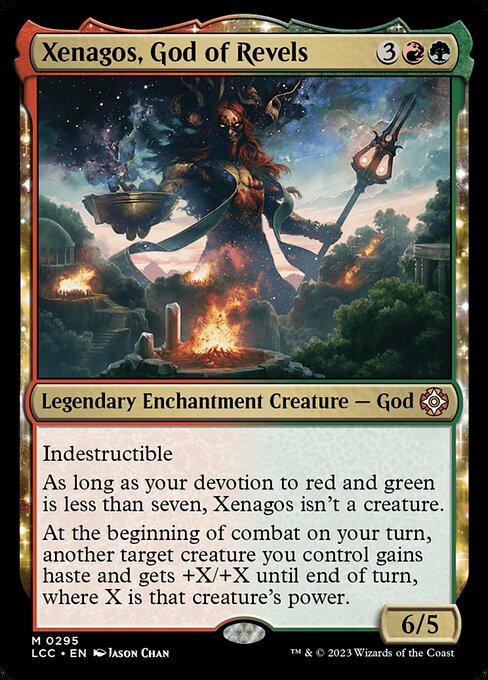
Xenagos, God of Revels is probably one of the clearest examples.
At the beginning of combat on your turn, another target creature you control gains haste and gets +X/+X until end of turn, where X is its power as the ability resolves. That normally doubles its power and increases its toughness too.
Play something enormous.
Double it.
Attack.
There’s not much mystery here.
There doesn’t need to be.
Ramp
Gruul is excellent at generating mana.
Green already has land ramp, mana dorks and creatures that produce ridiculous amounts of mana.
Red adds Treasures and temporary mana effects.
That means Gruul can get ahead of the table very quickly.
And unlike some decks that ramp because they want to cast several small spells, Gruul often has a very clear reason for wanting twelve mana.
It’s probably holding something horrible.
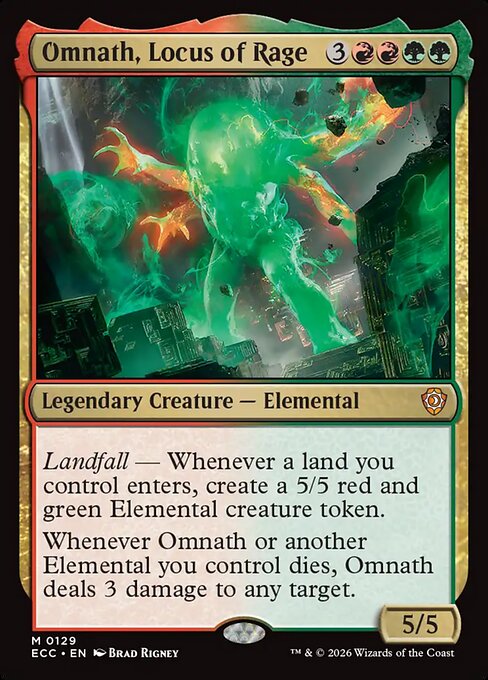
Omnath, Locus of Rage is a good example of what happens when ramp itself becomes part of your strategy.
Whenever a land enters under your control, you create a 5/5 Elemental. When Omnath or another Elemental you control dies, Omnath deals 3 damage to any target.
Now your ramp spells are also building your army.
Landfall
Green is naturally one of the best colors for land strategies, and red has some excellent landfall payoffs.
Gruul can play additional lands, search them from the library and trigger landfall several times in the same turn.
Phylath, World Sculptor creates a 0/1 Plant for each basic land you control when it enters the battlefield. After that, each landfall trigger puts four +1/+1 counters on one target Plant you control.
Mina and Denn, Wildborn let you play an additional land on each of your turns. For one red and one green mana, plus returning a land you control to its owner’s hand, they give a creature trample until end of turn: a useful way to reuse lands in a landfall deck.
Playing a land isn’t just something you do once per turn anymore.
It’s part of the engine.
+1/+1 Counters
Gruul also has plenty of ways to make creatures increasingly ridiculous through counters.
Green provides most of the counter support.
Red gives you aggressive payoffs and ways to turn all that power into actual damage.
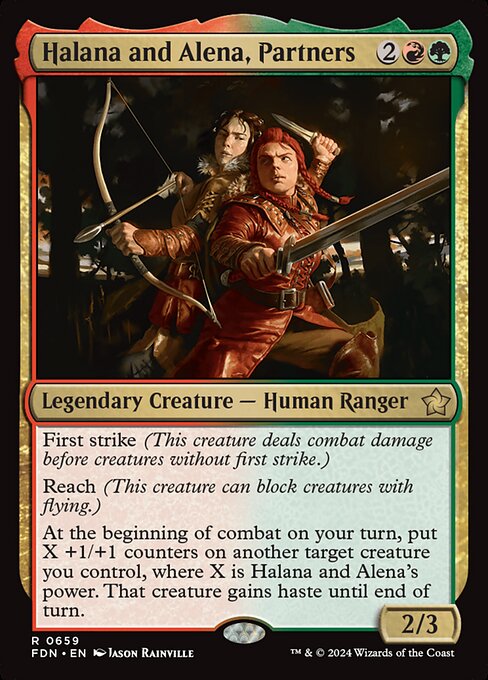
Halana and Alena, Partners are a great example.
At the beginning of combat on your turn, they put +1/+1 counters on another target creature you control equal to their power and give that creature haste until end of turn.
So making Halana and Alena bigger also makes everything else bigger.
This can get out of control very quickly.
Dragons, Dinosaurs and Other Large Tribes
Gruul is a natural home for several creature types where the general deck-building philosophy is:
“What if my creatures were bigger?”
Dinosaurs work particularly well with green ramp and red aggression.
Dragons get haste support, Treasures and plenty of damage synergies.
You can also build around Wolves, Werewolves, Beasts or plenty of other tribes.
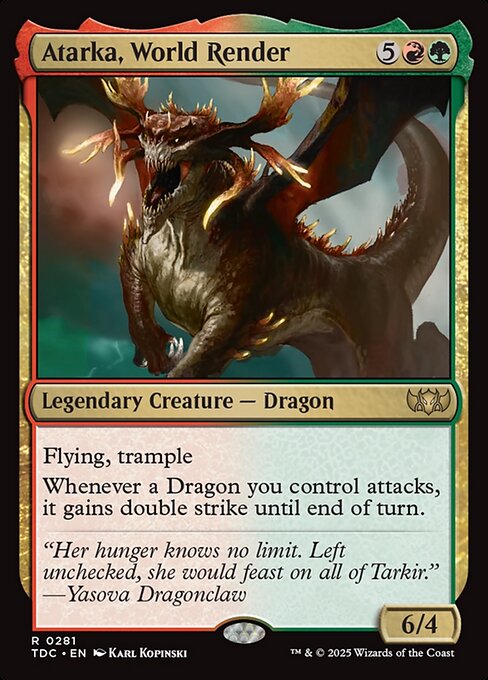
Atarka, World Render is a classic option for Dragons: whenever a Dragon you control attacks, it gains double strike until end of turn.
A Dragon is already a problem.
A Dragon with double strike is usually a much shorter conversation.
Combat
Gruul doesn’t just have big creatures.
It is also very good at making combat difficult for everyone else.
Trample is extremely important.
There’s no point having a 30/30 if somebody can block it with a 1/1 token every turn.
Gruul gives you trample, haste, extra combat steps, power boosts and effects that reward creatures for dealing combat damage.
Grand Warlord Radha generates one red or green mana for each creature you control that attacks. You keep this mana as steps and phases end until the end of the turn.
So you attack…
…and then get mana to play even more things.
Very reasonable.
Power Matters
A lot of Gruul cards care about how much power your creatures have.
That means simply making a creature huge can start triggering other effects.
Draw cards.
Deal damage.
Create mana.
Give something trample.
Fight another creature.
Suddenly “I have a 12/12” isn’t just about having a 12/12.
Goreclaw, Terror of Qal Sisma is a great support card in the 99, although it is mono-green as a commander. It reduces the generic cost of your creature spells with power 4 or greater by two. When it attacks, each creature you control with power 4 or greater gets +1/+1 and trample until end of turn.
Exactly what Gruul wanted anyway.
What Is Gruul Bad At?
One of Gruul’s biggest weaknesses is dealing with certain types of creatures.
Artifacts and enchantments?
No problem.
Green can destroy both, and red is also excellent at dealing with artifacts.
A problematic creature with indestructible?
Now things become slightly more complicated.
Gruul has fight effects, burn and damage-based removal, but it doesn’t have the same clean exile removal that white has.
Another issue is board wipes.
You spend several turns ramping into enormous creatures.
Your board looks fantastic.
Someone casts Wrath of God.
That’s not ideal.
Card draw and recovery are extremely important because a Gruul deck that empties its hand onto the battlefield can have a very difficult time after everything dies.
How Does Gruul Usually Win?
I’m going to surprise absolutely nobody here.
Combat.
Gruul is one of the best color combinations for simply killing players through damage.
Huge creatures.
Trample.
Haste.
Extra combat steps.
Double strike.
Power-doubling effects.
Sometimes you don’t need a complicated combo.
Sometimes you just need a 24/24 with trample.
That said, Gruul absolutely has combos.
It can generate infinite mana, infinite combat steps, infinite creature power or various loops involving creatures and lands.
But even many Gruul combos eventually arrive at the same conclusion:
Attack someone.
What Does a Gruul Deck Need?
The first thing I’d watch is your mana curve.
Yes, playing huge creatures is fun.
No, your deck probably shouldn’t contain thirty cards that cost seven mana.
Ramp helps, but you still need things to do early in the game.
You also need card advantage.
This is particularly important in Gruul because it’s very easy to dump your hand onto the battlefield.
Green has plenty of ways to draw based on creature power, creatures entering or creatures dealing damage.
Use them.
And give your creatures ways to actually connect.
Trample matters.
Evasion matters.
Haste matters.
A gigantic creature that never manages to damage anybody isn’t really doing its job.
Is Gruul for You?
I’d look at Gruul if you enjoy being proactive and making the rest of the table react to you.
It’s especially good if you like:
- Huge creatures
- Ramp
- Combat
- Trample
- Haste
- Landfall
- +1/+1 counters
- Dragons and Dinosaurs
- Generating lots of mana
- Explosive turns
- Making one creature absolutely enormous
- Solving problems by attacking them
If your favorite part of Magic is keeping five mana untapped and deciding what to counter, Gruul probably isn’t where I’d start.
Gruul generally has a different philosophy.
Why keep five mana open when you could spend it on another creature?
That’s five mana doing absolutely nothing.
Terrible.
Building Your First Gruul Commander Deck
Start by deciding what all that mana is actually for.
Are you ramping into enormous creatures?
Do you care about lands entering the battlefield?
Are you building around Dragons or Dinosaurs?
Are you making one creature huge?
Do you want lots of creatures attacking together?
Once you know that, the deck becomes much easier to build.
Don’t just fill it with every expensive creature you own.
Your big creatures should actually help your strategy.
And make sure you have enough ramp, draw and interaction to support them.
Gruul is straightforward in the best possible way.
You don’t necessarily need to trick the table.
You don’t need to pretend you aren’t dangerous.
Everyone can see the 18/18 with trample.
Everyone knows exactly what you’re planning to do with it.
The only question is:
Who’s getting hit first?
Ready to test your Gruul deck?
Analyze your list to check whether your ramp, mana curve, card draw and interaction support your big creatures and help you recover after a board wipe.