
Dimir Commander Guide: Control, Graveyards and Knowing More Than Everyone Else
By MTG Master EditorialPublished Updated 9 min read
Dimir is blue and black, which means you get two colors that are extremely good at drawing cards, interacting with opponents and doing questionable things with graveyards.
It’s not usually the color combination that puts thirty creatures onto the battlefield and attacks everyone.
Dimir tends to be a little more patient.
Draw cards.
Remove the important thing.
Counter something worse.
Put cards into graveyards.
Steal something.
Maybe reanimate it.
And somewhere during all of that, assemble whatever your deck is actually trying to do.
Dimir is one of those color combinations where the board doesn’t always tell you how dangerous the player really is.
Three creatures and six untapped lands might not look particularly scary.
It probably should.
How Does Dimir Play?
Blue gives you counterspells, card draw, bounce, clones, card selection and some of the best stack interaction in Magic.
Black gives you creature removal, tutors, sacrifice, reanimation, life-for-cards effects and plenty of ways to use the graveyard.
Together, they create a color combination that’s extremely good at information and resources.
You see more cards than most players.
You can search for specific cards.
You interact efficiently.
You use graveyards.
And you’re very good at waiting until somebody else creates a problem before deciding whether it’s worth spending a card on it.
Dimir rewards patience.
Just because you can counter something doesn’t mean you should.
Let somebody else deal with it.
Save the counterspell for the thing that actually matters.
What Is Dimir Good At?
Control
Unsurprisingly, Dimir is very good at control.
Blue counters spells before they resolve.
Black kills creatures once they arrive.
Together, you can deal with a huge percentage of the threats you’ll see in a Commander game.
Ertai Resurrected represents this style pretty well.
When he enters, you can choose to counter a spell, activated ability or triggered ability, including a planeswalker’s loyalty ability, or destroy another creature or a planeswalker.
The target’s controller draws a card in exchange, but sometimes you really don’t care.
If the alternative is losing the game, they can have the card.
The important part of playing Dimir control is the same as with Azorius:
You have three opponents.
You cannot answer everything.
And you really shouldn’t try.
Mill
This is probably the strategy most people immediately associate with blue/black.
Instead of reducing life totals, mill puts cards directly from libraries into graveyards.
In Commander, libraries start from a hundred-card deck, with the commander outside the library and an opening hand already drawn, rather than the usual sixty-card decks.
And there are three of them.
So yes, you need quite a lot of mill.
Emptying a library does not automatically eliminate its owner: normally, they lose when they try to draw from an empty library. Mill can also fuel your opponents’ graveyard strategies.
Luckily, Dimir can produce quite a lot of mill.
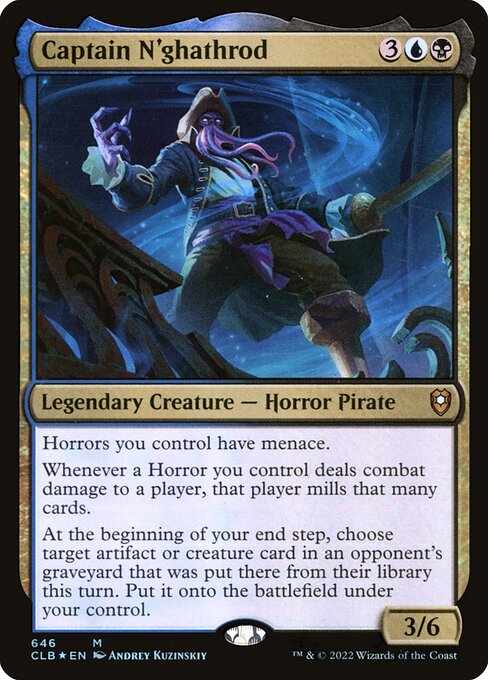
Captain N’ghathrod is a great example.
Horrors you control have menace and, when they deal combat damage to a player, that player mills that many cards. At the beginning of your end step, you put one artifact or creature card from an opponent’s graveyard onto the battlefield under your control, provided it went there from their library this turn.
So you’re not just removing cards from libraries.
You’re turning somebody else’s deck into your battlefield.
Very Dimir.
Graveyards
Golgari treats its own graveyard as a second hand.
Dimir often looks at everyone’s graveyard and thinks:
“I could probably use that.”
Black gives you excellent reanimation.
Blue gives you cloning, stealing and plenty of ways to put cards into graveyards.
That means mill doesn’t necessarily need to be the win condition.
Sometimes you’re milling because you want better things to steal.
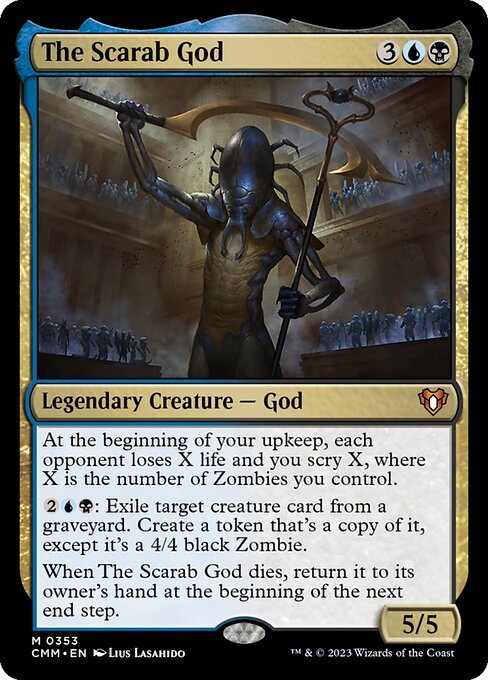
The Scarab God is one of the best examples.
For two generic, one blue and one black mana, it exiles a target creature card from any graveyard and creates a token copy, except it is a 4/4 black Zombie.
Your graveyard.
My graveyard.
Doesn’t really matter.
Once things start dying, The Scarab God starts getting options.
Zombies
Blue and black are also one of the classic Zombie color combinations.
Black gives you the majority of the tribe.
Blue adds some very useful Zombie support, card advantage and interaction.
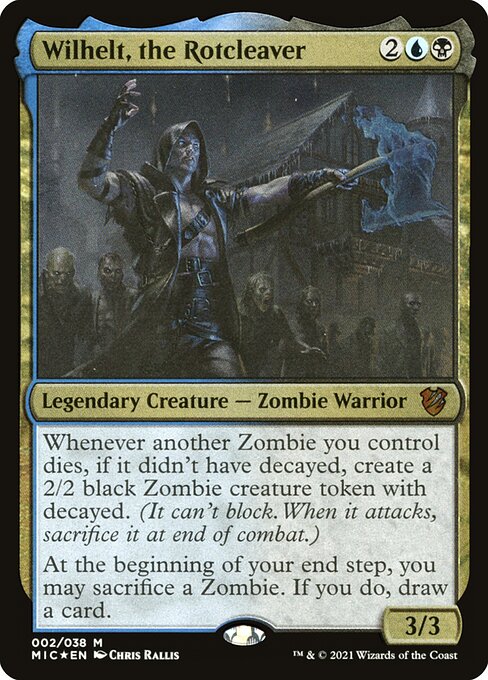
Wilhelt, the Rotcleaver is one of the most popular Dimir Zombie commanders.
When another Zombie you control dies without decayed, you create a 2/2 black Zombie token with decayed. These tokens cannot block and, if they attack, are sacrificed at end of combat.
At the beginning of your end step, you can sacrifice a Zombie to draw a card.
So naturally the deck starts doing very Zombie things.
Creatures die.
More creatures appear.
Those creatures die.
You draw cards.
Something brings the original creatures back.
Nobody stays dead for very long.
Theft
Why put good cards in your deck when your opponents already brought some?
Dimir is excellent at stealing things.
You can steal permanents from the battlefield.
Cast cards from opponents’ libraries.
Use creatures from their graveyards.
Copy their best spells.
Sometimes you’ll end the game with half your battlefield belonging to somebody else.
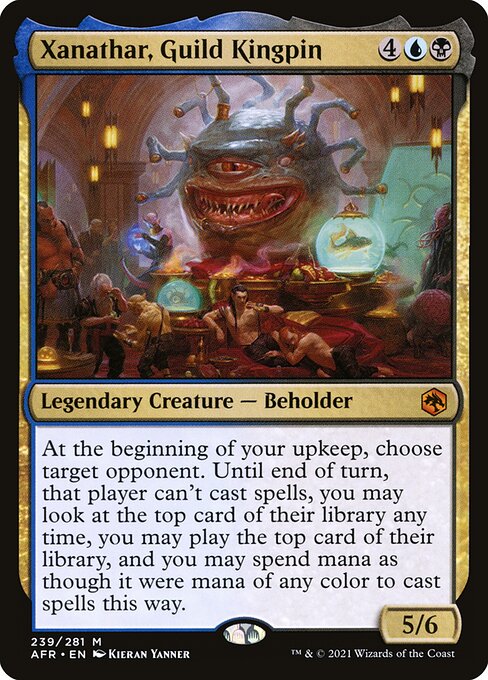
Xanathar, Guild Kingpin is a perfect example.
At the beginning of your upkeep, you choose an opponent. Until end of turn, that player cannot cast spells and you can look at and play the top card of their library, spending mana as though it were any color to cast those spells. Normal timing rules and your land-play limit still apply.
There’s something particularly satisfying about winning with a card your opponent put in their deck specifically to win themselves.
Rogues and Evasion
Dimir also has excellent support for Rogues and evasive creatures.
Blue gives you flying and unblockable effects.
Black adds menace and plenty of creatures that reward combat damage.
Anowon, the Ruin Thief is built around exactly that.
Your other Rogues get +1/+1. When one or more Rogues you control deal combat damage to a player, that player mills one card for each point of damage dealt this way.
If they mill at least one creature card this way, you draw one card, not one for each creature.
So attacking, mill and card advantage all become part of the same engine.
That’s a very efficient way to build a Commander deck.
Card Advantage
Dimir is extremely good at seeing cards.
Blue simply draws them.
Black draws them in exchange for life.
Both colors have tutors and ways to manipulate the top of the library.
This makes Dimir very consistent.
And consistency is dangerous in Commander.
If your deck needs three particular pieces to do something horrible, blue and black are very good at making sure you eventually find them.
Just remember that life is a resource.
Drawing five cards for five life usually sounds like a pretty good deal when you started the game at 40.
What Is Dimir Bad At?
Artifacts and enchantments can be awkward.
Black can remove creatures extremely well.
Blue can counter almost anything before it resolves.
But once certain permanents are actually on the battlefield, your options become more limited.
Especially enchantments.
This means Dimir often needs to think about problematic permanents before they resolve.
Sometimes your best enchantment removal really is:
“Counter it.”
Dimir can also struggle with going wide if you don’t prepare for it.
Black has board wipes, but if your deck is built almost entirely around targeted removal and counterspells, twenty creature tokens can become a serious problem.
And then there’s life.
Black is very happy to spend it.
Just remember that your opponents are also allowed to attack you.
Paying fifteen life to draw cards is fantastic until someone notices you’re suddenly at eleven.
How Does Dimir Usually Win?
Dimir has a lot of options.
Mill everyone’s libraries.
Reanimate the best creatures in the graveyards.
Build a Zombie army.
Win through evasive combat damage.
Steal your opponents’ threats.
Assemble a combo.
Control the game until you can protect your win condition.
Or simply generate so much card advantage that everyone else eventually runs out of resources.
Dimir is particularly good at combo because blue and black can both find pieces and protect them.
You have tutors.
You have card draw.
You have counterspells.
You have graveyard recursion.
If there’s a specific card your deck really wants to see every game, Dimir has a pretty good chance of finding it.
What Does a Dimir Deck Need?
First, decide how much interaction you actually need.
It’s very easy to overdo it.
Counterspells are useful.
Removal is useful.
But your deck still needs to accomplish something.
You should also think about permanent types you have difficulty removing.
If an enchantment resolves and completely shuts down your strategy, what’s the plan?
Counter it before it resolves?
Bounce it?
Ignore it and win anyway?
You need some answer to that question.
If you’re playing mill, be realistic about how much mill you need.
Putting ten cards into a ninety-card library isn’t a win condition.
It’s barely an inconvenience.
And if your deck cares about graveyards, remember that graveyard hate exists.
Don’t build a beautiful engine that immediately stops working because somebody played one artifact.
Is Dimir for You?
I’d look at Dimir if you enjoy having options and making decisions based on what everyone else is doing.
It’s especially good if you like:
- Counterspells
- Creature removal
- Drawing lots of cards
- Mill
- Graveyards
- Reanimation
- Zombies
- Rogues
- Stealing other people’s cards
- Tutors
- Combos
- Playing reactively
- Keeping mana open
- Knowing you have an answer even if nobody else knows it yet
If you like showing everyone exactly what you’re planning to do, Dimir might feel a little strange.
A lot of the fun comes from having possibilities.
Four cards in hand.
Mana open.
A graveyard full of useful things.
Maybe you have the answer.
Maybe you don’t.
Again, they don’t need to know.
Building Your First Dimir Commander Deck
Start by deciding what your deck is actually trying to accomplish.
Control isn’t really a win condition.
Neither is drawing cards.
They’re tools that help your actual strategy work.
If you’re playing mill, build enough mill to genuinely threaten libraries.
If you’re playing Zombies, make sure you have enough Zombies and enough reasons for them to die and come back.
If you’re playing reanimator, include good targets and reliable ways to put them into graveyards.
If you’re playing control, decide what you’re controlling the game towards.
Eventually you need to stop saying no and start doing something yourself.
That’s the part I like about Dimir.
You don’t necessarily need the biggest board.
You don’t need the largest creature.
Sometimes you just need the right card at the right moment.
And preferably several more cards than everybody else.
You don’t need to control everything. Just the things that matter.
Ready to test your Dimir deck?
Analyze your list to check whether your mana, card draw and interaction support your win plan and help you keep playing through graveyard hate.