
Golgari Commander Guide: Graveyards, Recursion and Getting Value From Death
By MTG Master EditorialPublished Updated 9 min read
Golgari is black and green, and the first thing you need to understand is that your graveyard isn’t really where your cards go when you’re finished with them.
It’s basically a second hand.
Creatures die, lands go to the graveyard, cards get milled… and somehow Golgari keeps finding ways to use all of them again.
That’s one of the reasons these colors are so good in Commander.
Depending on your commander, Golgari can play graveyard, reanimator, sacrifice, aristocrats, +1/+1 counters, lands, Elves, Fungus, self-mill or just good old-fashioned creatures and value.
The common theme is using resources again and again.
You kill my creature?
Fine.
It had a death trigger.
Now I’ll bring it back.
And probably sacrifice it again.
How Does Golgari Play?
Black and green are two of the best colors in Commander at generating value.
Green gives you ramp, creatures, lands, card draw and artifact/enchantment removal.
Black gives you creature removal, tutors, card draw, sacrifice and some of the best graveyard recursion in the game.
Together, they’re extremely good at playing a long game.
Golgari decks often don’t mind trading resources because they know they’ll probably get theirs back later.
Your creatures can die.
Your lands can end up in the graveyard.
You can mill half your library.
None of those things necessarily mean you’ve lost those cards.
Sometimes that’s exactly where you wanted them.
What Is Golgari Good At?
Graveyard and Self-Mill
This is probably the most obvious Golgari strategy.
Instead of being afraid of putting cards into your graveyard, you actively want to do it.
Self-mill lets you move cards from your library into your graveyard, where you can later reanimate them, return them to your hand or use them for some other effect.
A card going into your graveyard can almost feel like drawing it.
Sometimes it’s actually better.
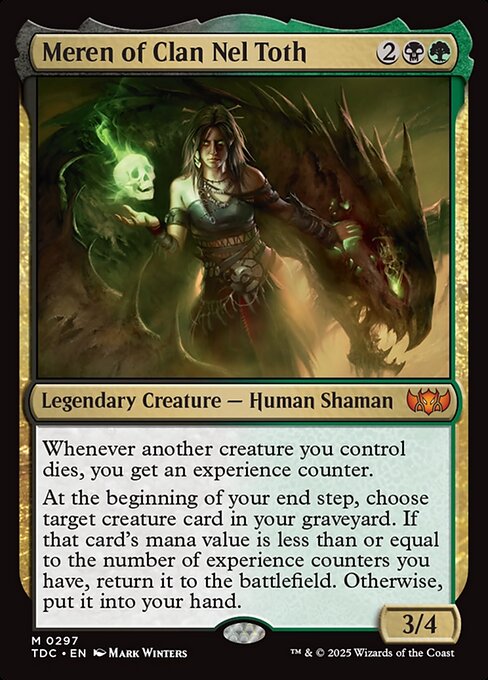
Meren of Clan Nel Toth is one of the classic Golgari commanders and probably one of the best examples of this philosophy.
When another creature you control dies, you get an experience counter. At the beginning of your end step, Meren returns a creature card from your graveyard to the battlefield if its mana value is no greater than your experience counters; otherwise, she returns it to your hand.
Killing things stops being a problem.
It becomes part of the engine.
Sacrifice
Rakdos isn’t the only color combination that enjoys sacrificing its own creatures.
Golgari is extremely good at it too.
The difference is that green gives you even more creatures, tokens and ways to recover those resources afterwards.
Sacrifice a creature.
Get a trigger.
Draw a card.
Bring the creature back.
Sacrifice it again.
That’s the kind of loop Golgari loves.
Meren of Clan Nel Toth works perfectly here too, but Mazirek, Kraul Death Priest takes sacrifice in another direction.
Whenever a player sacrifices a permanent other than Mazirek itself, Mazirek puts a +1/+1 counter on every creature you control.
And notice that it says a player.
Your opponents’ fetch lands and Treasures can suddenly start making your entire board bigger.
Reanimator
Why pay full price for a huge creature when you can put it into your graveyard and bring it back?
Black already does reanimator extremely well.
Green gives you even more big creatures worth reanimating and plenty of ways to fill your graveyard.
Old Stickfingers is a great example.
When you cast it, its ability reveals cards until you reveal X creature cards and puts the revealed creatures into your graveyard; the other cards go to the bottom of your library in a random order. Its power and toughness depend on the number of creature cards in your graveyard.
From there, you just need to decide which horrible thing you want to bring back first.
Golgari reanimator can also recover the same creatures repeatedly, which makes dealing with them permanently much harder.
+1/+1 Counters
Green is naturally excellent with +1/+1 counters, and black brings some interesting ways to use them.
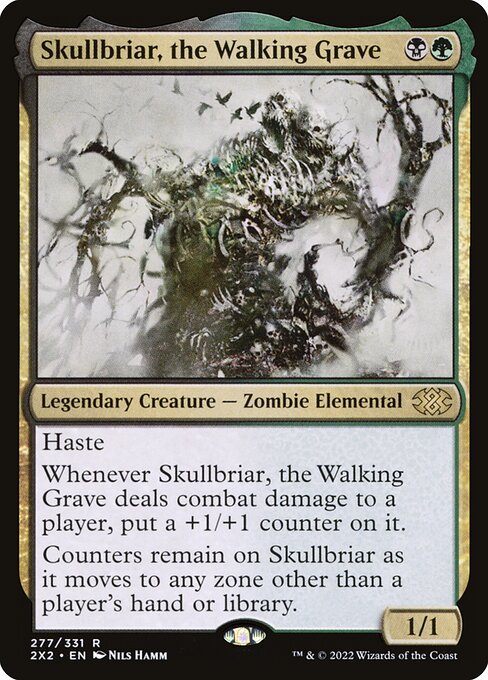
Skullbriar, the Walking Grave is probably one of the most recognizable Golgari commanders for this strategy.
The funny part about Skullbriar is that it keeps its counters as it moves between zones, including the command zone, except when it goes to a player’s hand or library.
So you can spend the game making it bigger and bigger, and killing it doesn’t necessarily reset all the work you’ve done.
It’s simple.
It’s aggressive.
And eventually you have a commander that nobody really wants to block.
Lands and the Graveyard
Golgari doesn’t only recycle creatures.
It can recycle lands too.
Fetch lands, sacrificed lands, milled lands… green has plenty of ways to bring them back.
This opens the door to entire strategies built around lands entering, leaving and returning from the graveyard.
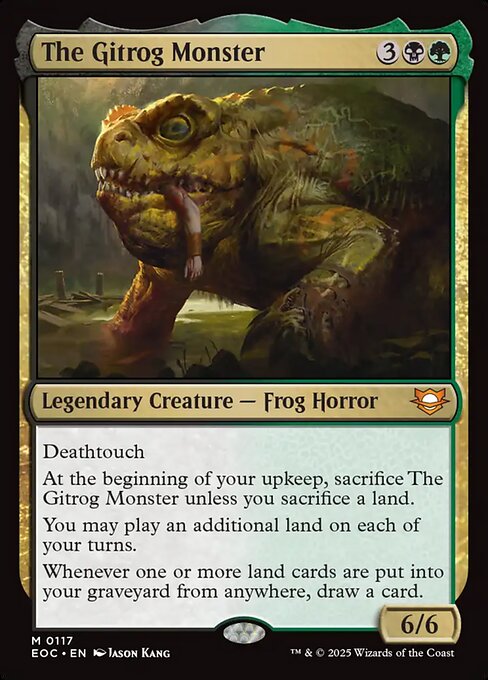
The Gitrog Monster is probably the most famous example.
It lets you play an additional land on each of your turns and draws you a card when one or more land cards go to your graveyard from anywhere. Multiple lands arriving together trigger it only once. At your upkeep, you also need to sacrifice a land or sacrifice Gitrog itself.
And once you start building around it, things can get complicated very quickly.
The Gitrog Monster is a good example of how Golgari can go from a normal value deck to some very serious combo territory.
Elves
You can’t talk about green/black without mentioning Elves.
Green gives you the huge Elf card pool and absurd mana generation.
Black gives you removal, recursion and some of the nastier Elf payoffs.
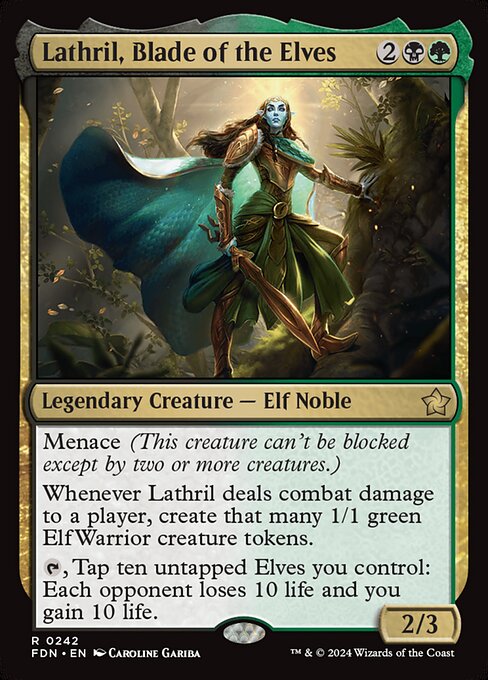
Lathril, Blade of the Elves is one of the most popular commanders for this.
When she deals combat damage to a player, she creates that many 1/1 Elf tokens. Her activated ability taps Lathril and ten other untapped Elves you control: each opponent loses 10 life and you gain 10 life.
Which isn’t particularly difficult when your Elf deck has approximately four hundred creatures on the battlefield.
Big Creatures and Value
Not every Golgari deck needs some complicated graveyard engine.
Black and green are simply very good colors.
Ramp.
Play good creatures.
Destroy things.
Draw cards.
Bring your creatures back when somebody kills them.
Repeat.
Sometimes your strategy really can just be “my cards are difficult to get rid of.”
And it works pretty well.
What Is Golgari Bad At?
The obvious weakness is graveyard hate.
If your entire deck treats the graveyard like a second hand and somebody exiles it, you’re going to have a bad day.
Cards that stop players from using graveyards can be even worse.
Suddenly half your deck doesn’t work the way it’s supposed to.
That’s why a graveyard-heavy Golgari deck should have ways to deal with artifacts and enchantments that shut down the graveyard.
Luckily, you’re playing green.
Another weakness is that Golgari isn’t naturally great at interacting with spells on the stack.
You can destroy almost anything once it’s on the battlefield.
But you’re not blue.
If someone casts the spell that’s going to win the game, sometimes your options are fairly limited.
How Does Golgari Usually Win?
Golgari has a lot of ways to finish games.
You can build a huge board and attack.
You can drain opponents whenever creatures die.
You can reanimate enormous threats.
You can generate ridiculous amounts of mana with Elves.
You can win through +1/+1 counters.
You can assemble graveyard combos.
Or you can simply grind the table until everybody else runs out of resources.
That last one is very Golgari.
You destroy my creature.
I bring it back.
I destroy yours.
You don’t.
Do that enough times and eventually the difference becomes pretty significant.
What Does a Golgari Deck Need?
The biggest thing I’d think about is how dependent you are on your graveyard.
Using the graveyard is great.
Needing the graveyard for absolutely everything can become dangerous.
You still need a deck that can function when somebody has graveyard hate on the battlefield.
You also need ways to put the right cards into your graveyard.
Don’t just add twenty recursion spells and assume creatures will magically end up there.
Self-mill, sacrifice outlets and discard effects are what actually make the engine work.
And don’t forget interaction.
Golgari has access to some fantastic removal.
Creatures, artifacts, enchantments, planeswalkers… there aren’t many permanent types black/green can’t deal with.
Use that advantage.
Is Golgari for You?
I’d look at Golgari if you enjoy getting value from cards long after you’ve already played them.
It’s especially good if you like:
- Using your graveyard as a resource
- Reanimating creatures
- Sacrificing things for value
- +1/+1 counters
- Self-mill
- Elves
- Lands
- Big creatures
- Grinding out long games
- Having answers to almost any permanent
- Engines that become harder and harder to stop
If seeing your best creature die makes you sad, Golgari might change your perspective.
After a while you’ll probably start looking at your own creatures and thinking:
“Okay, which one of you should I kill first?”
Building Your First Golgari Commander Deck
Start by deciding what your graveyard is actually for.
Are you filling it with creatures so you can reanimate them?
Do you want creatures to die repeatedly for sacrifice triggers?
Are you using lands from the graveyard?
Do you care about the number of card types there?
Or is the graveyard just a secondary source of value?
That decision changes the entire deck.
If you’re playing reanimator, you need good targets, ways to put them into the graveyard and ways to bring them back.
If you’re playing sacrifice, you need creatures you’re happy to lose and reliable sacrifice outlets.
If you’re playing +1/+1 counters, don’t fill the deck with graveyard cards just because you’re Golgari.
Build around what your commander actually wants.
Golgari is one of those color combinations where losing a permanent doesn’t necessarily feel like losing anything.
Because there’s a pretty good chance you’re going to see it again.
And again.
And probably again.
That’s Golgari:
Everything dies. The useful stuff comes back.
Ready to test your Golgari deck?
Analyze your list to check whether your mana, card draw and interaction support your recursion engine and backup plan.