
How to Build an Enchantress Commander Deck: Draw Cards, Build Synergies, and Win
By MTG Master EditorialPublished Updated 22 min read
There's something I really enjoy about Enchantress decks.
You play an enchantment. Draw a card. Play another enchantment. Draw another card. Generate some mana, gain a little life, and suddenly your battlefield is becoming much more dangerous than it looked a couple of turns ago.
And the best part is that you haven't necessarily played a single enormous creature.
That's what makes Enchantress interesting to me. Instead of relying on a few individually powerful cards, you're building an engine where almost everything contributes to something else.
A simple one-mana enchantment might accelerate your mana, draw you a card, trigger another ability, and help you create a creature.
All from one card.
But there's a difference between filling your deck with enchantments and building an Enchantress deck that actually works.
You need reliable card draw, enough mana to keep casting spells, ways to protect your important permanents, and a plan to finish the game.
Because drawing twenty cards is great.
But eventually, your opponents will want to know what you're planning to do with them.
What Exactly Is Enchantress in Commander?
Enchantress is a strategy built around playing enchantments and generating additional value from them.
Traditionally, the name comes from cards like Verduran Enchantress and Mesa Enchantress, which let you draw cards whenever you cast enchantment spells.
Today, the archetype has many more tools, but the basic idea hasn't changed much.
You want your enchantments to do more than their printed effects.
Imagine you control these three cards:
Sythis, Harvest's Hand
Enchantress's Presence
Sanctum Weaver
Now you cast Wild Growth for one green mana.
Wild Growth is an Aura that enchants a land and helps it produce additional green mana.
But because you've cast an enchantment spell, Sythis lets you gain 1 life and draw a card.
Enchantress's Presence also triggers, letting you draw another card.
And because you now control another enchantment, Sanctum Weaver can potentially generate more mana.
You've played a one-mana ramp card, drawn two cards, gained a life, and improved your mana engine.
That's a pretty good exchange.
The draw triggers resolve before Wild Growth itself. Sanctum Weaver only counts it as another enchantment after it resolves and enters the battlefield.
Now imagine having several effects like those on the battlefield.
You can start playing enchantments, drawing more enchantments, and using the mana they generate to keep going.
That's when Enchantress becomes particularly powerful.
But one important thing to remember: Enchantress isn't necessarily a combo strategy.
You can build it around tokens, Angels, lifegain, Auras, combat, defensive enchantments, or a mixture of several approaches.
And that's one of the reasons I enjoy it so much.
Choosing Your Enchantress Commander
I think your commander should influence the direction of your deck, but it doesn't need to dictate every single card.
Some Enchantress commanders provide card draw. Others focus on Auras, combat, recursion, or turning enchantments into creatures.
Here are some of the most interesting options.
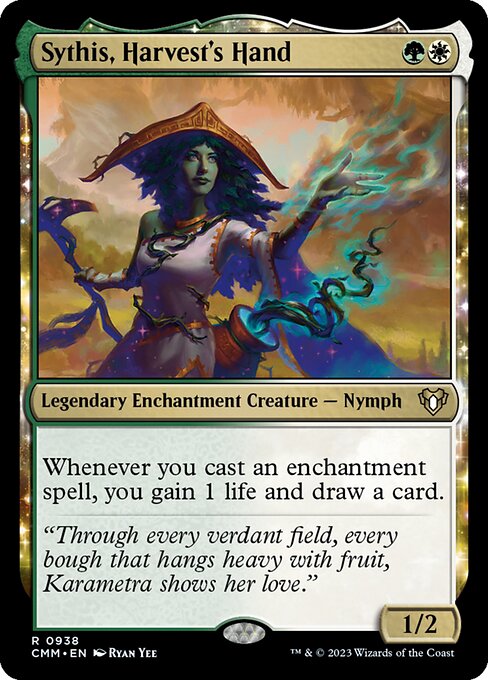
Sythis, Harvest's Hand: Simple, Efficient, and Surprisingly Powerful
Sythis, Harvest's Hand is one of my favorite Enchantress commanders.
For just two mana, you get a commander that lets you draw a card and gain 1 life whenever you cast an enchantment spell.
That might not sound spectacular at first.
One life and one card.
But when your deck contains lots of enchantments, those small advantages accumulate very quickly.
And because Sythis costs only two mana, you can start generating value early.
I particularly like that she doesn't force you into one specific win condition.
You can build around lifegain, create Angels, generate creature tokens, use powerful enchantment creatures, or even include a few combos.
And you can combine several of those strategies without losing the main Enchantress engine.
The main weakness is that Sythis doesn't protect herself.
She's only a 1/2, and opponents will eventually realize that letting you draw two or three extra cards every turn probably isn't a great idea.
That's why I'd include enough independent draw engines to keep playing when she isn't available.
Tuvasa the Sunlit: Enchantress Meets Voltron
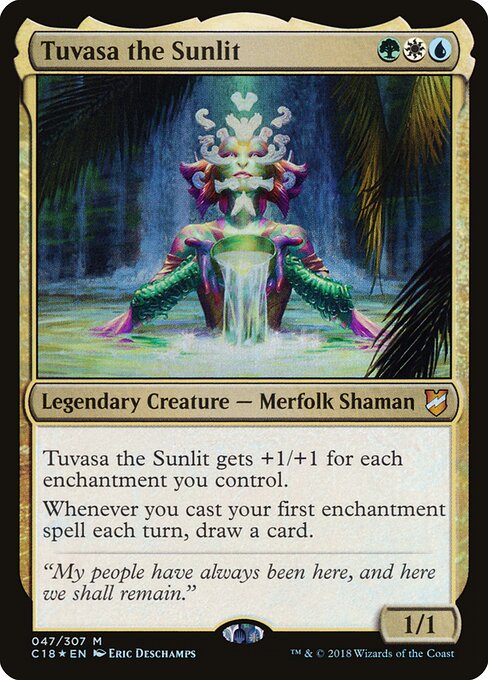
Tuvasa the Sunlit takes the strategy in a different direction.
She gets +1/+1 for each enchantment you control, and she lets you draw a card when you cast your first enchantment spell each turn.
That makes her particularly interesting if you enjoy combining enchantments with combat.
You can use Auras to increase her power, give her protection, and help her connect with opponents.
And because she has a Bant color identity, you also gain access to blue interaction and additional enchantment synergies.
What I like about Tuvasa is that she provides a clear way to win through commander damage.
You aren't just generating value. Your enchantments are also making your commander increasingly dangerous.
But remember that her card draw only triggers on your first enchantment spell each turn.
Casting five enchantments during your turn doesn't mean drawing five cards from Tuvasa.
Anikthea, Hand of Erebos: Enchantments That Refuse to Stay Dead
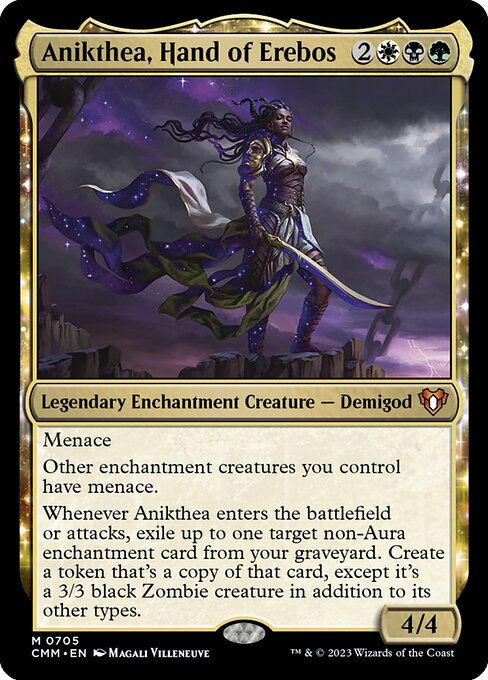
Anikthea, Hand of Erebos is an interesting option if you enjoy graveyard recursion.
Whenever Anikthea enters the battlefield or attacks, you can exile a non-Aura enchantment card from your graveyard and create a token copy of it.
That copy is also a 3/3 black Zombie creature.
Suddenly, enchantments that have already been destroyed can return as creatures while keeping their original abilities.
And because they're still enchantments, they can interact with your other Enchantress cards.
I like the idea of a deck where enchantments continue contributing even after they've been removed.
Anikthea also gives you access to Abzan colors, combining enchantment support with black recursion, removal, and sacrifice strategies.
The challenge is that her tokens are creatures as well as enchantments, so they're vulnerable to creature removal too.
And she can't recover Aura cards through that ability.
Estrid, the Masked: Auras, Untapping, and Mana
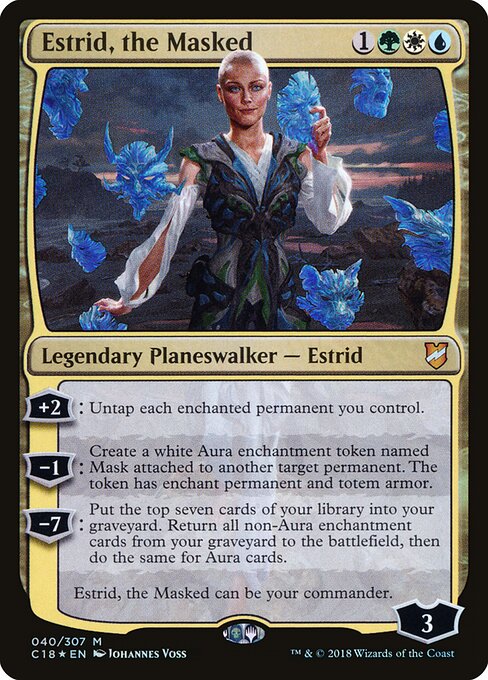
Estrid, the Masked is another interesting commander if you enjoy Auras and mana engines.
Her +2 ability untaps each enchanted permanent you control.
That can be particularly useful with lands enchanted by cards like Wild Growth or Overgrowth.
You can tap those lands for mana, activate Estrid, untap them, and use them again.
Her abilities also support an enchantment-heavy battlefield and give you different ways to generate value.
What I like about Estrid is that she's not simply another card-draw commander.
She encourages you to think about how enchantments interact with the rest of your permanents.
Of course, being a planeswalker means she needs protection from opposing attacks.
And if you build too heavily around her untap ability, losing Estrid can significantly slow down the deck.
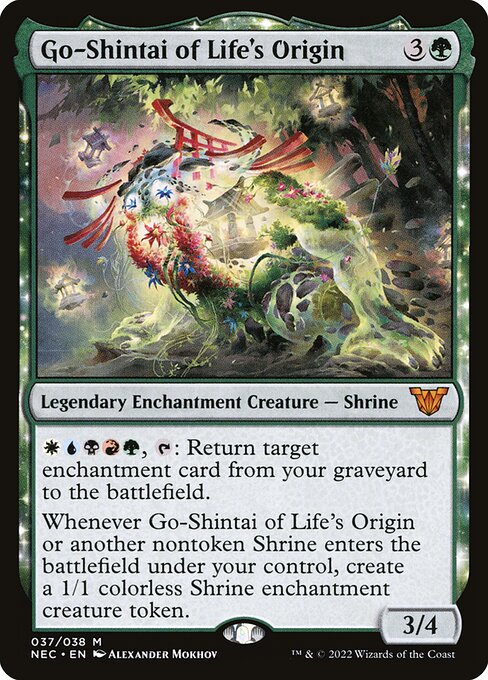
Go-Shintai of Life's Origin: Enchantress With Shrines
If you enjoy Shrines, Go-Shintai of Life's Origin offers a very different version of Enchantress.
It creates a 1/1 colorless Shrine enchantment creature token when it or another nontoken Shrine enters under your control. It does not trigger simply from casting any enchantment. Its activated ability can also return enchantments from your graveyard to the battlefield.
With access to all five colors, you can play the full range of Shrines and supporting enchantments.
This is a good example of how broad the Enchantress archetype can be.
You're still playing enchantments and generating value, but the main strategy revolves around Shrine abilities rather than traditional card-draw engines.
It's an interesting direction if you want something different.
The main drawback is the five-color mana base, especially if you're working with a limited budget.
Card Draw: The Engine That Makes Everything Work
For me, this is the most important part of Enchantress.
The strategy becomes powerful when your enchantments replace themselves or generate enough card advantage to keep your hand full.
Without those effects, you're mostly playing an enchantment deck.
And that's not quite the same thing.
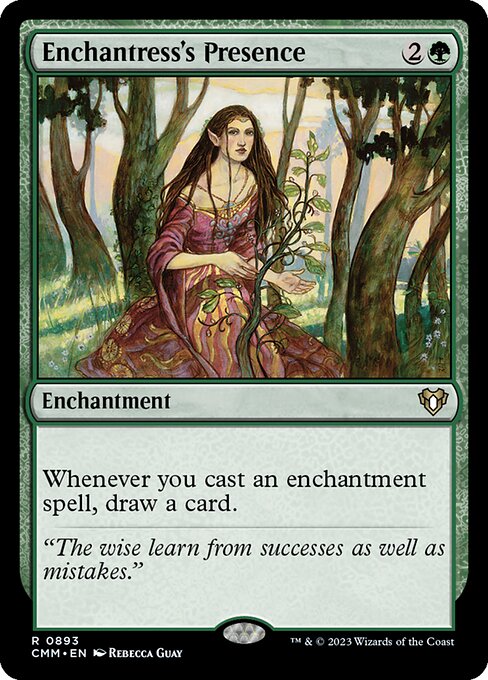
Cards like Mesa Enchantress, Verduran Enchantress, Satyr Enchanter, and Enchantress's Presence are classic examples.
They reward you for casting enchantment spells.
Setessan Champion and Eidolon of Blossoms provide another approach through constellation, rewarding enchantments entering the battlefield.
I like having several independent draw engines.
That way, if someone removes Sythis or another important card, the rest of the deck can continue functioning.
But there's a balance.
You don't want every permanent to be another card-draw engine while having nothing useful to do with all those cards.
Drawing cards is how your deck finds resources.
It isn't necessarily how your deck wins.
Casting Enchantments and Enchantments Entering Are Different
This distinction is particularly important.
Sythis, Harvest's Hand triggers when you cast an enchantment spell.
That means her ability triggers even if an opponent later counters that enchantment spell.
On the other hand, Setessan Champion triggers when an enchantment enters the battlefield under your control.
That can include enchantments entering without being cast, such as enchantments returned from the graveyard or enchantment tokens.
But simply casting a spell that gets countered won't cause constellation to trigger, because the enchantment never entered.
And creating an enchantment token won't trigger Sythis, because you didn't cast an enchantment spell.
These differences matter when you're choosing cards.
A deck full of enchantment tokens and recursion effects might benefit more from constellation than you'd initially expect.
While a deck focused on repeatedly casting cheap enchantments gets more consistent value from traditional Enchantress triggers.
I like having some of both, depending on the strategy.
Enchantment Ramp: One of the Best Parts of the Archetype
One thing I particularly enjoy about Enchantress is that your ramp can also trigger your card-draw engines.
Instead of relying only on mana rocks or conventional ramp spells, you can use cheap enchantments that make your lands produce more mana.
Cards like Wild Growth, Utopia Sprawl, Fertile Ground, and Overgrowth are excellent examples.
Utopia Sprawl specifically requires a Forest. This can be a nonbasic land with the Forest subtype.
You enchant a land, and that land becomes more productive.
But if you already control Sythis or another Enchantress effect, casting that ramp enchantment may also draw you a card.
That's fantastic value.
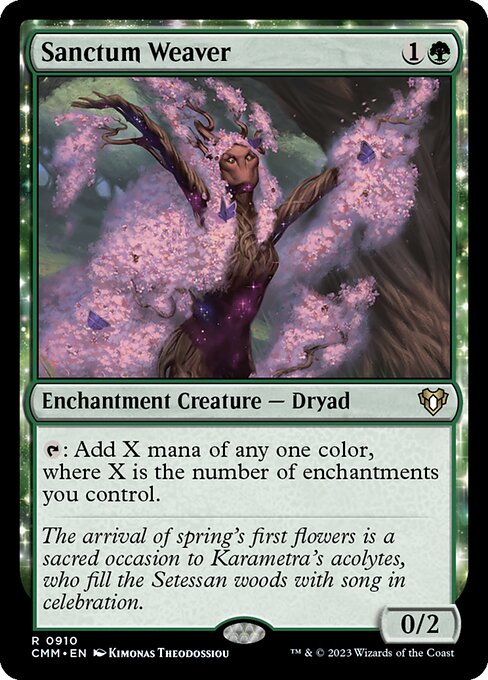
Sanctum Weaver is another card worth considering.
It taps to add X mana of a single color, where X is the number of enchantments you control.
In a deck with ten enchantments on the battlefield, Sanctum Weaver can generate ten mana.
From one creature.
That's the kind of interaction that makes enchantment decks surprisingly explosive.
But I'd still pay attention to the mana curve.
Having access to enormous amounts of mana later in the game doesn't automatically solve a slow start.
And remember that enchantment ramp isn't completely without risk.
If someone destroys the enchanted land, you generally lose the Aura attached to it as well.
That's why I like combining enchantment-based ramp with a few conventional options, rather than depending entirely on one type.
How Many Enchantments Should You Play?
This is one of the first questions people ask when building Enchantress.
And, as usual with Commander, there isn't a perfect number.
A Sythis deck focused on casting cheap enchantments has different needs from an Anikthea deck built around recursion or a Tuvasa deck using Auras for combat.
But I normally want a relatively high enchantment density in a dedicated Enchantress deck.
Somewhere around 28–38 enchantment cards can be a useful starting point, sometimes more if the strategy really supports it.
That includes enchantment creatures and Auras, not just traditional enchantments.
But I wouldn't add an enchantment simply to increase the total.
A card should still accomplish something useful.
One of the biggest advantages of Enchantress is that many enchantments can perform jobs normally handled by other card types.
You can use enchantments for ramp, removal, protection, card advantage, token generation, and even win conditions.
That makes it possible to increase enchantment density without sacrificing too much functionality.
Still, don't forget the rest of the deck.
You need lands, interaction, and ways to recover from difficult situations.
Having thirty-five enchantments doesn't automatically make a deck consistent.
Those enchantments need to work together.
Using Enchantments for Removal and Interaction
I think this is one of the most interesting parts of building Enchantress.
You can interact with opponents while continuing to advance your main strategy.
Cards like Darksteel Mutation, Kenrith's Transformation, Song of the Dryads, and Grasp of Fate provide different ways to deal with troublesome permanents.
And because they're enchantments, casting them can trigger your draw engines.
That's a nice combination.
You're removing a dangerous threat while also generating card advantage.
But enchantment-based removal isn't always the same as conventional removal.
Some effects leave the original permanent on the battlefield, only with changed abilities or characteristics.
Others exile something for as long as the enchantment remains in play.
If your opponent removes the enchantment, the threat might become dangerous again or return to the battlefield.
That's why I wouldn't rely entirely on enchantment-based answers.
I'd still include some direct removal, especially for situations where you need an immediate and permanent solution.
And I'd pay attention to the kind of problems your deck struggles with.
Enchantment decks can be excellent at controlling certain permanents, but they still need answers to fast combos, graveyard strategies, and other threats.
Protecting Your Enchantments
Here's one of the biggest weaknesses of Enchantress.
You spend several turns building a battlefield full of enchantments.
You've got card-draw engines, ramp, protection, and perhaps a few creatures.
Everything is working beautifully.
Then somebody casts Bane of Progress.
And suddenly, your entire engine disappears.
That's the risk of building around one permanent type.
Fortunately, enchantment decks have access to some useful protection.
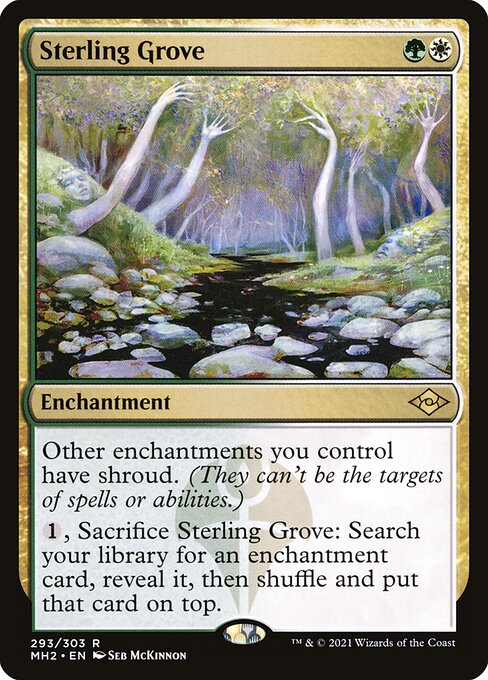
Sterling Grove gives your other enchantments shroud and can be sacrificed to search for an enchantment card and put it on top of your library.
Greater Auramancy gives other enchantments you control shroud and also protects enchanted creatures with shroud.
Heroic Intervention can give your permanents hexproof and indestructible until end of turn.
And Teferi's Protection can help your permanents survive many situations by phasing them out.
But none of these cards solves every problem.
Indestructible doesn't stop exile.
Shroud doesn't stop board wipes that don't target.
And shroud also prevents you from targeting your own protected permanents.
That's particularly important if your deck uses Auras or other effects that need to target enchantments or creatures.
I'd think about protection as part of the deck's structure, not something to add after filling every slot with exciting cards.
Because rebuilding an entire Enchantress engine from zero can be painful.
Recursion: Recovering After an Enchantment Board Wipe
Protection is useful, but sometimes your opponents will find a way through it.
That's why I like including some ways to recover enchantments from the graveyard.
Replenish is one of the most powerful examples, returning all enchantment cards from your graveyard to the battlefield.
Open the Vaults can do something similar with artifacts and enchantments, although it also helps your opponents.
Hall of Heliod's Generosity provides a slower but repeatable way to put an enchantment card from your graveyard on top of your library.
And cards like Eternal Witness can recover individual important pieces.
I wouldn't fill the deck with recursion spells, but I'd definitely want some way to recover after losing several enchantments.
One thing worth remembering is that enchantment board wipes aren't necessarily the end of the game.
If you've drawn enough cards and developed your mana, you might be able to rebuild fairly quickly.
The danger is losing your engines and having no resources left.
That's why card draw and resilience are so important.
Auras, Enchantment Creatures, and Regular Enchantments
Not every Enchantress deck needs to use the same kinds of enchantments.
And I think this is where you can give the deck more personality.
Auras
Auras attach to creatures, lands, or other objects depending on their enchant ability.
They can provide ramp, protection, removal, or combat bonuses.
They're particularly interesting with commanders like Tuvasa or Estrid.
But they come with some risks.
If a creature enchanted by an ordinary Aura leaves the battlefield, the Aura usually ends up in the graveyard.
And if you put several Auras on one creature, a single removal spell can cost you multiple cards.
That's why protection matters so much in Aura-heavy builds.
Enchantment Creatures
Enchantment creatures are especially useful because they contribute to your enchantment count while also providing creatures for combat, blocking, or additional abilities.
Cards like Sanctum Weaver, Eidolon of Blossoms, and Doomwake Giant are good examples.
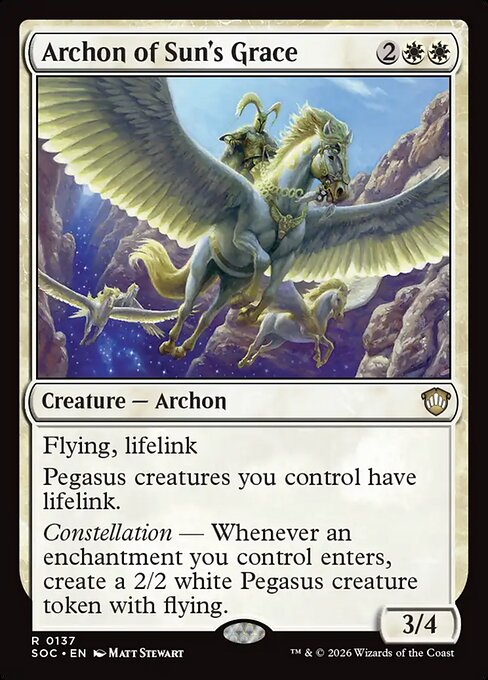
Archon of Sun's Grace is different: it has constellation, but it is not an enchantment. Having an ability that rewards enchantments does not change a card's type.
I particularly like enchantment creatures that immediately generate value.
That way, even if an opponent removes them, you've hopefully already gained something.
But remember that enchantment creatures are vulnerable to both creature and enchantment removal.
They're flexible, but they give your opponents more ways to interact.
Regular Enchantments
Traditional enchantments are often the backbone of the deck.
They can provide repeatable effects without needing to attack, tap, or survive creature combat.
Cards like Enchantress's Presence, Mirari's Wake, and Sphere of Safety can contribute to very different parts of your strategy.
I like having a mixture of enchantment types.
It gives the deck more options and prevents everything from depending on one kind of permanent.
Pillowfort: Make Attacking You a Bad Idea
Some Enchantress decks use a defensive approach commonly called Pillowfort.
The idea is to make attacking you difficult, expensive, or simply unattractive.
Cards like Ghostly Prison, Sphere of Safety, and Propaganda can help, depending on your colors.
Sphere of Safety is particularly interesting in a dedicated Enchantress deck.
It makes opponents pay mana for each creature attacking you, based on the number of enchantments you control.
If you already have a large enchantment battlefield, that cost can become enormous.
And suddenly your opponents start looking for somebody else to attack.
I like having some defensive tools in Enchantress, especially if the deck needs time to build its engines.
But I wouldn't necessarily turn every Enchantress deck into a full Pillowfort strategy.
There's a difference between protecting yourself while you develop and making the game so restrictive that nobody can accomplish anything.
It depends on what you enjoy and what kind of games your group wants to play.
And remember: preventing opponents from attacking you isn't the same as winning.
Eventually, you still need a plan to finish the game.
How Does an Enchantress Deck Actually Win?
This is probably the most important decision when building the deck.
Because Enchantress is very good at generating value.
Sometimes too good.
You can draw cards, generate mana, gain life, and develop an impressive battlefield.
But if you don't have a way to convert all those resources into a victory, you might spend twenty minutes playing enchantments while your opponents wait for something decisive to happen.
There are several good ways to win.
Winning With Angels and Other Tokens
This is one of my favorite approaches.
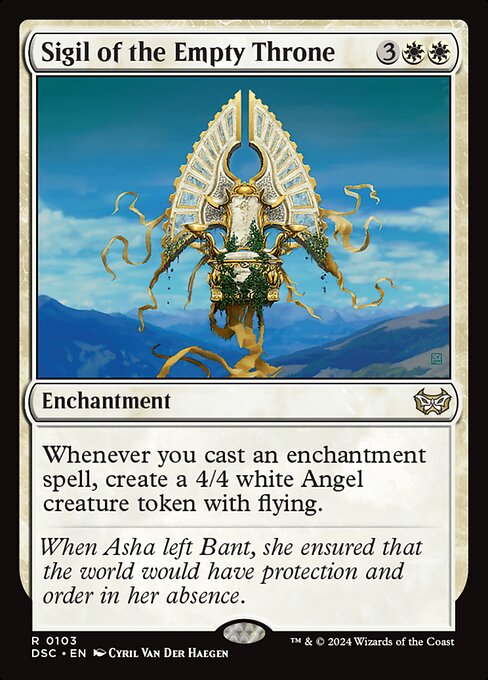
Sigil of the Empty Throne creates a 4/4 white Angel token with flying whenever you cast an enchantment spell.
Imagine casting four enchantments during a turn.
You get four Angels.
That's sixteen power in flying creatures, generated simply by playing cards your deck already wants to play.
Archon of Sun's Grace provides another interesting option, creating 2/2 Pegasus tokens with flying whenever an enchantment enters under your control.
And Hallowed Haunting creates Spirit Cleric tokens with power and toughness equal to the number of Spirits you control. At seven or more enchantments, it also gives all your creatures flying and vigilance.
I particularly enjoy this approach because it gives the deck a natural way to finish through combat.
You're not assembling a random combo unrelated to your strategy.
You're simply playing enchantments, developing your engines, and building an army.
And Angels are always a nice bonus.
Winning With Auras and Commander Damage
Some Enchantress decks prefer a more aggressive approach.
With commanders like Tuvasa, you can use Auras to make your commander increasingly powerful and win through commander damage.
Cards like Ethereal Armor, All That Glitters, and various protection Auras can support that strategy.
This creates an interesting combination of Enchantress and Voltron.
You still generate card advantage through enchantments, but your commander becomes the main threat.
The downside is that you're investing resources in one creature.
If that creature gets removed repeatedly, you can lose a lot of momentum.
I'd include enough protection and ways to connect through blockers if I chose this direction.
Winning Through Lifegain
Lifegain is another direction that works well with certain Enchantress commanders.
Sythis, for example, naturally gains life whenever you cast an enchantment spell.
That might not seem particularly threatening.
But over several turns, those small amounts of life can accumulate.
Cards like Archangel of Thune can turn repeated lifegain into +1/+1 counters across your creature board.
And other lifegain payoffs can help convert that resource into a way to win.
I like lifegain as a secondary theme in Enchantress.
It gives you additional resilience while supporting other parts of your strategy.
But I wouldn't assume gaining a hundred life automatically means you're winning.
Commander damage, combos, and alternative win conditions can still eliminate you regardless of your life total.
Lifegain is useful.
You still need a way to finish the game.
Winning With Enchantment Combos
Enchantress can also support powerful combos.
Cheap enchantments, mana engines, untap effects, and recursion can create repeatable interactions.
For example, Sanctum Weaver can generate enormous amounts of mana when you control many enchantments.
Combine that with a suitable repeatable untap effect and enough mana production, and you may be able to generate unlimited mana.
Other combinations involve enchantments that create tokens, recover cards, or trigger whenever enchantments enter.
Some builds also use dedicated combo finishes.
There's nothing wrong with that if it's the kind of deck you want.
But personally, I don't think every Enchantress deck needs to rely on infinite combos.
I enjoy building a powerful board, finding interesting synergies, and winning through creatures or other effects that naturally fit the strategy.
If you do include combos, I'd make sure they match the power level of the games you're planning to play.
Common Mistakes When Building Enchantress
There are a few problems I'd watch out for.
Too many expensive enchantments. You want to cast multiple enchantments, not spend every turn playing one expensive card.
Not enough draw engines. Having thirty enchantments is nice, but you need ways to keep finding more.
Too many draw engines and no way to win. Drawing cards is useful, but eventually you need a finishing plan.
Ignoring enchantment removal. One well-timed board wipe can destroy several turns of development.
Relying entirely on the commander. Your deck should still function if Sythis or another commander gets removed repeatedly.
Not enough interaction. Your enchantments might be powerful, but opponents can still assemble dangerous strategies.
Forgetting the difference between casting and entering. Not every enchantment-related trigger works in the same way.
And one more thing: don't assume an enchantment is automatically better than a non-enchantment card simply because it triggers your engines.
Sometimes a conventional removal spell or a useful creature is exactly what your deck needs.
I'd rather have a good Commander deck with strong enchantment synergies than a deck that contains every enchantment I could find.
Test Your Enchantress Deck Before Buying Everything
Enchantress can be surprisingly difficult to evaluate just by looking at a decklist.
You might have plenty of card-draw effects, good ramp, and a collection of powerful enchantments.
But during real games, you could discover that your deck takes too long to get started.
Or perhaps you draw plenty of cards but struggle to turn them into meaningful threats.
Maybe your enchantment count looks excellent, but you don't have enough interaction or protection.
That's why I like testing the deck before spending money on every card.
In MTG Master Deck Builder, you can build your Enchantress Commander deck, explore enchantment synergies, and use the Deck Analyzer to review consistency, mana curve, interaction, resilience, and other aspects of the deck.
I'd pay particular attention to the number of inexpensive enchantments, independent card-draw engines, ramp, and actual win conditions.
The opening-hand simulator is useful here too.
Try several hands and see whether you can realistically cast your commander, play some useful enchantments, and continue developing without running out of cards.
And if your deck includes mana engines, recursion, and repeatable untap effects, the combo detection tools are worth checking.
Sometimes cards that look like ordinary synergy pieces can create a much more powerful interaction than you expected.
No analyzer replaces real games, of course.
But it can help you identify structural weaknesses before you spend money on a deck that doesn't work quite the way you imagined.
Is Enchantress the Right Archetype for You?
I think Enchantress is a fantastic choice if you enjoy building engines, generating card advantage, and watching several small interactions become something much more powerful.
It's also surprisingly flexible.
You can build around Angels, lifegain, Auras, tokens, control, or even combos.
And you don't necessarily need to fill the deck with expensive staples.
Some of the most useful cards are simple enchantments that cost one or two mana and contribute to several parts of your strategy.
But Enchantress isn't for everyone.
If you prefer straightforward combat and quick turns, managing several enchantment triggers and card-draw effects might feel a little complicated.
And if your group plays a lot of enchantment removal, you'll need to be comfortable rebuilding your engines.
Personally, I think the most enjoyable Enchantress decks are those where the individual cards work well together without losing the personality of the deck.
You don't need to include every powerful enchantment available.
You don't need to win through the same combo every game.
You can build something that reflects the way you enjoy playing.
And when your opponents see you cast a harmless one-mana enchantment, only to realize that you've drawn three cards, gained some life, created an Angel, and generated additional mana...
Well, perhaps that enchantment wasn't so harmless after all.
Build an Enchantress engine with a winning plan
Balance inexpensive enchantments, independent draw engines, ramp and a clear win condition in Deck Builder.