
Izzet Commander Guide: Spells, Card Draw and Explosive Turns
By MTG Master EditorialPublished Updated 9 min read
Izzet is blue and red, and if you like casting spells, drawing cards and occasionally having a turn where nobody really understands what you’re doing anymore, you’re probably going to enjoy it.
Unlike Selesnya, you don’t necessarily want a huge board full of creatures.
Sometimes you barely need creatures at all.
Izzet decks can play spellslinger, storm, artifacts, Wizards, copying spells, burn, card draw, chaos or combo. Some are quite controlled and patient. Others look completely harmless until they suddenly cast fifteen spells in the same turn.
The common theme is usually getting value from casting things.
You cast an instant.
Something triggers.
You draw a card.
That lets you cast another spell.
Something else triggers.
You copy that spell.
Now you have another card.
And somehow the five mana you had at the start of the turn still hasn’t run out.
That’s Izzet.
How Does Izzet Play?
Blue and red are naturally very good at spells.
Blue gives you card draw, counterspells, card selection, bounce, copying effects and ways to control what happens at the table.
Red gives you direct damage, Treasures, impulse draw, temporary mana and plenty of ways to copy or benefit from instants and sorceries.
Together, they can produce some extremely efficient engines.
Izzet often doesn’t build its advantage by putting lots of permanents onto the battlefield.
Its resources are frequently in your hand.
Or your graveyard.
Or, somehow, in exile.
This can make an Izzet player look less threatening than someone with twenty creatures in front of them.
Don’t trust that.
What Is Izzet Good At?
Spellslinger
This is probably the most recognizable Izzet strategy.
The idea is simple: play lots of instants and sorceries and have permanents that reward you every time you cast one.
Of course, “simple” can stop being simple quite quickly.
Your spells can draw cards, create tokens, deal damage, generate mana or reduce the cost of the next spell.
Once several of those effects are on the battlefield at the same time, even a cheap cantrip can start doing five different things.
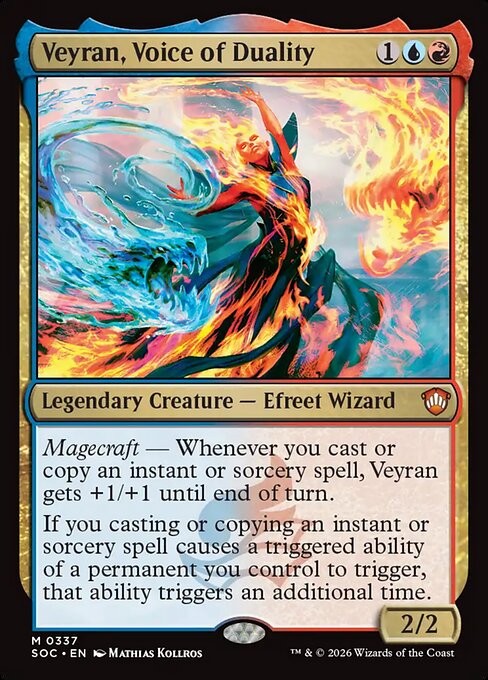
Veyran, Voice of Duality is a perfect example. If casting or copying an instant or sorcery spell causes a triggered ability of a permanent you control to trigger, Veyran makes that ability trigger an additional time.
Things can get stupid very quickly.
Balmor, Battlemage Captain takes a more aggressive approach, turning all those spells into bonuses for your creatures and letting a spellslinger deck suddenly kill through combat.
Copying Spells
Why settle for one spell when you can add a copy to the stack?
Or two.
Or five.
Copying spells is one of the most Izzet things you can do.
A normal draw spell suddenly draws twice as many cards. A removal spell kills several targets. A huge X spell can become a win condition by itself.
One important detail: copying a spell already on the stack is not casting it. Those copies don’t increase your storm count or trigger abilities that only care about casting a spell. Abilities that also care about copying, such as magecraft, can still trigger.
Melek, Izzet Paragon is one of the classic commanders for this kind of strategy, letting you cast instant and sorcery spells from the top of your library and copying them when you cast them from there.
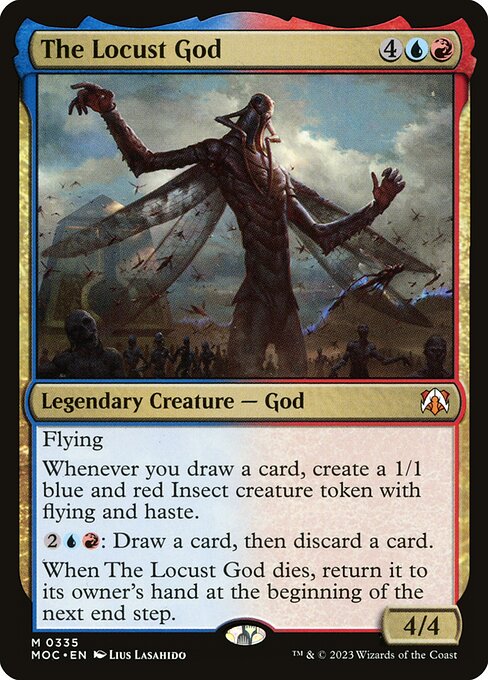
The Locust God is a different kind of engine, built around drawing rather than copying spells: every card you draw creates a 1/1 Insect token with flying and haste.
And blue/red is quite good at drawing cards.
Sometimes a little too good.
Storm and Big Turns
This is where Izzet can go from “I’m just drawing some cards” to “I think the game is over” in a single turn.
Storm-style decks want to cast lots of spells in succession.
One spell gives you mana.
Another draws cards.
Another reduces costs.
Another copies something.
And each new spell keeps the engine moving.
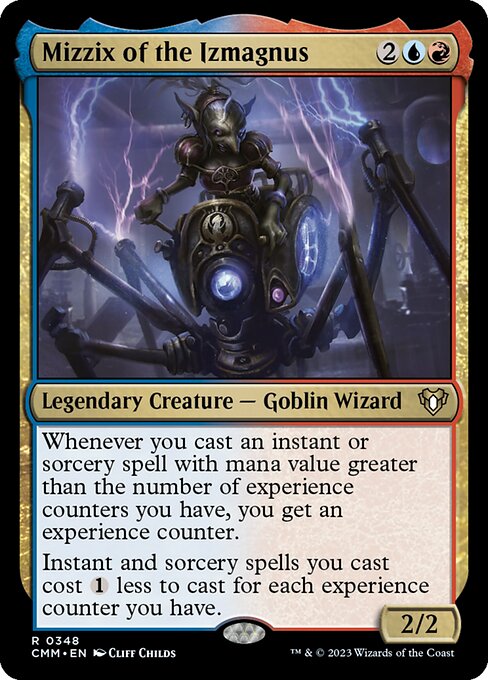
Mizzix of the Izmagnus is one of the classic commanders here. When you cast an instant or sorcery spell with mana value greater than your number of experience counters, you get another experience counter. Each one reduces the generic cost of your instants and sorceries by one mana.
Eventually spells that should cost five or six mana can cost much less, although you still need to pay their colored mana costs.
The difficult part with these decks is knowing when to go for it.
Start too early and your engine can simply run out of fuel.
Wait too long and somebody else may win first.
Card Draw
Blue is already one of the best colors in Magic for drawing cards.
Red adds impulse draw, wheel effects and plenty of cards that discard your hand and replace it with a new one.
Izzet can go through an incredible amount of its deck.
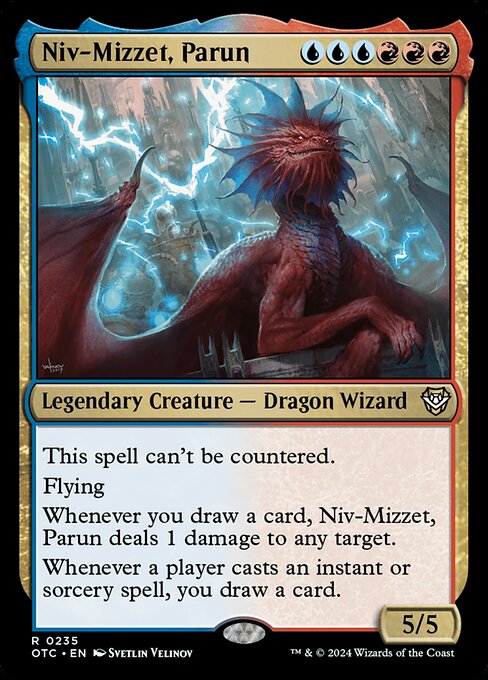
Niv-Mizzet, Parun is probably the commander that best represents this.
Whenever you draw a card, Niv-Mizzet deals 1 damage to any target.
Whenever a player casts an instant or sorcery spell, you draw another card.
So you’re doing something Izzet already wants to do and turning it directly into damage.
There’s a reason Niv-Mizzet has a reputation.
Artifacts
Izzet isn’t only about instants and sorceries.
Blue and red also work extremely well with artifacts.
Treasure tokens, artifact creatures, mana rocks and strange little machines that interact with each other can form some very powerful engines.
Jhoira, Weatherlight Captain is a good example. Every historic spell you cast draws you another card, which means artifact-heavy builds can cycle through the deck incredibly quickly.
These decks can feel almost like spellslinger even though most of the cards you’re casting are permanents.
Wizards
If you want creatures in your Izzet deck, Wizards are an obvious place to look.
Both blue and red have access to plenty of them, and many already care about exactly the things Izzet wants to do: casting spells, drawing cards and copying effects.
Adeliz, the Cinder Wind turns Wizards into an aggressive strategy by giving Wizards you control +1/+1 until end of turn every time you cast an instant or sorcery spell.
It’s a nice reminder that Izzet doesn’t always have to sit there doing maths for twenty minutes.
Sometimes you can just attack.
What Is Izzet Bad At?
One of Izzet’s biggest weaknesses is dealing permanently with certain types of permanents.
Creatures normally aren’t a huge problem. Red can burn them, and blue can bounce them or counter creature spells before they resolve.
But enchantments can be much more annoying once they’ve actually resolved.
Blue can bounce them.
You can counter enchantment spells before they resolve.
You can sometimes steal them.
But simply destroying an enchantment isn’t something blue/red naturally does very well.
Another problem is that some Izzet decks can become too dependent on their engine pieces.
Your deck might contain forty fantastic spells, but if the commander or permanent that turns those spells into actual value gets removed repeatedly, suddenly you’re doing a lot of work without getting very far.
And yes, sometimes you will spend ten minutes doing an enormous turn only to discover that you haven’t actually won anything.
That’s also quite Izzet.
How Does Izzet Usually Win?
There are plenty of options.
Spellslinger decks can slowly burn the table through triggers.
Storm decks can generate one enormous turn and finish everyone at once.
Some decks create huge armies of tokens simply by casting or drawing cards.
Others assemble combos.
And some Izzet decks just generate so much card advantage that eventually nobody else can keep up.
Commanders like Niv-Mizzet, Parun can even become part of very compact combos, which means you need to think carefully about the power level you’re aiming for when building them.
Izzet has a very high ceiling.
You can build something casual and chaotic or something frighteningly efficient using exactly the same colors.
What Does an Izzet Deck Need?
The first thing I’d watch is the balance between payoffs and actual spells.
If your deck cares about instants and sorceries, you need enough instants and sorceries.
It sounds obvious.
But it’s very easy to start adding creatures that trigger from spells, enchantments that trigger from spells, artifacts that trigger from spells…
And suddenly your spellslinger deck doesn’t actually contain enough spells.
You also need mana.
Casting three or four spells in a turn sounds great until you realize they still cost mana.
Cost reducers, mana rocks, Treasures and effects that generate mana when you cast spells can make a huge difference.
And don’t forget actual interaction.
You’re playing blue.
Use it.
Is Izzet for You?
I’d look at Izzet if you enjoy having lots of options and making decisions during your turn.
It’s especially good if you like:
- Instants and sorceries
- Drawing lots of cards
- Copying spells
- Counterspells
- Combo
- Storm
- Artifacts
- Casting lots of spells in one turn
- Finding interactions between different cards
- Having explosive turns
If you want to play one enormous creature every turn and attack with it, there are probably easier color combinations.
And if you hate keeping track of triggers, mana, cards in exile and the number of spells you’ve already cast this turn…
Izzet might become a headache.
Because sometimes playing Izzet feels less like playing Magic and more like doing your taxes while somebody keeps adding triggers to the stack.
Building Your First Izzet Commander Deck
Start by deciding what happens when you cast a spell.
That’s really the core question.
Does your commander deal damage?
Create tokens?
Draw cards?
Make your creatures bigger?
Copy the spell?
Reduce the cost of the next one?
Once you know that, build around that specific plan instead of simply adding every good blue/red instant and sorcery you own.
If you’re playing spellslinger, keep enough cheap spells to make the engine move.
If you’re playing storm, make sure you have enough mana generation and card draw to keep going.
If you’re playing artifacts, your ratios will look completely different.
And if your deck needs the commander to function, think about what happens after someone removes it for the third time.
Izzet can create some of the most ridiculous turns in Commander.
But the best Izzet decks aren’t just casting lots of spells for the sake of casting lots of spells.
Every spell should be pushing the engine forward.
And eventually you reach that wonderful Izzet moment where you look at your hand, your mana, the stack and your graveyard and say:
“Wait… I think I can do something stupid here.”
Ready to test your Izzet deck?
Analyze your list to check whether your mana, card draw and interaction support the engine you want to build.