
How to Build a Mill Commander Deck: Empty Libraries, Survive, and Win
By MTG Master EditorialPublished Updated 23 min read
There are plenty of ways to win a game of Commander.
You can attack with enormous creatures, assemble an infinite combo, drain everyone's life, or build a battlefield so powerful that nobody can stop you.
Or you can ignore your opponents' life totals and start removing cards from their libraries.
One card.
Another card.
Twenty more.
And suddenly someone looks at their deck and asks, "Wait, how many cards do I have left?"
That's Mill.
And I think it's one of the strangest and most entertaining ways to play Magic.
You're attacking a resource that most players don't normally pay much attention to: their library.
But there's a problem.
In Commander, each opponent starts with a 100-card deck, including their commander, and you normally have three opponents.
That means you could potentially need to mill hundreds of cards before winning.
And while you're doing that, your opponents are still playing creatures, casting spells, and trying to kill you.
Even worse, some of them might actually be happy that you're putting cards into their graveyards.
That's what makes Mill particularly interesting in Commander.
It's not enough to play a few cards that mill ten or twenty cards. You need a strategy capable of threatening entire libraries, ways to survive while you're doing it, and a plan for dealing with opponents who actually benefit from being milled.
Let's see how I'd build it.
What Exactly Is Mill in Commander?
Mill is the mechanic that puts cards from the top of a player's library directly into their graveyard.
Normally, players lose when their life total reaches zero.
Mill attacks them from another direction.
You try to empty their library so that they eventually attempt to draw a card when there are none left.
And that last part is important.
A player doesn't lose simply because their library is empty. They lose when they attempt to draw from an empty library.
This loss is checked as a state-based action, normally after the spell or ability making them draw has finished resolving. Effects that replace the draw or prevent a loss can change that result.
So if you've just milled the last card of an opponent's library, they haven't necessarily lost yet.
They might survive until their next draw step.
Or they might have a way to shuffle cards back into their library, replace their draws, or win before needing to draw again.
Imagine you control these two cards:
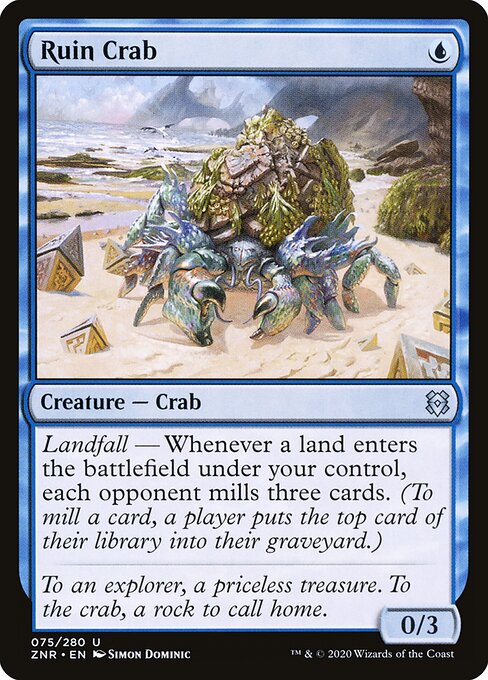
Ruin Crab
Psychic Corrosion
Whenever a land enters the battlefield under your control, Ruin Crab makes each opponent mill three cards.
And whenever you draw a card, Psychic Corrosion makes each opponent mill two cards.
You play a land, and each opponent mills three.
Then you draw two cards through another spell, making each opponent mill four more.
That's seven cards from each opponent's library.
Twenty-one cards milled across the table.
And you haven't attacked anyone.
That's how Mill starts becoming interesting.
Small effects can accumulate very quickly when they're repeated and affect all your opponents.
But there's a significant difference between milling seven cards once and consistently milling enough cards to actually win.
Choosing Your Mill Commander
I think choosing the right commander matters a lot for Mill.
Some commanders directly increase the number of cards you mill.
Others turn your creatures into repeatable mill engines, reward you for filling graveyards, or allow you to steal the cards you've milled.
And those approaches produce very different decks.
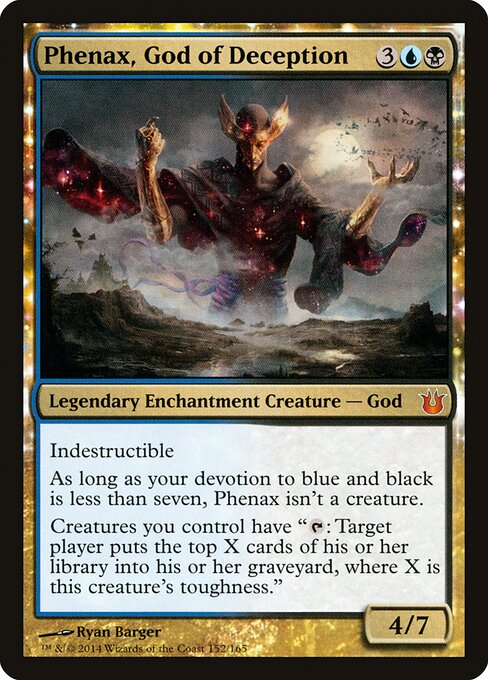
Phenax, God of Deception: Toughness Becomes Mill
Phenax, God of Deception is one of the most recognizable Mill commanders.
He gives creatures you control an activated ability that lets you tap them to make a player mill cards equal to that creature's toughness.
That's a very interesting approach.
Normally, when you look at a creature, you pay attention to its power, abilities, and mana cost.
With Phenax, toughness becomes an offensive resource.
A creature with zero power and seven toughness might not look particularly dangerous.
But with Phenax on the battlefield, it can mill seven cards every time you activate its granted ability.
And because you're tapping creatures rather than attacking with them, you can keep a defensive battlefield while working toward your win condition.
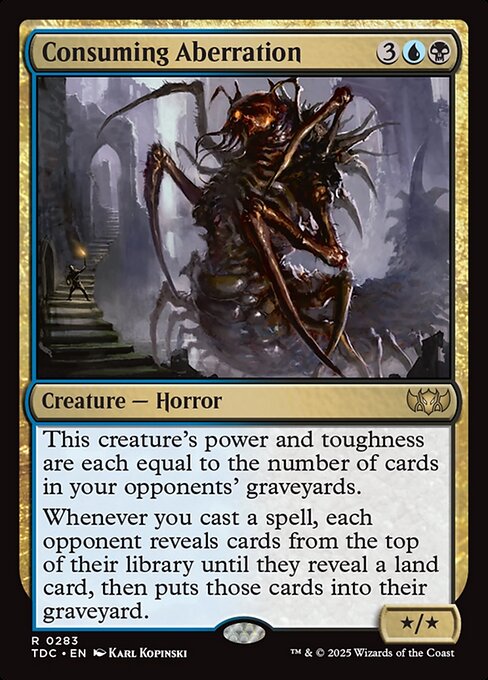
Consuming Aberration is especially interesting here.
Its power and toughness are equal to the total number of cards in your opponents' graveyards.
As those graveyards grow, Consuming Aberration becomes enormous.
And Phenax can turn that toughness into a huge mill activation.
I like this approach because the deck naturally combines defense and offense.
Your creatures protect you from attacks while also helping empty libraries.
But remember that creatures normally need to be under your control since the beginning of your turn before they can activate abilities that use the tap symbol, unless they have haste.
Playing Phenax doesn't automatically let every creature you just cast start milling immediately.
Bruvac the Grandiloquent: Twice as Much Mill
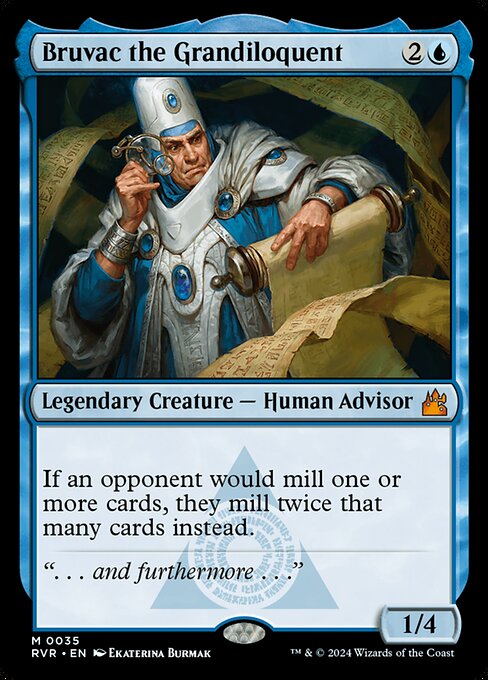
Bruvac the Grandiloquent is one of the most straightforward commanders for the strategy.
His ability doubles the number of cards your opponents mill.
If an effect would make an opponent mill five cards, they mill ten instead.
If they would mill twenty, they mill forty.
You can probably see where this is going.
I particularly like Bruvac because he makes otherwise modest mill effects much more threatening.
A card that mills three cards might not seem particularly impressive in Commander.
But with Bruvac, that's six.
And if you're triggering that effect repeatedly, the numbers start adding up.
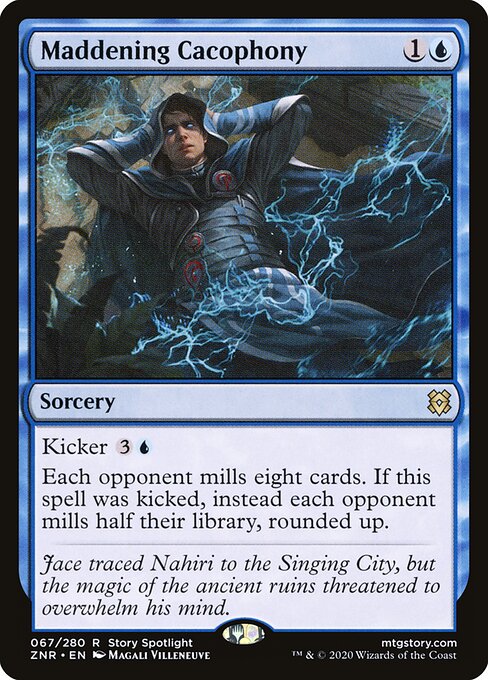
There's also a well-known combination with Maddening Cacophony.
When you cast Maddening Cacophony with its kicker cost paid, each opponent mills half their library, rounded up.
With Bruvac on the battlefield, that amount is doubled.
That can empty every opponent's library in one spell.
But remember that empty libraries don't automatically eliminate players. They still need to attempt to draw.
And Bruvac only doubles actual mill effects. He doesn't double every effect that moves cards from libraries into graveyards or exiles cards from libraries.
That distinction matters.
The downside of playing Bruvac as your commander is that he's mono-blue.
You have excellent access to counterspells, card draw, and mill effects, but you miss out on black removal and some powerful graveyard interactions.
Captain N'ghathrod: Mill Their Cards, Then Steal Them
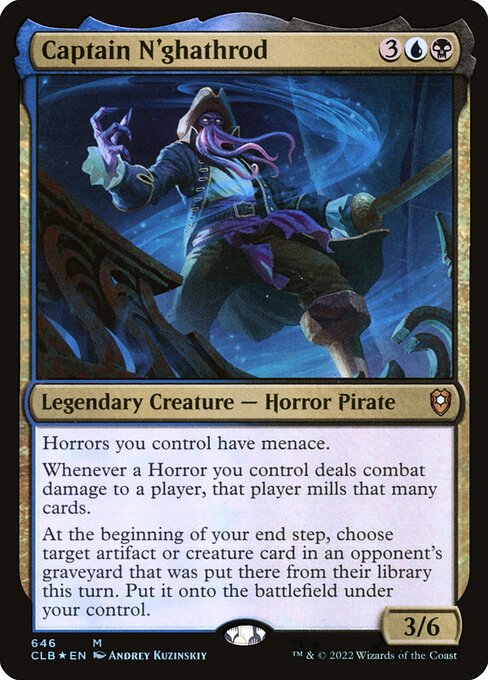
Captain N'ghathrod is probably one of the most entertaining options if you enjoy combining Mill with creature combat.
He gives your Horrors menace.
And whenever a Horror you control deals combat damage to a player, that player mills that many cards.
But his most interesting ability happens at the beginning of your end step.
You can take an artifact or creature card from an opponent's graveyard that went there from their library during that turn and put it onto the battlefield under your control.
That's fantastic.
You're not simply removing cards from opposing libraries.
You're turning their cards into your own resources.
Imagine attacking with a few Horrors, milling an opponent, and finding a powerful creature among the milled cards.
At your end step, that creature might become yours.
I like this approach because Mill isn't your only way to win.
You can build a battlefield using the cards you steal and eventually win through combat.
And because Captain N'ghathrod is in Dimir colors, you have excellent removal, counterspells, and graveyard synergies.
The drawback is that you need enough Horrors and ways to make them connect.
If your creatures can't deal combat damage, you're missing an important part of the strategy.
The Mindskinner: Damage Becomes Mill
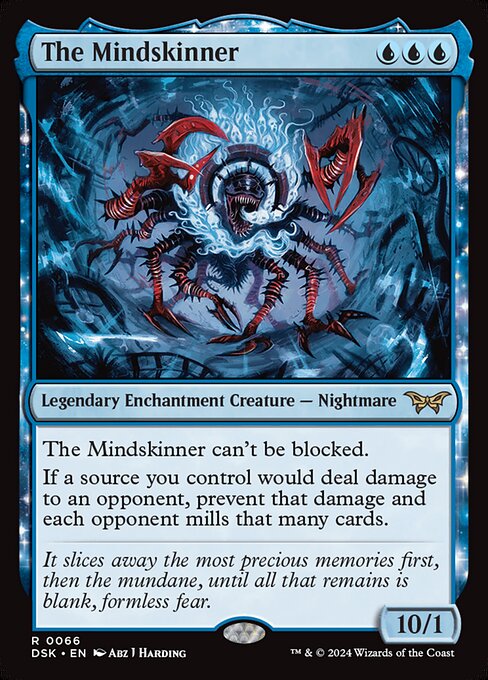
The Mindskinner takes the archetype in a completely different direction.
It's a mono-blue 10/1 creature that can't be blocked.
That's already interesting.
But its ability is what makes it unusual.
If a source you control would deal damage to an opponent, that damage is prevented, and each opponent mills that many cards instead.
Imagine attacking with The Mindskinner.
It would normally deal ten combat damage to one opponent.
Instead, that damage is prevented and each opponent mills ten cards.
That's thirty cards across a four-player table.
From one attack.
And the ability applies to other sources you control too, not just The Mindskinner.
I like this commander because it combines a combat-oriented strategy with mass mill.
But there's an important detail.
Because the damage is prevented and replaced with milling, The Mindskinner isn't dealing commander damage to the player.
So you can't use the 21 commander-damage rule to win through that replaced damage.
Abilities that require combat damage, such as Captain N'ghathrod's or Anowon's, also do not trigger from the prevented damage. If damage cannot be prevented, it is still dealt and the additional mill effect still happens.
And with only one toughness, keeping your commander alive can be challenging.
I'd include protection and ways to make the mill effects large enough to finish games.
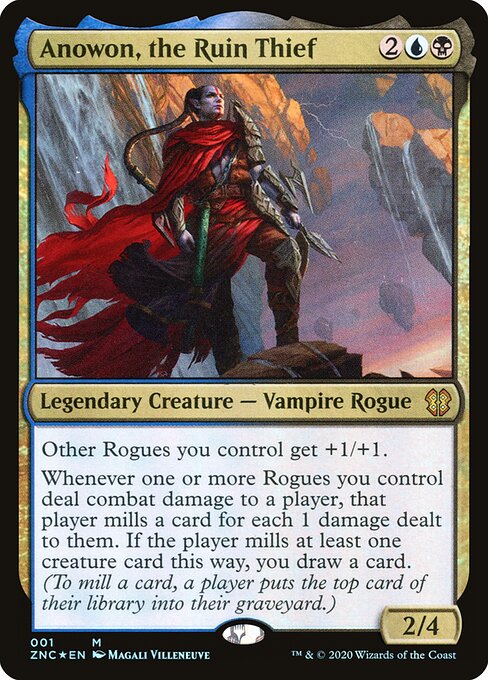
Anowon, the Ruin Thief: Rogues and Mill Together
Anowon, the Ruin Thief is another interesting Dimir option.
He gives your other Rogues +1/+1.
And whenever one or more Rogues you control deal combat damage to a player, that player mills cards equal to the damage dealt by those Rogues.
If at least one creature card is milled this way, you draw a card.
That's a nice combination of Aggro, Typal, and Mill.
You play small evasive Rogues, attack opponents, mill cards, and generate card advantage.
I like Anowon because you're not completely dependent on emptying libraries.
Your creatures are also dealing ordinary combat damage.
That gives you another way to finish opponents.
And a deck that can win through both combat and Mill is often more flexible than one that only does one thing.
Just remember that Anowon's ability doesn't draw a card for every creature milled.
You draw only one card per relevant trigger if the condition is met.
Milling One Player or the Whole Table?
This is one of the most important decisions when building Mill in Commander.
Some cards mill one player.
Others mill every opponent.
And those two approaches have different advantages.
Imagine you're facing three opponents, each with approximately eighty cards remaining in their library.
If you mill ten cards from one opponent, you've made some progress.
But the other two libraries are completely untouched.
If you mill ten cards from each opponent, you've removed thirty cards in total.
That's a much better result if your intention is to eliminate everyone through Mill.
This is why I particularly like repeatable effects that affect the entire table.
Ruin Crab, Psychic Corrosion, and Altar of the Brood are good examples.
But targeted Mill isn't necessarily bad.
Sometimes concentrating on one opponent is the right decision.
Perhaps one player has a particularly dangerous deck.
Maybe they're already close to running out of cards.
Or perhaps you're playing Captain N'ghathrod and specifically want to fill one opponent's graveyard with useful creatures and artifacts.
The important thing is knowing what your Mill effects are accomplishing.
I wouldn't fill the deck with small, one-time mill spells and assume that they'll eventually add up to a win.
In multiplayer Commander, they often won't.
Repeatable Mill Engines: Make Every Turn Count
For me, repeatable Mill effects are usually much more interesting than spells that mill a small number of cards once.
You want cards that continue putting pressure on libraries while you develop the rest of your strategy.
Landfall and Mill
Ruin Crab and Hedron Crab are classic examples.
Both reward lands entering the battlefield under your control.
Ruin Crab makes each opponent mill three cards.
Hedron Crab makes a target player mill three cards.
And because the ability triggers when a land enters, you can use fetchlands to generate additional triggers.
Imagine you control Ruin Crab.
You play Evolving Wilds.
Each opponent mills three cards.
Then you sacrifice Evolving Wilds, search for a basic land, and put it onto the battlefield tapped.
Each opponent mills another three cards.
That's six cards per opponent from one land card.
And if Bruvac is also on the battlefield, those mill amounts are doubled.
I like this approach because you can combine Mill with a normal part of your development.
You're already playing lands.
You might as well get some extra value from them.
Mill Through Card Draw
Psychic Corrosion and Sphinx's Tutelage are interesting options if your deck already draws lots of cards.
Psychic Corrosion makes each opponent mill two cards whenever you draw a card.
Sphinx's Tutelage targets one opponent and can mill additional cards depending on what gets milled.
I like combining these effects with reliable card draw.
You're finding more resources while simultaneously advancing your win condition.
But I'd be careful about building the entire deck around a few enchantments.
If an opponent removes them, your card draw should still be useful.
That's one of the reasons I like engines that support a strategy you already want to play.
Artifacts That Mill
Mesmeric Orb is another famous Mill card.
Whenever a permanent becomes untapped, its controller mills a card.
That can generate a surprising amount of Mill during a multiplayer game.
But there's a catch.
It affects you too.
If you're untapping several lands and other permanents every turn, you'll also be milling your own library.
That can be useful in a graveyard-based deck, but potentially dangerous if your main strategy is focused entirely on milling opponents.
Altar of the Brood is another interesting option.
Whenever another permanent enters the battlefield under your control, each opponent mills one card.
That works particularly well with token generation, Blink, or other strategies that repeatedly put permanents onto the battlefield.
A single token isn't particularly impressive.
But creating ten tokens can mean ten cards milled from each opponent.
And sometimes those small artifacts become part of much larger engines.
Big Mill Spells: When You Need to Remove Half a Library
Repeatable engines are useful, but sometimes you want one spell that creates a huge impact.
Maddening Cacophony, Fractured Sanity, and Traumatize are examples of cards capable of milling significant numbers of cards.
They approach the problem differently.
Fractured Sanity mills fourteen cards from each opponent when cast normally.
Traumatize targets one player and mills half their library, rounded down.
Maddening Cacophony normally mills eight cards from each opponent, but its kicked version mills half of each opponent's library, rounded up.
These spells can provide a big push toward your win condition.
But I'd be careful with cards that mill a fixed number.
Milling fourteen cards from each opponent can be impressive.
Yet if everyone still has sixty cards left afterward, you're not necessarily close to winning.
I prefer combining big mill spells with repeatable engines rather than relying entirely on one-time effects.
And I'd pay attention to when I cast them.
If you know your opponents have graveyard recursion available, milling forty cards from their libraries might give them exactly the resources they need.
Which brings us to one of the biggest problems with Mill.
You're Filling Your Opponents' Graveyards
This is probably the most dangerous part of playing Mill in Commander.
You're trying to remove cards from your opponents' libraries.
But those cards aren't disappearing.
They're going into graveyards.
And for some decks, the graveyard is practically a second hand.
Imagine playing against Reanimator.
Your opponent has spent several turns trying to put a powerful creature into their graveyard.
Then you kindly mill twenty cards from their library.
You find three enormous creatures for them.
They thank you.
And next turn, they bring one of those creatures back for two mana.
Not exactly the result you wanted.
The same problem can happen against Aristocrats, graveyard recursion, Flashback, Escape, Delve, and other graveyard-based mechanics.
That's why I think a good Mill deck needs to understand the strategies it's facing.
Sometimes milling an opponent is helping them more than hurting them.
You need to prepare for that.
Graveyard Hate Is Part of Your Interaction
Cards like Soul-Guide Lantern, Nihil Spellbomb, Bojuka Bog, and Tormod's Crypt can help you manage opposing graveyards.
And depending on your colors and strategy, you have other options.
But I'd be careful with effects that interfere with your own synergies.
For example, if you're using Captain N'ghathrod to steal creatures from opposing graveyards, completely preventing cards from reaching those graveyards can work against your plan.
The same applies to cards that reward creatures being milled or count cards in graveyards.
I prefer choosing graveyard interaction that supports the specific Mill strategy I'm playing.
Sometimes you want to exile an opponent's graveyard after you've already taken advantage of the cards there.
Other times you need to remove a particular card before they can reanimate it.
And sometimes the best decision is to leave one opponent alone temporarily.
Mill is much more interesting when you think about what you're giving your opponents as well as what you're taking away.
How Does a Mill Deck Actually Win?
This might seem like a strange question.
Isn't the objective simply to mill everyone's library?
Well, yes.
But there's a difference between emptying libraries and actually eliminating players.
And you should also have a plan for situations where Mill isn't working.
Empty Their Libraries and Force Them to Draw
This is the most direct win condition.
You mill an opponent's entire library.
Then they attempt to draw a card.
They lose the game.
Normally, that happens during their next draw step.
But you can also force them to draw earlier with an appropriate spell or ability.
That's useful because giving an opponent another turn after emptying their library can be dangerous.
They might have a way to win, recover cards, or avoid losing.
I like having at least some way to finish an opponent without relying entirely on waiting for their next turn.
And remember that milling more cards than a player has doesn't make them lose immediately.
If they have five cards left and an effect makes them mill ten, they simply mill the five available cards.
The empty-library loss still depends on attempting to draw.
Win Through Repeated Damage
Some Mill decks use effects that convert milling or cards entering graveyards into damage or life loss.
Bloodchief Ascension is an excellent example of a card that can become dangerous when opponents are putting lots of cards into their graveyards.
With at least three quest counters, each card entering an opponent's graveyard can make that player lose 2 life while you gain 2 life. The counter condition is checked both when the ability triggers and when it resolves.
Mindcrank can create interesting interactions because it makes opponents mill cards whenever they lose life.
Together, an active Bloodchief Ascension and Mindcrank can create a repeatable life-loss and mill loop once an opponent loses life or cards go into their graveyard in the appropriate way.
This is not literally infinite: without more cards entering the graveyard, there are no new Ascension triggers. An opponent with enough life might run out of library cards before life; in that case, you still need the final draw or another way to finish.
I like this as a secondary win condition because it connects naturally with what Mill is already doing.
But it can also be a very powerful combo.
So I'd consider the level of Commander I want to play before adding it.
Win Through Combat
Not every Mill deck has to win exclusively by emptying libraries.
Captain N'ghathrod can steal powerful creatures from opponents' graveyards.
Anowon can build an aggressive Rogue army.
Phenax decks can include creatures that become enormous as graveyards fill.
And Consuming Aberration can become a serious combat threat when your opponents have lots of cards in their graveyards.
I like having this alternative.
If one opponent has a way to shuffle their graveyard into their library repeatedly, or your main Mill engines get removed, you can still try to win through damage.
That makes the deck more resilient.
And sometimes your opponents are so focused on protecting their libraries that they forget you have an actual army on the battlefield.
Library-Shuffling Effects: Sometimes the Graveyard Comes Back
There's another problem Mill players eventually encounter.
Some cards can shuffle cards from graveyards back into libraries.
Certain Eldrazi Titans are famous for having abilities that shuffle their owner's graveyard into their library when they're put into a graveyard.
That can undo a huge amount of your progress.
Imagine you've spent several turns milling forty cards from an opponent.
Then one of those cards triggers an ability that shuffles their graveyard back into their library.
Suddenly, they have a large library again.
Not ideal.
You need to understand the specific card involved.
Some effects shuffle automatically through triggered abilities.
Others replace what would happen or need to be activated.
And those differences determine whether you can respond.
For example, if a graveyard-shuffling ability goes onto the stack, you may have an opportunity to exile the relevant graveyard before that ability resolves.
But you need an appropriate instant-speed effect available.
I wouldn't build a Mill deck assuming every opponent will simply let their library disappear.
You need a plan for recycling effects, graveyard strategies, and cards that interfere with milling.
Card Draw, Ramp, and Interaction Still Matter
It's very easy to focus so heavily on milling that you forget the rest of your deck.
You find an enchantment that mills cards.
An artifact that mills more.
A creature that doubles milling.
Another spell that mills half a library.
And suddenly you've filled almost every slot.
But you still need to play Commander.
You need lands.
You need ramp.
You need card advantage.
And you absolutely need interaction.
Blue gives you excellent counterspells and card draw.
Black provides creature removal, tutors, and graveyard interaction.
If you're playing a commander with additional colors, you gain more options.
I'd include enough mana development to cast my engines consistently.
And enough card draw to keep finding useful spells after the first few turns.
Because if your opponent removes your two most important Mill permanents and you're left with an empty hand, you'll have a difficult time rebuilding.
I'd also pay attention to the actual mana curve.
Some powerful Mill cards are expensive.
And if your deck doesn't do much until turn six, opponents may have plenty of time to execute their own strategies.
How Many Mill Cards Should You Play?
I wouldn't follow a fixed number for every Mill deck.
A Phenax deck can use creatures with high toughness as repeatable Mill engines.
A Bruvac deck relies more heavily on spells and permanents that directly mill opponents.
Captain N'ghathrod combines Mill with Horror combat and stealing cards.
And The Mindskinner can turn ordinary damage sources into mass mill.
Those decks need different structures.
But I'd want enough reliable Mill effects that the deck can actually threaten libraries without needing one specific card every game.
As an initial reference, perhaps 10–15 dedicated Mill engines or major Mill effects could be a reasonable place to start, with additional cards that support the strategy through landfall, combat, draw triggers, or other synergies.
A dedicated Mill deck might need significantly more.
The important thing is how much milling those cards realistically produce.
A repeatable effect that mills several cards from every opponent each turn can be more useful than a one-time spell that mills ten cards from one person.
And some commanders provide much of the engine themselves.
I'd rather evaluate how the deck functions over several turns than simply count cards with the word "mill" in their text.
Also, don't forget that your deck still needs enough removal, ramp, card advantage, and protection.
A hundred-card deck has limited space.
Every slot matters.
A Few Mill Rules Worth Knowing
There are some details that come up regularly.
An empty library doesn't immediately make a player lose. They lose when they attempt to draw a card and can't.
Mill isn't the same as drawing or discarding. A player who mills cards isn't drawing them or discarding them from their hand.
Cards milled normally go to the graveyard. But replacement effects can change where those cards go.
Exiling cards from the top of a library isn't necessarily milling. Cards such as Tasha's Hideous Laughter exile cards, so effects that specifically double milling, like Bruvac, don't automatically apply.
Milling cards doesn't cast them. A card with an ability that triggers when it's cast won't trigger simply because it was milled.
Cards can trigger abilities when they're milled. But the exact wording matters. Some care about cards entering graveyards, while others specifically care about the mill event.
An effect can instruct a player to mill more cards than remain in their library. The player mills as many as are available. They cannot choose or pay a cost to mill a number of cards they do not have.
And one more thing: don't assume milling a powerful card has permanently removed it from the game.
In Commander, graveyards are often very active.
Sometimes putting an opponent's best creature into their graveyard is exactly what they wanted.
Common Mistakes When Building Mill
There are several things I'd watch out for.
Too many small, one-time Mill spells. Milling eight cards once isn't particularly threatening when you're facing three large libraries.
No repeatable engines. You need ways to continue applying pressure without spending a new card every turn.
Ignoring graveyard strategies. Some opponents will be delighted when you mill their cards.
No way to force the final draw. Emptying a library doesn't automatically eliminate its owner.
Not enough protection. Your opponents will remove powerful Mill engines once they understand what's happening.
Trying to mill everyone without enough resources. Three libraries are a lot to empty.
No alternative way to win. Some games will require combat, damage triggers, or another approach.
Assuming every card that puts cards into graveyards counts as Mill. Read the exact wording and current card text.
And one more thing.
Don't assume that milling half an opponent's library means you're halfway to winning.
If that opponent is playing Reanimator, you might have just made their deck twice as dangerous.
Test Your Mill Deck Before Buying Everything
Mill is one of those archetypes that can look fantastic on paper.
You find powerful cards that mill large numbers, add a few multipliers, include some counterspells, and imagine emptying all three opposing libraries.
But actual games can be very different.
Perhaps your deck mills quite a few cards during the first turns but can't finish the job.
Maybe one opponent keeps recovering cards from their graveyard.
Or perhaps your Mill engines are too slow, and another player assembles a combo before you're close to winning.
That's why I'd test the deck before buying everything.
In MTG Master Deck Builder, you can build your Mill Commander deck, explore possible card synergies, and use the Deck Analyzer to review speed, consistency, mana curve, interaction, resilience, and other aspects of the deck.
I'd pay particular attention to whether you have enough repeatable Mill effects, whether your mana curve lets you establish those engines early, and whether you can survive while working toward your win condition.
The opening-hand simulator can help identify hands where you have several expensive Mill cards but not enough mana or interaction.
And if your deck includes repeatable milling loops, recursion, or combinations such as Bruvac with large Mill effects, the combo detection tools are worth checking.
Of course, an analyzer can't perfectly predict how opponents will use their graveyards.
That's something you'll discover during actual games.
But it can help you avoid building a deck that looks dangerous because it mills lots of cards, yet struggles to eliminate anyone.
Is Mill the Right Archetype for You?
I think Mill is a fantastic choice if you enjoy unusual win conditions, controlling resources, and attacking opponents from a direction they're not always prepared for.
It's particularly satisfying when your small, repeatable engines gradually become a real threat.
A Crab here.
An enchantment there.
A few extra card draws.
And suddenly someone's library has practically disappeared.
But Mill isn't for everyone.
If you prefer straightforward combat and large creatures, winning by emptying libraries might not be particularly appealing.
And if you don't enjoy dealing with graveyard recursion, you'll probably find some opponents frustrating.
Personally, I like Mill most when it does more than simply put cards into graveyards.
Maybe you're stealing the creatures you mill.
Perhaps you're creating an army while emptying libraries.
Or you're playing Control and gradually forcing your opponents toward a different kind of defeat.
I think those approaches make the deck more interesting and give it something meaningful to do throughout the game.
Because removing forty cards from an opponent's library is impressive.
But if they simply reanimate the best creature you milled, look at you, and say "Thanks"...
Well, perhaps the next card you should draw is some graveyard hate.
Build Mill with engines and a way to finish
Balance mill engines, mana, card advantage, graveyard interaction and protection in Deck Builder.