
How to Build a Reanimator Commander Deck: Graveyards, Big Creatures, and Bringing Things Back
By MTG Master EditorialPublished Updated 21 min read
There's something particularly satisfying about putting an eight-mana creature onto the battlefield when you've only spent one or two mana to get it there.
Your opponents are still playing lands, setting up their mana rocks, and trying to develop their boards.
Meanwhile, you've just brought back something enormous from your graveyard.
And everybody is looking at you.
Welcome to Reanimator.
The idea behind this strategy is pretty straightforward: instead of paying the normal mana cost of your most powerful creatures, you put them into your graveyard and find a cheaper way to bring them onto the battlefield.
But there's a lot more to Reanimator than simply cheating big creatures into play.
Some decks want to bring back a huge threat as early as possible. Others repeatedly recycle creatures for their abilities, gradually overwhelming the table with value. And some combine reanimation with sacrifice effects, turning the graveyard into something that resembles a second hand.
Personally, I find the last two approaches particularly interesting. Bringing back a giant creature is fun, but repeatedly using creatures that do something useful when they enter or die opens up many more possibilities.
Let's look at what makes a good Reanimator deck, which cards I'd consider, and how to avoid building something that completely stops working the moment somebody plays graveyard hate.
What Exactly Is Reanimator?
Reanimator is a strategy built around returning creatures from the graveyard directly to the battlefield.
The important part is that you're usually not casting those creatures.
You're using another spell or ability to put them onto the battlefield, often for considerably less mana than they would normally cost.
Imagine this situation.
You have Archon of Cruelty in your graveyard.
Normally, casting it costs eight mana.
But if you have Reanimate in your hand, you can pay one black mana to return it directly to the battlefield.
You lose eight life because of Reanimate's effect, but you get a 6/6 flying creature with a very powerful enter-the-battlefield ability.
A targeted opponent sacrifices a creature or planeswalker, discards a card, and loses 3 life. You draw a card and gain 3 life.
That's a pretty good exchange for one mana.
Of course, you still need to get Archon of Cruelty into your graveyard first.
And that's one of the most important parts of building Reanimator.
You don't just need powerful creatures and spells that bring them back.
You also need reliable ways to put the right cards into your graveyard.
Your Graveyard Is Part of Your Strategy
In most Commander decks, having a powerful card in your graveyard is something you're trying to avoid.
In Reanimator, it might be exactly where you want it.
That changes how you think about discarding and milling cards.
Discarding an eight-mana creature doesn't necessarily mean losing it.
You might actually be setting up your next play.
And milling your own library isn't automatically a disadvantage if you've built your deck to use the cards that end up in your graveyard.
There are several ways to get creatures there.
Discarding the Creatures You Want to Reanimate
This is probably the most direct approach.
Cards like Faithless Looting, Frantic Search, and Careful Study let you draw cards and discard others.
That means you can improve your hand while deliberately putting useful creatures into your graveyard.
For example, imagine your opening hand contains an expensive creature that you won't realistically cast for another five turns.
In a normal deck, that might be an awkward card to draw early.
In Reanimator, it can be exactly what you want.
Discard it, find a reanimation spell, and suddenly that creature becomes available much earlier.
I particularly like discard effects that also provide card selection because they help you find both parts of your strategy.
And if your commander rewards discarding cards, even better.
Milling Your Own Library
Self-mill is another excellent way to fill the graveyard.
Cards like Stitcher's Supplier, Satyr Wayfinder, and Grisly Salvage can put several cards into your graveyard while contributing to your overall strategy.
The advantage is that you don't need to draw your expensive creatures first.
You can simply put cards from your library into your graveyard and work with whatever ends up there.
The downside is that self-mill is less precise.
You might find exactly the creature you wanted.
Or you might mill three lands and a removal spell.
That's Magic.
But in a deck with enough useful graveyard interactions, you don't necessarily need to mill one specific card.
You just need enough good options.
Putting Specific Cards Into the Graveyard
Sometimes you know exactly what you want.
That's where cards like Entomb and Buried Alive become particularly powerful.
Entomb can search your library for any card and put it into your graveyard.
Buried Alive searches for up to three creature cards and puts them there.
These are excellent tools for Reanimator because they let you prepare your next play rather than hoping to draw or mill the right card.
But they're also the kind of cards that can push a deck toward a much more optimized strategy.
Personally, I wouldn't automatically add every available tutor to a casual Reanimator deck.
Sometimes discovering which creatures you can bring back is more interesting than searching for the same powerful target every game.
It depends on what kind of Commander you want to play.
Bringing Your Creatures Back
Now that you've put something useful in your graveyard, you need to get it onto the battlefield.
Fortunately, black has some excellent reanimation spells.
Reanimate: Simple and Extremely Efficient
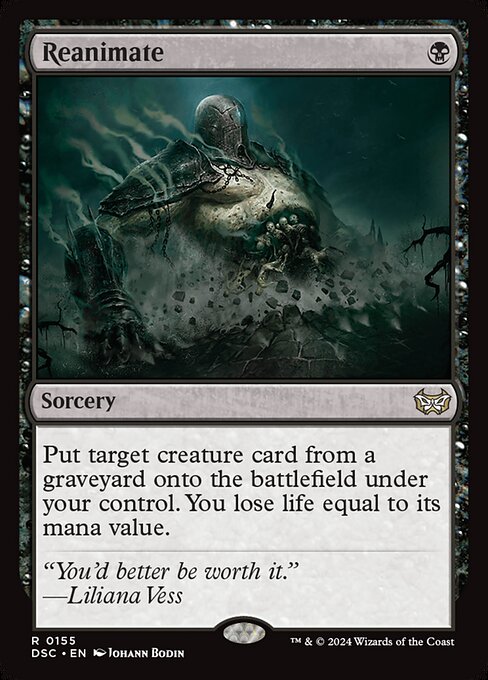
Reanimate is one of the classic cards of the archetype.
For one black mana, you return a creature card from a graveyard to the battlefield under your control.
You lose life equal to its mana value.
That last part matters, especially if you're repeatedly bringing back expensive creatures.
Losing eight or ten life isn't something you can ignore indefinitely, even in Commander.
But getting an enormous threat onto the battlefield for one mana can easily be worth it.
Also, notice that Reanimate can target a creature card in any graveyard.
You aren't limited to your own creatures.
Sometimes the best target belongs to an opponent.
Animate Dead and Necromancy
Animate Dead and Necromancy are other classic tools.
Both can bring creatures back from graveyards through enchantment-based effects, although they work differently and have their own rules.
What I like about these cards is their efficiency.
They're useful whether you're trying to bring back a huge creature early or recover an important engine later.
But remember that enchantment removal can also disrupt them.
If the effect keeping your creature on the battlefield disappears, you may lose the creature too.
That doesn't make them bad. It's simply something to consider when planning your turns.
Victimize: One Creature Becomes Two
Victimize is one of my favorite examples of how well Reanimator can work with sacrifice strategies.
You target two creature cards in your graveyard, then sacrifice a creature as the spell resolves. If you do, both targeted cards return to the battlefield tapped.
You must have two targets to cast it. The creature you sacrifice cannot be one of those targets because it is still on the battlefield when you choose them.
In a deck that already creates tokens or has creatures you don't mind sacrificing, that's a fantastic exchange.
You sacrifice something small and bring back two useful creatures.
And if those creatures have powerful enter-the-battlefield abilities, you can generate a huge amount of value immediately.
This is one reason Reanimator and Aristocrats work so well together.
One strategy gives you creatures to sacrifice.
The other gives you ways to bring them back.
Living Death: Sometimes You Want Everything Back
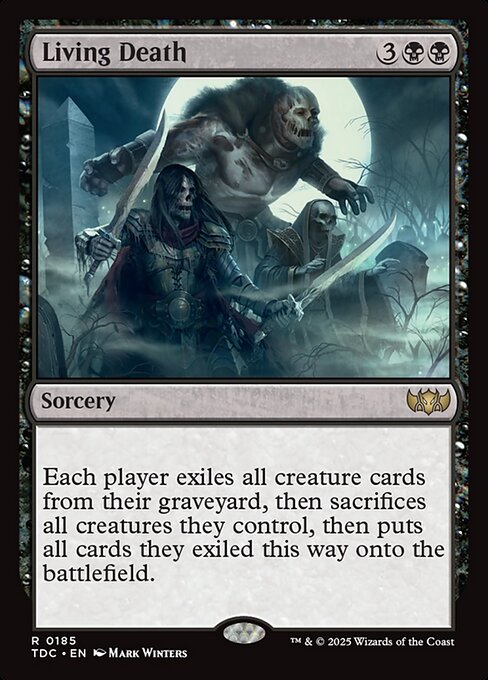
Living Death is a very different kind of reanimation spell.
Rather than returning one creature, it can completely transform the battlefield by exchanging creatures in play with creature cards in graveyards.
First all players exile the creature cards already in their graveyards, then sacrifice their creatures, then return only the exiled cards. Creatures sacrificed during Living Death do not come back from that same resolution.
If you've spent several turns filling your graveyard, resolving Living Death can put an enormous number of creatures onto the battlefield.
But be careful.
Your opponents can get their creatures back too.
And depending on the current board state, Living Death might not work out the way you expected.
I really like cards like this because they create interesting decisions.
Sometimes Living Death is your best recovery tool after a board wipe.
Other times, it's the card that ends the game.
And occasionally, it's a terrible idea because the player across the table has an even better graveyard than yours.
It's worth checking before you cast it.
Choosing the Right Reanimator Commander
Reanimator can work in several color combinations.
Black is usually the foundation, but the other colors can change how the deck plays quite dramatically.
Some commanders reward repeated recursion. Others help fill the graveyard or make it easier to reuse creatures.
Here are a few I'd look at.
Meren of Clan Nel Toth: Keep Bringing Them Back
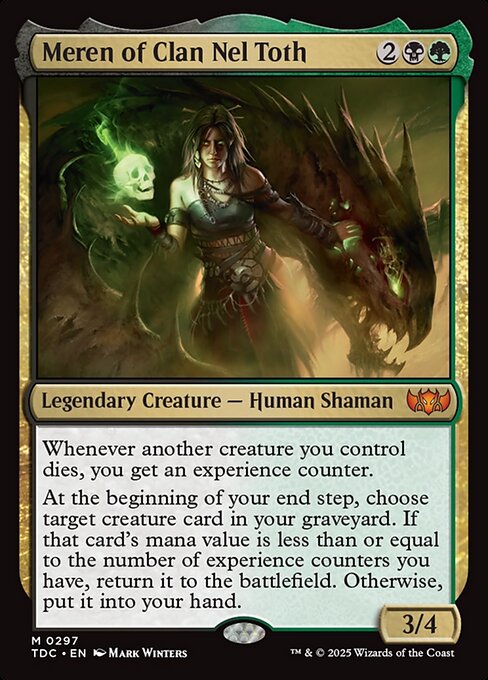
Meren of Clan Nel Toth is one of the commanders that immediately comes to mind when I think about graveyard recursion.
Whenever another creature you control dies, you get an experience counter.
Then, at the beginning of your end step, Meren can return a creature card from your graveyard to your hand or directly to the battlefield, depending on its mana value and your experience counters.
What I like about Meren is that she doesn't need to bring back enormous creatures to be useful.
Sometimes returning a small creature with a good ability is exactly what you need.
And with enough sacrifice outlets, Meren can generate value turn after turn.
She's particularly interesting if you enjoy combining Reanimator with Aristocrats.
The main weakness is that opponents can see what you're trying to do.
If your graveyard is full of useful creatures and Meren is on the battlefield, don't be surprised when somebody starts looking for graveyard hate.
Chainer, Nightmare Adept: Discard It, Then Play It
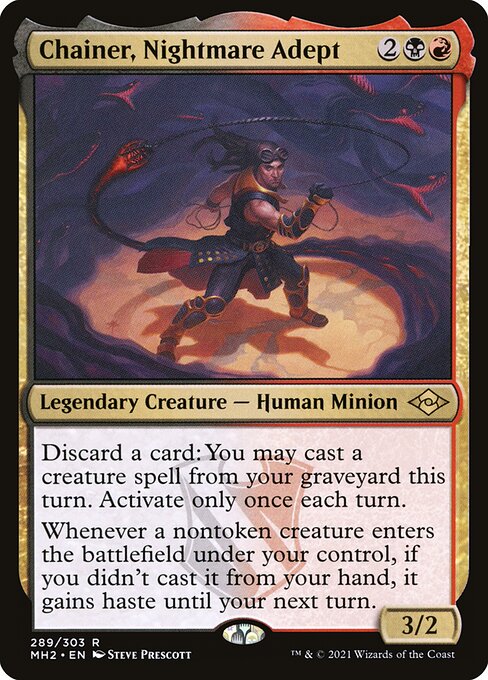
Chainer, Nightmare Adept gives you a different approach in Rakdos colors.
Activating his ability costs discarding a card and gives you permission to cast one creature spell from your graveyard that turn. You can activate that ability only once each turn; it does not change when you can cast the creature.
This is an important distinction: Chainer lets you cast a creature from the graveyard rather than putting it directly onto the battlefield.
You still need to pay the creature's casting cost.
That means Chainer isn't necessarily about cheating enormous creatures into play for one mana.
He's more about turning your graveyard into an additional resource.
And when you cast a creature from your graveyard using Chainer, his haste-granting ability can make it useful immediately.
I like this approach if you enjoy aggressive recursion and want your creatures to keep coming back.
Red also provides plenty of ways to discard cards and generate mana, making Rakdos an interesting home for the strategy.
Karador, Ghost Chieftain: Creature Recursion in Abzan
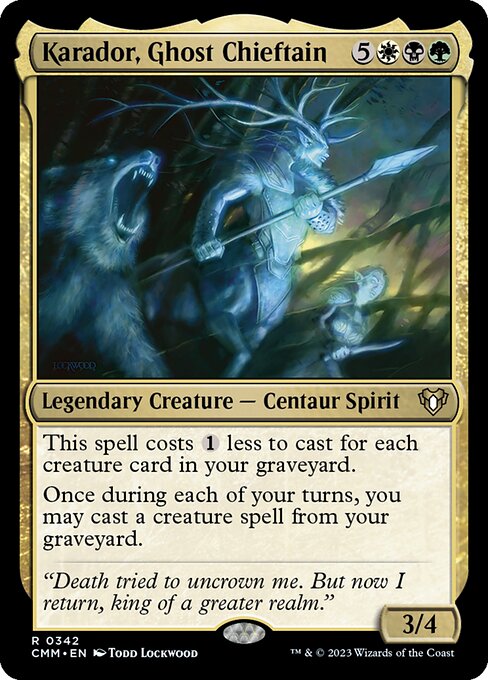
Karador, Ghost Chieftain is another commander that lets you cast creatures from your graveyard.
He becomes cheaper to cast based on the number of creature cards in your graveyard, and he allows you to cast one creature spell from your graveyard during each of your turns. You still pay its costs and follow normal timing rules.
Again, casting is different from reanimating directly onto the battlefield.
But the ability to reuse creatures repeatedly can be extremely powerful.
Abzan colors also give you access to excellent removal, ramp, sacrifice effects, and creatures with useful abilities.
Karador is a good choice if you prefer a slower, more resilient graveyard strategy rather than concentrating entirely on one explosive reanimation turn.
Sefris of the Hidden Ways: Reanimator With Dungeons
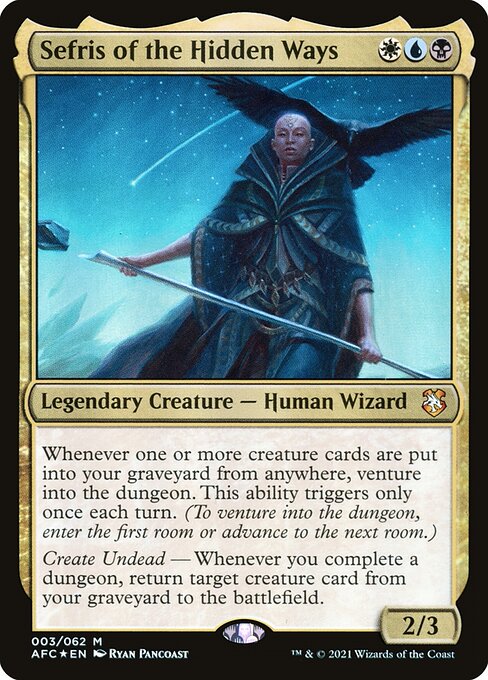
Sefris of the Hidden Ways is an interesting option if you want something a little different.
Whenever one or more creature cards enter your graveyard, Sefris can help you progress through a dungeon, although that ability only triggers once each turn.
When you complete a dungeon, you can return a creature card from your graveyard to the battlefield.
That means you're rewarded for putting creatures into your graveyard repeatedly.
And because the trigger can happen during opponents' turns, instant-speed discard or sacrifice effects become particularly interesting.
I like the idea of combining Reanimator with a secondary mechanic that gives the deck its own personality.
Sefris is also in Esper colors, giving you a wide range of interaction and card advantage.
The Scarab God: Your Graveyard, My Graveyard, Everybody's Graveyard
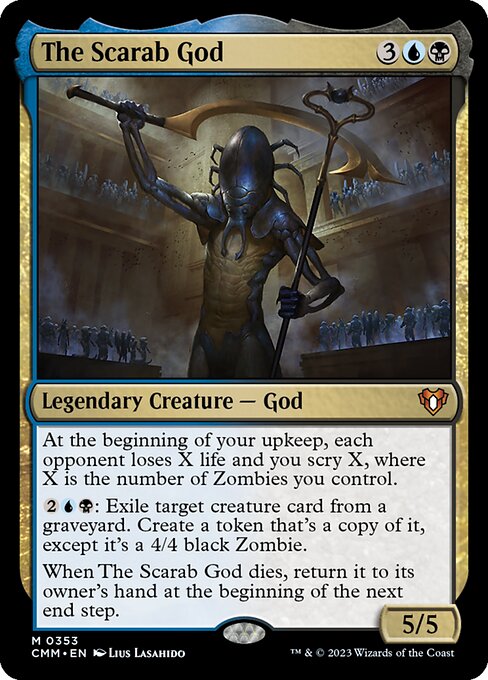
The Scarab God takes yet another approach.
Instead of returning creature cards directly, it can exile a creature card from a graveyard and create a 4/4 black Zombie token that's a copy of that creature, with some changes.
And that creature card can come from an opponent's graveyard.
This opens up some very entertaining possibilities.
Maybe you want to copy one of your own creatures with a powerful enter-the-battlefield ability.
Or perhaps an opponent has been kind enough to put something excellent into their graveyard.
It would be a shame not to use it.
The Scarab God is particularly interesting because it doesn't depend entirely on reanimation spells in your hand.
Your commander already provides a repeatable way to turn graveyards into threats.
What Creatures Should You Reanimate?
This is where I think people sometimes get carried away.
It's tempting to search for the most expensive creatures in Magic and start adding them to your deck.
Huge Eldrazi, enormous Demons, terrifying Dragons...
And yes, bringing back a giant creature early can be very powerful.
But I'd look beyond power and toughness.
A creature that's simply a 12/12 with no useful abilities might be less valuable than a smaller creature that immediately changes the game.
Creatures With Powerful Enter-the-Battlefield Abilities
These are some of my favorite targets.
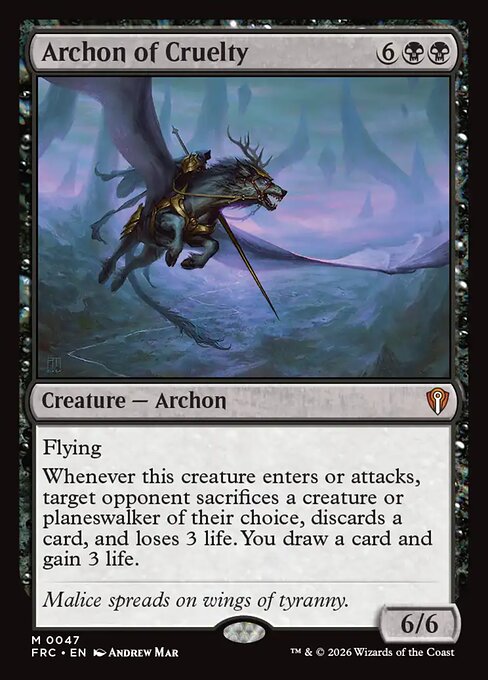
Archon of Cruelty can immediately force an opponent to sacrifice, discard, and lose life while giving you cards and life.
Ashen Rider can exile an important permanent when it enters or dies.
Sun Titan can return smaller permanents from your graveyard when it enters or attacks.
And Sepulchral Primordial can bring creatures back from your opponents' graveyards.
The important part is that these creatures do something useful as soon as they enter the battlefield.
Even if someone removes them afterward, you've already received some value.
That's particularly important in Commander, where your opponents usually have plenty of removal.
Creatures That Are Difficult to Ignore
Sometimes you simply want a powerful threat.
Something that attacks well, generates pressure, or forces the table to find an answer.
Avenger of Zendikar is a good example because it immediately creates a board of Plant tokens and can grow them through landfall.
A large creature with a meaningful attack trigger can also be an excellent target, provided it can survive long enough to attack.
I'd generally prefer threats that do something more than just being large.
Because a huge creature that gets removed before it accomplishes anything isn't necessarily a great investment.
Even if you only spent two mana bringing it back.
Creatures You Can Reuse Repeatedly
This is where Reanimator starts to overlap with Aristocrats and Blink.
Instead of looking for one enormous creature, you can focus on smaller creatures with useful abilities that you want to repeat.
Maybe a creature destroys an artifact when it enters.
Maybe it draws cards, brings something else back, or generates tokens.
If you can sacrifice and reanimate that creature repeatedly, it becomes a reusable resource.
And sometimes those small engines will win you more games than a single enormous creature.
Don't Confuse Enter-the-Battlefield Effects With Cast Triggers
This is an important rules detail.
When you return a creature directly from the graveyard to the battlefield, you're not casting it.
That means abilities that trigger when the creature enters the battlefield will work normally.
But abilities that trigger when you cast the creature won't trigger just because you reanimated it.
That's particularly important with certain Eldrazi and other expensive creatures.
You might see a creature with a spectacular ability that triggers when you cast it and assume you'll get that effect by returning it from the graveyard.
You won't.
You still get the creature, but not the cast trigger.
This is one reason I pay particular attention to enter-the-battlefield abilities when choosing reanimation targets.
Read the card carefully before deciding it's the perfect creature for your deck.
How Many Reanimation Spells and Targets Do You Need?
I wouldn't follow a strict formula.
A deck with a commander that provides repeatable reanimation needs a different structure from one that depends entirely on spells in the 99.
And a deck built around huge creatures has different requirements from one focused on reusing small utility creatures.
But as a starting point, I might look at something like 7–11 reliable ways to reanimate creatures, plus a reasonable number of ways to fill the graveyard.
For the actual targets, I'd rather have a selection of creatures that perform different useful jobs than simply fill the deck with ten enormous monsters.
Some can help you draw cards.
Others remove threats, create creatures, or finish games.
And don't forget the rest of the deck.
You still need lands, ramp, card advantage, removal, and ways to protect your strategy.
That's something I see quite often with Reanimator.
Players find fifteen spectacular creatures, add a few reanimation spells, and suddenly discover they have no space left for the cards that actually make the deck function.
I'd rather have fewer reanimation targets and a more consistent deck.
Graveyard Hate: The Problem You Can't Ignore
Eventually, someone is going to exile your graveyard.
It might be Bojuka Bog.
It might be Soul-Guide Lantern.
Or somebody might play Rest in Peace, and suddenly your entire strategy looks much less impressive.
That's simply part of playing Reanimator.
Graveyard hate is common in Commander, and for good reason.
If nobody interacts with graveyards, some decks can generate enormous advantages with very little effort.
So I'd prepare for it rather than hope nobody brings any.
First, don't put every important creature into your graveyard unnecessarily.
If you already have a good target and a reanimation spell available, you might not need to mill another fifteen cards.
Second, include ways to remove problematic permanents.
Nature's Claim, Generous Gift, Feed the Swarm, and similar cards can help depending on your colors and the kind of permanent you need to answer.
And third, make sure you have some way to function without your graveyard.
Maybe you can cast some of your creatures normally.
Maybe you have token generation, card draw, or another secondary strategy.
Or perhaps your deck can recover quickly once the graveyard hate is removed.
One important detail: if an opponent exiles the creature card targeted by your reanimation spell before that spell resolves, you can lose the target and the spell may do nothing.
So timing matters.
Sometimes it's better to wait until opponents have fewer resources available rather than announcing your plans too early.
Reanimator and Sacrifice Work Very Well Together
This is one of my favorite combinations.
Reanimator wants creatures in the graveyard.
Aristocrats wants creatures to die.
Seems like a pretty good match.
You can sacrifice a creature to generate value, return it to the battlefield, and potentially repeat the process.
Cards like Viscera Seer, Ashnod's Altar, and Phyrexian Altar can provide useful sacrifice outlets.
Meanwhile, cards like Blood Artist, Zulaport Cutthroat, and Pitiless Plunderer can reward those sacrifices.
You don't necessarily need an infinite combo.
Simply reusing a creature with a powerful enter-the-battlefield ability several times can generate enormous value.
And this gives your deck something useful to do with creatures that have already accomplished their main purpose.
Instead of leaving them sitting on the battlefield, you can sacrifice them and prepare to bring them back again.
Of course, this also makes the deck more dependent on having several pieces working together.
That's why I like having some cards that are useful on their own.
How Does a Reanimator Deck Actually Win?
Getting a powerful creature onto the battlefield is not the same as winning.
It's easy to forget that when you've just reanimated an eight-mana monster for one mana.
But you're still playing against three opponents.
And a single creature, however powerful, may not be enough.
I think a good Reanimator deck should have several realistic ways to close a game.
You might win through combat by repeatedly bringing back large threats.
You might overwhelm the table with creatures after resolving Living Death.
You might reuse creatures with powerful enter-the-battlefield or death triggers until your opponents can't keep up.
Or you might combine reanimation with sacrifice engines that gradually drain everyone's life.
Some Reanimator decks also use infinite loops or more compact combos.
That's perfectly valid if it fits your group and the power level you're aiming for.
But I wouldn't include an infinite combo simply because the cards are available.
There's something satisfying about building a graveyard full of useful creatures, bringing them back at the right moments, and gradually taking over the game.
And sometimes the best move isn't bringing back your biggest creature.
It's bringing back the one that answers the problem currently stopping you from winning.
Common Mistakes When Building Reanimator
There are a few problems I'd watch out for.
Too many enormous creatures. They look fantastic in your decklist, but drawing several with no way to discard or cast them can make your opening hands terrible.
Not enough ways to fill the graveyard. Your reanimation spells need targets. Waiting for your creatures to die naturally isn't always enough.
Too few reanimation effects. Getting your best creatures into the graveyard doesn't accomplish much if you can't bring them back.
Ignoring graveyard hate. Somebody will eventually interact with your graveyard. Have a plan.
Choosing creatures only because they're expensive. A creature with a useful ability is often more valuable than a giant creature that does nothing immediately.
Forgetting about the mana curve. Reanimator may cheat expensive creatures into play, but you still need to cast your setup spells, ramp, removal, and interaction.
And one more thing: don't assume every game needs to begin with the perfect reanimation target.
Sometimes bringing back a smaller utility creature is exactly what you need to keep the deck moving.
Test Your Reanimator Deck Before Buying Everything
Reanimator is one of those strategies that can look amazing on paper.
You find a collection of enormous creatures, add your favorite reanimation spells, and imagine putting something terrifying onto the battlefield on turn three.
But actual games can be very different.
You might draw all your expensive creatures and none of the cards that let you discard them.
Or you might fill your graveyard perfectly but never find a spell to bring anything back.
That's why I like testing the deck before spending money on every card.
In MTG Master Deck Builder, you can build your Reanimator Commander deck, explore possible card synergies, and use the Deck Analyzer to review consistency, mana curve, interaction, resilience, and other aspects of the deck.
I'd pay particular attention to how reliably your deck can put useful creatures into the graveyard and then recover them.
The opening-hand simulator can also help you identify awkward starts.
For example, a hand with two eight-mana creatures, four lands, and no way to discard or reanimate anything probably isn't as exciting as it first appears.
And the combo detection tools are worth checking if you're combining recursion with sacrifice effects and repeatable mana generation.
Sometimes a combination of cards that simply looked useful turns out to create an infinite loop.
That can be a nice discovery, or something you decide to avoid, depending on the kind of deck you want.
No analyzer replaces real games, of course.
But it can help you discover structural problems before you invest money in a deck that doesn't quite work the way you imagined.
Is Reanimator the Right Archetype for You?
I think Reanimator is a great choice if you enjoy graveyard interactions, powerful creatures, and finding ways to get more value out of cards you've already used.
It's particularly satisfying if you like building engines that can recover after removal and keep generating threats throughout a long game.
And there's something undeniably entertaining about bringing back a creature that your opponent spent several resources trying to remove.
Again.
But Reanimator isn't for everyone.
If you prefer straightforward combat decks or dislike depending on the graveyard, the strategy might feel a little fragile.
And if your playgroup uses a lot of graveyard hate, you'll need to think carefully about how you build the deck.
Personally, I enjoy Reanimator most when the graveyard becomes a collection of useful options rather than a place where I store one enormous creature waiting to bring it back.
You look at your graveyard, consider the current board, and decide which creature would help you the most.
Sometimes that's a huge threat.
Sometimes it's a small creature with exactly the ability you need.
And sometimes it's the same creature your opponents have already killed three times.
At that point, I can understand why they're getting annoyed.
But really, they should have made sure it stayed dead.
Build a Reanimator deck that keeps coming back
Balance graveyard setup, reanimation, useful creatures and a backup plan in Deck Builder.