
How to Build a Superfriends Commander Deck: Planeswalkers, Loyalty, and Winning
By MTG Master EditorialPublished Updated 23 min read
There's something particularly satisfying about having several planeswalkers on the battlefield.
One is drawing cards. Another is creating creatures. A third is removing threats, and somewhere in the corner, you've got a planeswalker that's getting dangerously close to its ultimate ability.
Your opponents start looking at the board, trying to decide which one they should attack.
And you're already planning what happens if they all survive another turn.
Welcome to Superfriends.
It's one of the most interesting Commander strategies because you're not building around a single creature type or one particular mechanic. You're assembling a team of planeswalkers that support each other, generate resources, and gradually take control of the game.
At least, that's the plan.
Because there's another version of Superfriends where you spend five turns casting expensive planeswalkers, your opponents attack them immediately, and you discover that having eight powerful cards on the battlefield doesn't help much when you have no creatures to defend them.
That's the challenge with this archetype.
You need planeswalkers that work together, enough protection to keep them alive, and a reliable way to turn all those loyalty abilities into a victory.
And preferably without taking twenty minutes to resolve your turn.
What Exactly Is Superfriends in Commander?
Superfriends is a strategy built around playing multiple planeswalkers and taking advantage of their loyalty abilities.
Instead of relying primarily on creatures, you use planeswalkers to generate card advantage, remove threats, create tokens, produce mana, and eventually threaten powerful ultimate abilities.
A normal Commander deck might include one or two planeswalkers because they support its strategy.
A Superfriends deck makes them a central part of the game plan.
Imagine you control these three cards:
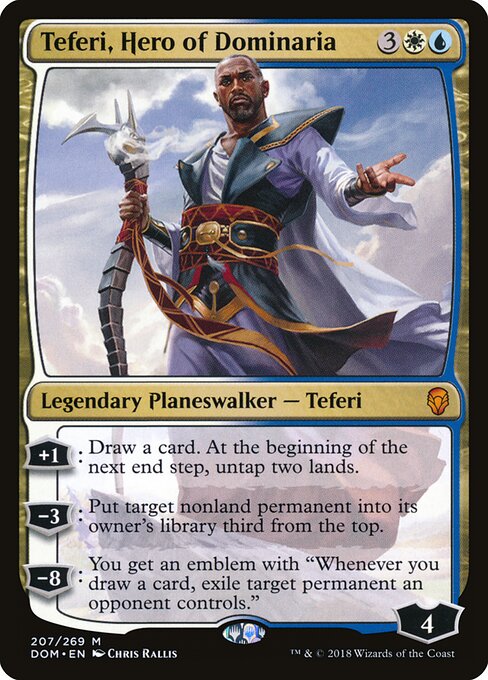
Teferi, Hero of Dominaria
Elspeth, Sun's Champion
Atraxa, Praetors' Voice
Teferi can draw you a card while helping you keep mana available.
Elspeth can create three 1/1 Soldier tokens to defend your battlefield.
And Atraxa proliferates at the beginning of your end step, adding another loyalty counter to each planeswalker you choose.
You're drawing cards, building defenses, and increasing loyalty counters.
And you haven't even needed to attack.
That's the idea behind Superfriends.
Each planeswalker contributes something useful, and the rest of the deck helps them survive long enough for those advantages to accumulate.
But there's something important to understand.
Playing lots of planeswalkers isn't automatically a strategy.
They need to complement each other.
A battlefield full of planeswalkers that all draw cards but can't defend themselves is going to have problems.
So will one with plenty of removal but no way to actually finish the game.
The interesting part is finding the right combination.
Can a Planeswalker Be Your Commander?
Before choosing your commander, there's one rule worth clarifying.
A commander is normally a legendary creature. Current rules also allow legendary Vehicles and Spacecraft with a power/toughness box.
A planeswalker can't automatically be your commander just because it's legendary.
Some planeswalkers specifically say that they can be your commander. Those are exceptions.
Commodore Guff is one example.
But you don't need a planeswalker as your commander to build Superfriends.
In fact, some of the most interesting Superfriends commanders are legendary creatures that support planeswalkers through proliferation, card advantage, or other abilities.
That's why commanders like Atraxa are so popular for this strategy.
You can keep a creature in the command zone and build the rest of your deck around planeswalkers.
And sometimes that's even more useful than having a planeswalker as your commander.
Choosing Your Superfriends Commander
I'd choose a commander that helps solve one of the archetype's biggest problems.
Maybe you need more loyalty counters.
Perhaps you want to find planeswalkers consistently.
Or maybe your commander can generate creatures to defend them.
Here are a few interesting options.
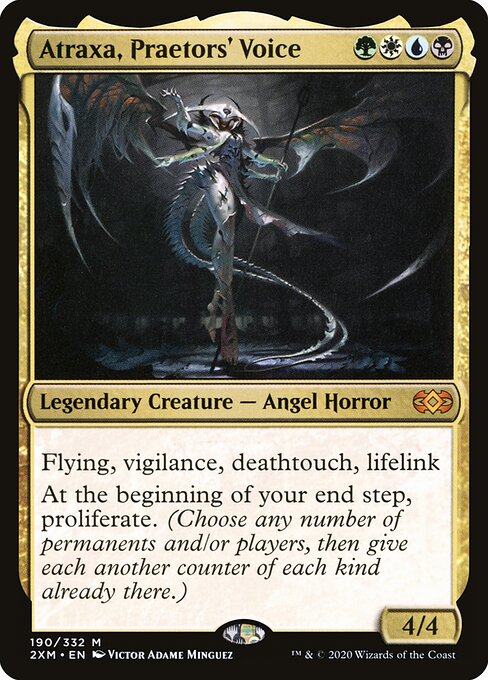
Atraxa, Praetors' Voice: More Loyalty Every Turn
Atraxa, Praetors' Voice is one of the most recognizable Superfriends commanders.
She's a 4/4 with flying, vigilance, deathtouch, and lifelink.
Already a pretty useful creature.
But her most important ability for this strategy is proliferate at the beginning of your end step.
Proliferate lets you choose any number of permanents or players that already have counters and add another counter of each kind they have.
That includes loyalty counters on planeswalkers.
Imagine you control three planeswalkers.
One has four loyalty counters, another has five, and the third has six.
Atraxa proliferates, and you can give each of them another loyalty counter.
Now they have five, six, and seven.
That's three additional loyalty counters from one triggered ability.
And if you can proliferate several times, your planeswalkers can reach their ultimate abilities much faster.
What I like about Atraxa is that she also helps defend your planeswalkers.
Flying, vigilance, and deathtouch make her a useful combat presence.
And lifelink can help you survive while building your engines.
The downside is her four-color identity.
You have access to white, blue, black, and green, which provides plenty of options, but the mana base needs some attention.
Also, proliferate doesn't put the first counter on something. Your planeswalkers need loyalty counters already, although they normally enter with them.
Commodore Guff: Superfriends Straight From the Command Zone
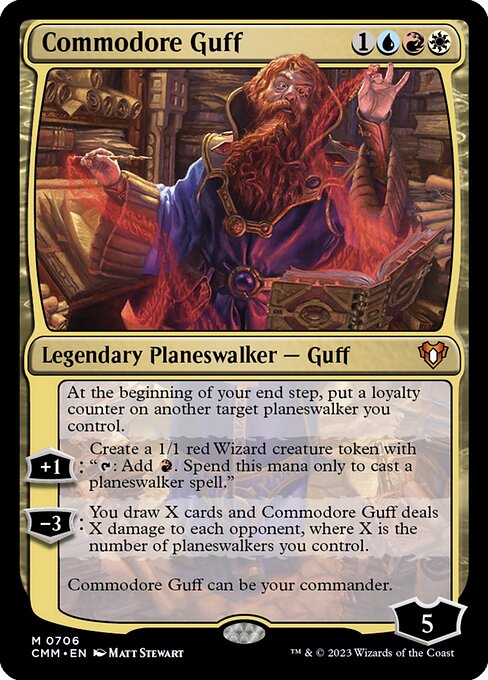
Commodore Guff is one of the most direct choices for Superfriends.
He specifically says he can be your commander.
His abilities are built around planeswalkers.
At the beginning of your end step, he puts a loyalty counter on another target planeswalker you control.
His +1 ability creates a 1/1 Wizard token that can tap for red mana, although that mana can only be spent casting planeswalker spells.
That Wizard needs haste or to have been under your control since the start of your turn to activate its tap-symbol ability. It normally cannot provide mana immediately after being created.
And his -3 ability lets you draw cards and deal damage to each opponent based on the number of planeswalkers you control.
That's a pretty complete package.
He helps cast planeswalkers, increases their loyalty, and can eventually turn your planeswalker count into a way to win.
What I like about Guff is that the deck has a very clear direction.
You want to develop mana, play planeswalkers, protect them, and gradually make the entire group more powerful.
He's in Jeskai colors, so you also have access to excellent removal, counterspells, and board wipes.
But he has a weakness.
He's a planeswalker himself.
Your opponents can attack him, and if they eliminate Guff repeatedly, the commander tax can become expensive.
You'll still need enough creatures and defensive tools to keep him alive.
Carth the Lion: Loyalty Abilities Become Better
Carth the Lion takes an interesting approach in Golgari colors.
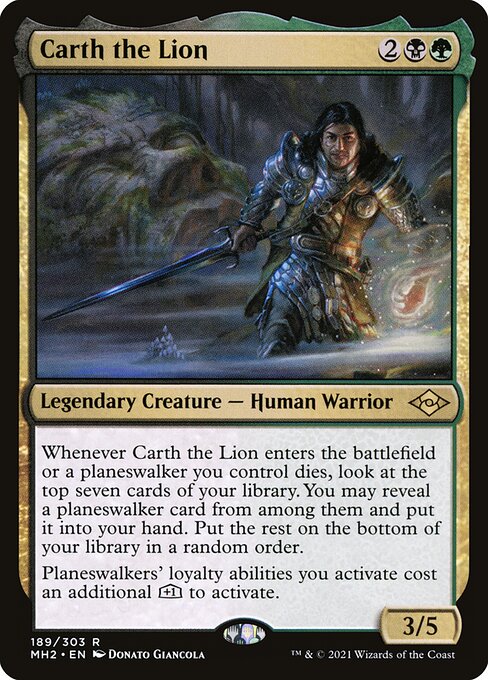
Whenever Carth enters the battlefield or a planeswalker you control dies, you look at the top seven cards of your library and can put a planeswalker card from among them into your hand.
That helps you keep finding more planeswalkers.
But his other ability is particularly unusual.
The loyalty abilities of planeswalkers you control cost an additional +1 loyalty to activate.
That means a +1 ability effectively becomes +2.
A 0 ability becomes +1.
And a -3 ability effectively costs only two loyalty counters.
Calculate the total cost before paying it: for the modified -3, you remove two counters at once, not three and then add one. Carth does not grant extra activations.
That's extremely useful.
You're making it easier to build loyalty and reducing the loyalty cost of powerful negative abilities.
I like Carth because he changes how you evaluate planeswalkers.
A planeswalker that normally has a modest loyalty ability might become much more interesting.
And having black and green gives you access to removal, ramp, and recursion.
The limitation is that you only have two colors.
You'll have fewer planeswalker options than a four- or five-color deck, so I'd focus on choosing planeswalkers that actually work together.
Sisay, Weatherlight Captain: Find the Planeswalker You Need
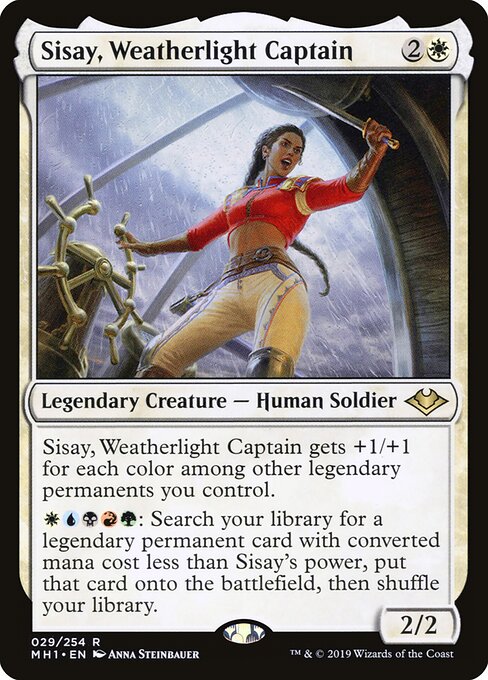
Sisay, Weatherlight Captain is another interesting approach.
Her activated ability lets you search your library for a legendary permanent card with mana value less than Sisay's power and put it directly onto the battlefield.
That includes legendary planeswalkers.
So instead of hoping to draw the right planeswalker, you can find one that fits the current situation.
Maybe you need removal.
Perhaps you need to generate creatures.
Or you're looking for a particular loyalty ability.
What I like about Sisay is the flexibility.
And because her color identity includes all five colors, you have access to an enormous selection of planeswalkers.
But her activated ability requires one mana of each color, and the planeswalker you find must have a mana value lower than Sisay's power.
So building the mana base and increasing Sisay's power are important parts of the strategy.
It's not necessarily the simplest Superfriends deck to build.
But it offers plenty of interesting decisions.
Don't Just Add Every Planeswalker You Like
This is probably the biggest temptation when building Superfriends.
You start looking through planeswalkers.
Find a Teferi you like.
Then an Elspeth.
A Jace.
A Liliana.
An Ugin.
And suddenly you've got twenty-five planeswalkers on your list and you're wondering which lands to remove.
I've had that feeling with plenty of Commander strategies.
But planeswalkers need more support than they might appear to.
Most of them don't defend themselves particularly well.
And many cost four, five, or six mana.
If your deck is filled with expensive planeswalkers but doesn't have enough ramp, protection, or interaction, you'll struggle to develop.
I'd rather have fewer planeswalkers that work well together than an impressive collection of cards that don't actually support the same plan.
For example, a planeswalker that creates creatures can help protect the others.
One that draws cards helps you find more resources.
And one that removes opposing threats can help clear the way for your entire board.
That's a much better foundation than simply choosing the most powerful ultimate abilities you can find.
Protecting Your Planeswalkers: The Real Challenge
This is where Superfriends becomes quite different from other Commander strategies.
In a four-player game, you potentially have three opponents who can attack your planeswalkers.
And unlike a normal creature, a planeswalker doesn't block attackers by itself.
Your opponents can choose to attack you or planeswalkers you control.
If a creature attacks one of your planeswalkers and deals combat damage to it, that damage removes loyalty counters.
And if a planeswalker reaches zero loyalty, it goes to the graveyard.
So if you spend five mana on a planeswalker and it gets attacked by two creatures immediately, you might not get much value from it.
That's why protection needs to be part of the deck from the beginning.
Creatures That Defend Your Planeswalkers
One of my favorite approaches is using planeswalkers that create their own blockers.
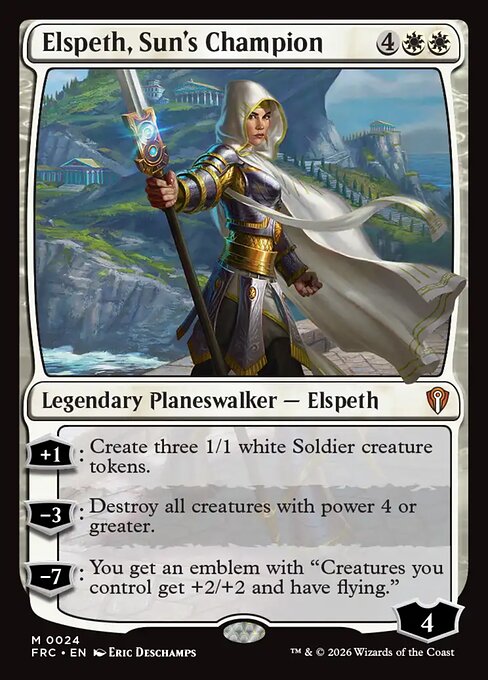
Elspeth, Sun's Champion is an excellent example.
Her +1 ability creates three 1/1 Soldier tokens.
That's three creatures that can help protect your planeswalkers from attacks.
And if Elspeth survives, you can keep creating more.
The Wandering Emperor can also create a 2/2 Samurai token with vigilance, among other useful abilities.
I like planeswalkers that contribute to their own defense.
They're less dependent on having an established battlefield before you cast them.
But I wouldn't rely only on planeswalker-generated creatures.
I'd also include some conventional creatures or token engines that can protect your board.
Because if somebody eliminates your token generators, your planeswalkers might suddenly become very vulnerable.
Defensive Enchantments and Other Protection
There are also cards that make attacking your planeswalkers more difficult.
Sphere of Safety, for example, taxes creatures attacking you or planeswalkers you control based on the number of enchantments you control.
That can be particularly useful in a Superfriends deck that also plays several enchantments.
But read your defensive cards carefully.
Ghostly Prison and Propaganda make attacking you more expensive. Their normal wording doesn't impose that same tax on attacks directed at your planeswalkers.
That's an important distinction.
I've seen players assume that protecting themselves automatically protects their planeswalkers.
It doesn't always work that way.
You can also use removal, board wipes, and other defensive tools to control combat.
But I like having a mixture of protection rather than relying completely on one expensive enchantment.
Proliferate: Make Every Loyalty Counter Matter
Proliferate is one of the most natural mechanics to combine with Superfriends.
And it's easy to understand why.
Your planeswalkers enter with loyalty counters.
Proliferate adds more.
The more planeswalkers you control, the more total value you can get from each proliferate effect.
Evolution Sage is a great example.
Whenever a land enters the battlefield under your control, Evolution Sage proliferates.
That means every land drop can increase the loyalty of several planeswalkers.
Contentious Plan gives you another proliferate effect while drawing a card.
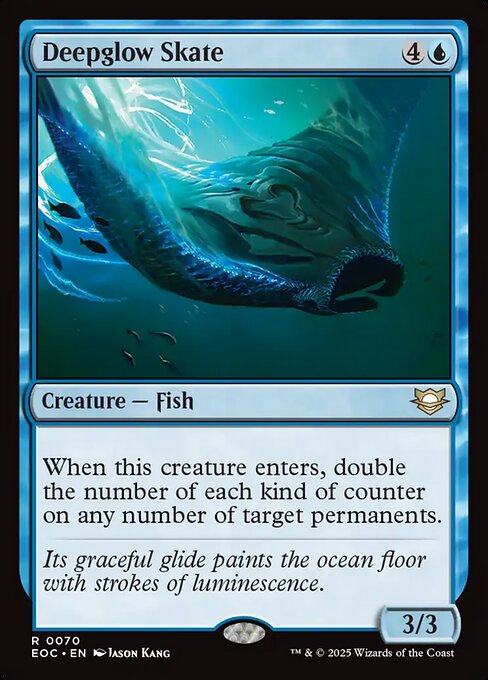
And Deepglow Skate can double the number of counters on any number of target permanents when it enters the battlefield.
Imagine controlling three planeswalkers with four, five, and six loyalty counters.
If you use Deepglow Skate to target all three, they end up with eight, ten, and twelve loyalty counters.
That's an enormous increase.
Suddenly, ultimate abilities that seemed several turns away might become available immediately.
Adding loyalty does not reset the normal once-per-turn activation limit. A planeswalker at zero loyalty goes to the graveyard as a state-based action before you can cast a spell or activate an ability to proliferate it.
I like these effects because they make your existing planeswalkers better rather than requiring you to constantly cast more.
But I wouldn't fill the deck with proliferation cards that do nothing useful on their own.
If you have no planeswalkers on the battlefield, repeatedly proliferating isn't going to accomplish much for a pure Superfriends strategy.
You need enough actual planeswalkers and other useful permanents to make those effects worthwhile.
Doubling Season and Other Counter Interactions
There's another famous interaction worth understanding.
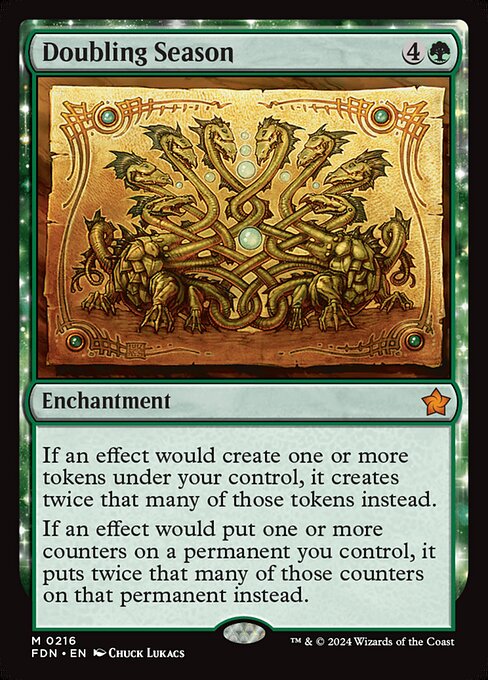
Doubling Season can make planeswalkers enter the battlefield with twice their normal number of loyalty counters.
For example, if a planeswalker would normally enter with four loyalty counters, Doubling Season can make it enter with eight.
That may allow you to activate an ultimate ability immediately, assuming it has enough loyalty and you can legally activate it.
That's extremely powerful.
But there's an important rules detail.
Doubling Season doesn't double the loyalty counters added as the cost of activating a +1 ability.
That's because paying the cost of a loyalty ability isn't the same as an effect putting counters on the planeswalker.
So you can double the counters it enters with, but you don't automatically turn every +1 activation into +2.
Also, these powerful counter interactions can dramatically increase the strength of your deck.
I'd think about the power level of your playgroup before adding every available multiplier.
There's a big difference between slowly building toward an ultimate and playing a planeswalker that can activate it immediately.
Both approaches are valid.
They just create very different games.
Activating Loyalty Abilities More Than Once
Normally, you can activate one loyalty ability of each planeswalker you control during your turn, at sorcery speed.
That means during one of your main phases, while the stack is empty.
But some cards let you do more.
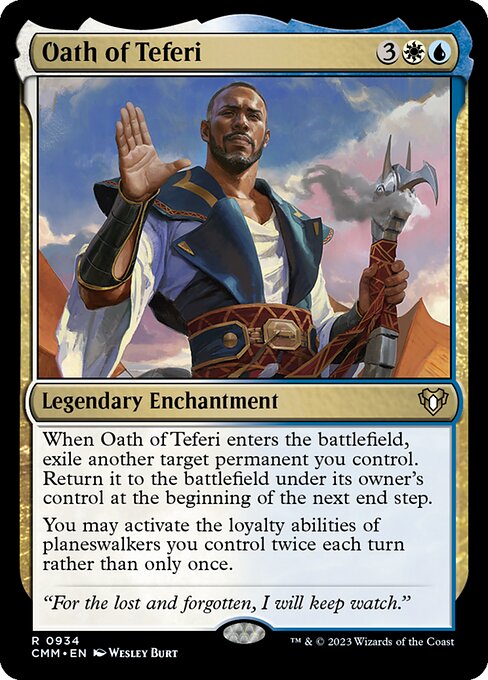
Oath of Teferi allows you to activate loyalty abilities of planeswalkers you control twice each turn instead of once.
You can activate the same ability twice or two different abilities, paying each cost. Oath’s entry ability exiles another target permanent you control and returns it at the beginning of the next end step; a planeswalker returns as a new object.
That's a very powerful effect in Superfriends.
Imagine activating a planeswalker's +1 ability to generate resources and then using another ability during the same turn.
Or activating two different planeswalkers twice each.
The amount of value can become enormous.
The Chain Veil is another well-known card that can give you additional loyalty activations.
These effects are particularly useful when you already have several planeswalkers in play.
But they're also the kind of cards that can create complicated combos and long turns.
I'd make sure I understand the interactions before adding them.
And remember that these effects don't automatically remove the normal timing restrictions on loyalty abilities.
Being allowed to activate another ability doesn't mean you can do it whenever you want.
Card Draw: You Need to Keep Finding Planeswalkers
One of the problems with Superfriends is that planeswalkers can be expensive and relatively slow.
You spend several turns developing mana, cast an important planeswalker, activate one ability, and then perhaps lose it before your next turn.
If that happens repeatedly, you need ways to recover.
That's why card advantage matters so much.
I like planeswalkers that generate cards themselves, but I wouldn't rely exclusively on them.
Teferi, Hero of Dominaria is a good example of a planeswalker that can help you draw cards while maintaining mana for interaction.
Jace, the Mind Sculptor provides several useful abilities, including card selection.
And conventional card-draw spells still have a place in the deck.
Cards like Fact or Fiction, Memory Deluge, or other efficient draw effects can help you find the tools you need.
I particularly like having enough card advantage that losing two planeswalkers doesn't leave the deck without resources.
Because in multiplayer Commander, your opponents will eventually remove some of them.
And they'll probably be quite happy about it.
Ramp and Mana Curve: Superfriends Can Be Expensive
This is another area I'd pay close attention to.
A lot of interesting planeswalkers cost four or more mana.
If your deck has fifteen expensive planeswalkers and very little ramp, it's going to be slow.
And because planeswalkers often need protection, you might want to cast other spells during the same turn.
That requires mana.
I'd build a reliable ramp package based on the commander's colors.
Cards like Sol Ring, Arcane Signet, Fellwar Stone, and color-appropriate land ramp can help.
Interplanar Beacon is also interesting in Superfriends because it provides color fixing for casting planeswalker spells and gains you life when you cast them.
And in a Commodore Guff deck, the Wizard tokens he creates can help pay for additional planeswalkers.
But I'd still make sure the deck functions when the commander isn't available.
I also wouldn't try to play only the most expensive planeswalkers.
Some lower-cost options can provide useful interaction or card advantage while you prepare for the more powerful ones.
That's usually better than spending your first four turns doing almost nothing.
Removal and Board Wipes: Keep the Battlefield Manageable
Superfriends often needs more defensive interaction than you might expect.
You aren't only protecting your life total.
You're protecting several permanents that opponents can attack directly.
That's why removal matters.
Cards like Swords to Plowshares, Generous Gift, Beast Within, and Anguished Unmaking can provide useful answers, depending on your colors.
And board wipes can be particularly valuable.
Supreme Verdict, Austere Command, and Toxic Deluge can help reset dangerous creature boards.
But I'd choose board wipes carefully.
Some damage-based wipes also damage planeswalkers, depending on their wording.
And effects that destroy or exile all nonland permanents can remove your own planeswalkers too.
You don't want to cast an impressive board wipe only to discover you've destroyed half your own strategy.
I like having some selective or flexible answers that let me preserve important permanents.
And I'd also remember that you don't need to remove every creature.
Sometimes having enough blockers is more efficient than constantly spending removal to keep your planeswalkers safe.
How Many Planeswalkers Should You Play?
I wouldn't use one number for every Superfriends deck.
A Commodore Guff deck, where the commander directly rewards controlling planeswalkers, has different requirements from a more defensive Atraxa deck.
And a Sisay deck that can search for particular legendary planeswalkers might need fewer of them than a deck relying entirely on drawing them naturally.
But as a starting point, I'd look at roughly 12–18 planeswalkers in a dedicated Superfriends Commander deck, then adjust according to the commander and the rest of the strategy.
Some decks will want more.
Others can work with fewer if they have strong tutoring, recursion, or additional support.
What I wouldn't do is include twenty-five planeswalkers and assume the deck is automatically better.
Every planeswalker takes a slot that could otherwise provide ramp, removal, protection, card draw, or creatures to defend your board.
And many planeswalkers perform similar jobs.
You don't necessarily need six planeswalkers whose main ability is drawing one card.
I'd rather have a balanced group where each one contributes something meaningful.
How Does a Superfriends Deck Actually Win?
This is probably the most important question before finishing the deck.
Because Superfriends is excellent at generating value.
You can draw cards, remove creatures, increase loyalty counters, and slowly build a battlefield full of planeswalkers.
But that's not automatically a victory.
And there's a big difference between controlling the game and actually finishing it.
There are several ways to win with Superfriends.
Winning Through Ultimate Abilities
This is probably the most obvious approach.
Many planeswalkers have powerful ultimate abilities that can completely change the game.
Some create emblems.
Others generate enormous advantages, remove opposing resources, or put you in a position that's very difficult to lose from.
For example, Teferi, Hero of Dominaria can eventually create an emblem that lets you exile opposing permanents whenever you draw a card.
And Elspeth, Sun's Champion can create an emblem that gives your creatures +2/+2 and flying.
Those effects can become extremely powerful.
But I'd be careful about relying entirely on ultimates.
Your opponents can attack or remove planeswalkers before they accumulate enough loyalty.
And some ultimate abilities don't immediately win the game.
An emblem might give you an enormous advantage, but you still need to use that advantage to finish.
I like having ultimates as an important part of the strategy, not as the only way to win.
Winning With Tokens and Combat
This is one of my favorite ways to build Superfriends.
Several planeswalkers can create creatures.
Elspeth creates Soldiers.
The Wandering Emperor can create Samurai.
Other planeswalkers generate different kinds of creatures or help strengthen your battlefield.
Those creatures protect your planeswalkers while also becoming a potential win condition.
Eventually, you can use a powerful combat effect or a planeswalker emblem to turn your army into a serious threat.
I like this approach because it solves two problems at once.
You need blockers to keep your planeswalkers alive.
And you need creatures to attack your opponents.
Why not use the same creatures for both?
Winning Through Repeated Value
Some Superfriends decks gradually reach a point where their opponents simply can't keep up.
You draw several additional cards every turn.
Your planeswalkers remove threats.
You create creatures, generate mana, and keep improving your board.
Eventually, you're far enough ahead to win through combat or another reliable threat.
This is a perfectly valid strategy.
But I'd make sure the deck actually has a way to convert that advantage into a win.
Having five planeswalkers on the battlefield doesn't necessarily mean you're winning if none of them creates meaningful pressure.
Winning With Combos
Superfriends can also use combos involving loyalty abilities, repeated activations, and mana generation.
The Chain Veil is a well-known piece in several such combinations.
Some decks use repeatable untap effects and enough mana to activate planeswalker abilities many times.
Others use counter multipliers to make ultimate abilities available much earlier than usual.
Those interactions can be extremely powerful.
But I wouldn't automatically include every available combo.
If you enjoy higher-power Commander, they might fit perfectly.
If your group prefers slower, more casual games, building toward ultimates and winning through creatures can be just as satisfying.
The important thing is deciding what kind of experience you want.
Threat Assessment: Everybody Can See Your Planeswalkers
There's something worth remembering about Superfriends.
Your threats are very visible.
An opponent might not immediately understand every synergy in your deck, but they can look at a planeswalker with eight loyalty counters and see that something dangerous is approaching.
And once you have several planeswalkers on the battlefield, the table may decide you're the biggest threat.
Even if you haven't actually done much yet.
That's why I think politics and threat assessment matter in Superfriends.
You don't always need to activate the most threatening ability available.
Sometimes drawing a card or making a blocker is better than immediately putting yourself in a position where every opponent wants to attack you.
And I'd pay attention to which planeswalkers actually need protecting.
Maybe one is about to activate an ultimate.
Another is simply generating a little card advantage.
If you have to choose what to defend, those priorities matter.
Superfriends rewards thinking ahead.
But it also rewards knowing when to stop developing and actually put pressure on your opponents.
Common Mistakes When Building Superfriends
There are several things I'd watch out for.
Too many planeswalkers and not enough protection. A battlefield full of planeswalkers isn't very impressive if opponents can attack them freely.
Ignoring the mana curve. Many planeswalkers are expensive. You still need to develop during the early turns.
Relying entirely on ultimate abilities. They're powerful, but you won't always reach them.
Not enough creatures. Even a few reliable blockers can make an enormous difference.
Forgetting about card draw. Losing several planeswalkers can leave you without resources if you don't have independent draw engines.
Using protection that doesn't actually protect planeswalkers. Some defensive cards protect your life total but don't stop opponents from attacking your planeswalkers.
No realistic win condition. Generating loyalty counters is useful, but eventually you need to turn them into a victory.
And one more thing: don't include a planeswalker just because you like the character.
Well, actually, sometimes that's a perfectly valid reason.
But at least make sure the rest of the deck can support it.
Test Your Superfriends Deck Before Buying Everything
Superfriends is one of those archetypes where it's easy to make the deck look powerful on paper.
You choose several famous planeswalkers, add proliferation, include some protection, and imagine activating three ultimate abilities during the same turn.
But actual games can be quite different.
Maybe you don't have enough ramp to cast your planeswalkers consistently.
Perhaps your opponents keep attacking them before they can generate meaningful value.
Or you might build a powerful board but struggle to actually finish the game.
That's why I'd test the deck before buying every card.
In MTG Master Deck Builder, you can build your Superfriends Commander deck, explore card synergies, and use the Deck Analyzer to review mana curve, consistency, interaction, resilience, and other aspects of the deck.
I'd pay particular attention to the balance between planeswalkers, defensive creatures, ramp, and removal.
The opening-hand simulator can also help you identify slow starts.
A hand with three five-mana planeswalkers and no acceleration might look powerful, but it probably isn't going to do much during the first few turns.
And if your deck includes repeated loyalty activations, untap effects, or mana engines, the combo detection tools are worth checking.
Of course, no analyzer can predict whether your opponents will decide to attack your planeswalkers instead of you.
That's something you'll discover during real games.
But it can help identify structural problems before you invest money in a deck that doesn't function quite the way you imagined.
Is Superfriends the Right Archetype for You?
I think Superfriends is a fantastic choice if you enjoy planeswalkers, managing several abilities, and building a battlefield where different pieces support each other.
It's particularly interesting if you like planning several turns ahead.
You're deciding which loyalty abilities to activate, which planeswalkers to protect, when to use removal, and whether it's worth taking a risk to reach an ultimate.
And there's something very satisfying about watching your collection of planeswalkers gradually take over the game.
But Superfriends isn't for everyone.
If you prefer straightforward combat and quick turns, managing several loyalty abilities can become a little exhausting.
And if your group plays aggressive creature decks, you'll need to be prepared for your planeswalkers to become immediate targets.
Personally, I think the most enjoyable Superfriends decks are those where the planeswalkers actually work together instead of simply being a collection of powerful cards.
One draws cards.
Another protects the battlefield.
Another removes threats.
And the rest gradually help you build toward victory.
You don't necessarily need the most expensive planeswalkers or the fastest possible ultimate.
You just need a team that works.
And when your opponents ask how many loyalty abilities you still have to activate this turn...
Well, that's usually when you know you've built a proper Superfriends deck.
Just try not to make them regret asking.
Build a planeswalker team with a winning plan
Balance planeswalkers, blockers, ramp, protection and card advantage in Deck Builder.