
Mardu Commander Guide: Combat, Sacrifice and Making Every Creature Matter
By MTG Master EditorialPublished Updated 9 min read
Mardu is red, white and black.
Red wants to attack.
White brings creatures, tokens, Equipment and protection.
Black looks at all those creatures and asks what happens when we sacrifice them.
That’s Mardu.
Attack with your creatures.
Get combat triggers.
Sacrifice the ones you don’t need.
Get death triggers.
Bring some of them back.
Make more tokens.
Attack again.
Mardu is not particularly interested in keeping every resource forever.
It’s interested in getting as much as possible out of those resources before they’re gone.
Sometimes your creature’s job is to attack.
Sometimes its job is to die.
The good ones do both.
How Does Mardu Play?
Mardu is usually proactive.
It wants to put pressure on the table.
Creatures.
Tokens.
Equipment.
Combat triggers.
Sacrifice engines.
Life drain.
You can absolutely build Mardu Control or a slower value deck, but the color combination naturally rewards doing things.
Especially things involving creatures.
A Mardu board can become dangerous very quickly because attacking isn’t always just about combat damage.
Maybe attacking creates tokens.
Maybe creatures entering trigger something.
Maybe creatures dying trigger something else.
Maybe you sacrifice the tokens after combat.
Maybe those deaths drain the table.
The combat phase ends.
Apparently half the deck has triggered.
What Is Mardu Good At?
Combat
Mardu is one of the best combat color combinations in Commander.
Red gives you haste, extra combats and aggressive creatures.
White gives you efficient creatures, Equipment and combat support.
Black adds removal, recursion and ways to profit when creatures die.
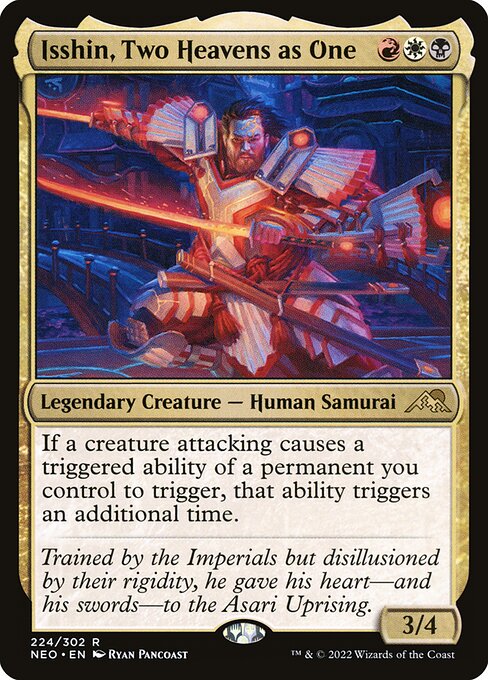
Isshin, Two Heavens as One is a perfect example.
If a creature attacking causes a triggered ability of a permanent you control to trigger, Isshin makes it trigger an additional time. This can also work when an opponent’s creature attacks, but it does not double combat damage, ETB triggers or every ability that happens during combat.
Attack.
Get the trigger.
Get it again.
If several creatures have attack triggers, things become ridiculous very quickly.
At some point attacking with five creatures involves considerably more than simply turning five cards sideways.
Tokens
Mardu is excellent at creating tokens.
White makes armies.
Red creates aggressive and temporary tokens.
Black makes creatures that are often extremely happy to be sacrificed later.
Soldiers.
Warriors.
Vampires.
Spirits.
Goblins.
Treasure.
And many other things depending on the commander.
Creature tokens can attack.
They can block.
They can carry Equipment.
They can be sacrificed.
They can trigger abilities when they enter or die.
A 1/1 token doesn’t look particularly impressive.
It doesn’t need to be.
Sometimes its job is simply to exist for approximately twelve seconds and generate three triggers.
Good token.
Sacrifice
Black and red are already excellent sacrifice colors.
White adds more creatures, tokens and recursion.
That makes Mardu a natural home for sacrifice strategies.
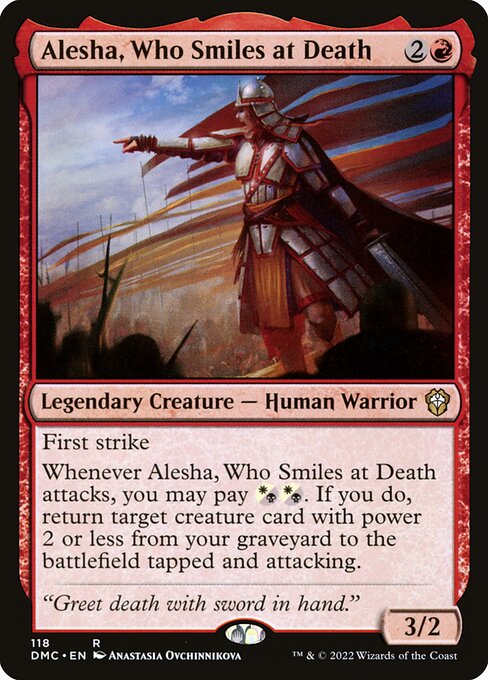
Alesha, Who Smiles at Death shows the relationship between combat and recursion particularly well.
When Alesha attacks, you may pay two mana, each white or black, to return a target creature card with power 2 or less from your graveyard tapped and attacking. The limit is power, not mana value. Entering attacking does not trigger that creature’s own attack abilities.
So the creature died.
That’s fine.
We’re attacking with it again.
Mardu sacrifice decks often want creatures moving between zones.
Battlefield.
Graveyard.
Battlefield again.
Maybe exile occasionally.
Then back somehow.
The important thing is that every trip generates value.
Aristocrats
Mardu has basically everything an Aristocrats deck wants.
Token generation.
Sacrifice outlets.
Death triggers.
Life drain.
Recursion.
Removal.
You sacrifice creatures and get paid for it.
Maybe you draw cards.
Maybe opponents lose life.
Maybe you create another creature.
Maybe something returns from the graveyard.
And because you’re in white as well as black and red, you have excellent access to both token generation and protection.
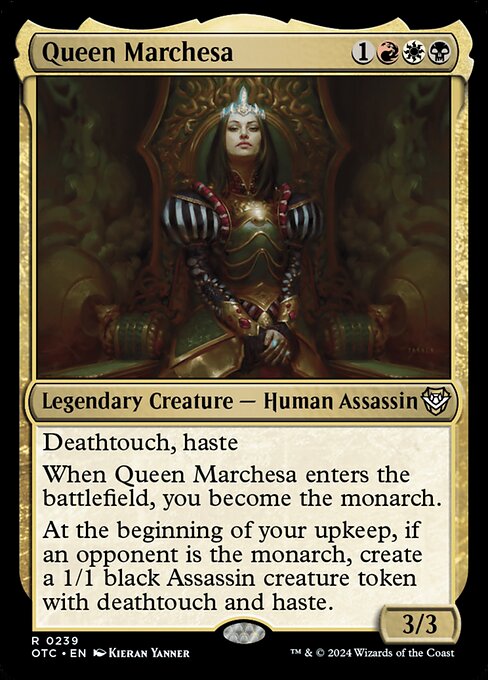
Queen Marchesa can play a very different style of Mardu, but she demonstrates something important about the colors: Mardu doesn’t need to blindly attack every turn.
You become the monarch when she enters. At the beginning of your upkeep, if an opponent is the monarch, she creates a 1/1 Assassin with deathtouch and haste. The crown provides card draw at the beginning of the monarch’s end step; losing it does not immediately create an Assassin.
Politics.
Combat.
Card advantage.
And a fairly clear suggestion that perhaps you should give the crown back.
Equipment
White and red are two of the best Equipment colors in Magic.
Black adds tutors, recursion and powerful creatures to carry everything.
Mardu can build excellent Equipment and Voltron decks.
Find Equipment.
Attach Equipment.
Attack.
Move Equipment around.
Recover destroyed Equipment.
Repeat.
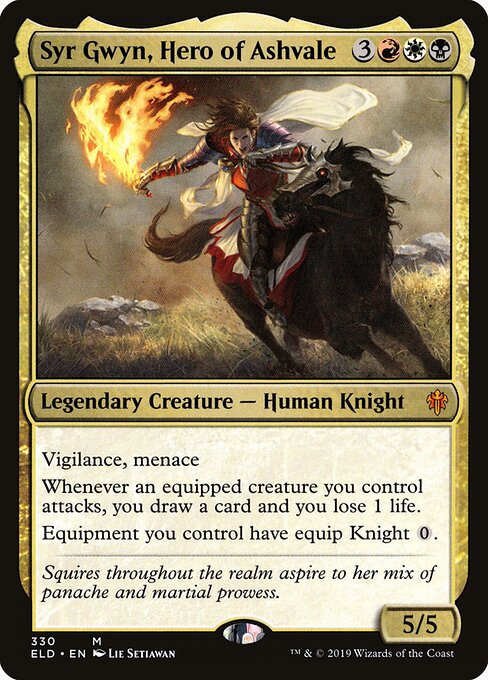
Syr Gwyn, Hero of Ashvale is a great example.
She gives Equipment you control equip Knight {0}, letting you equip a Knight you control without paying mana. Equip still normally works only as a sorcery; this does not let you move Equipment around during combat.
Whenever an equipped creature you control attacks, you draw one card and lose 1 life. This happens per attacking equipped creature, not per Equipment attached to it.
So you attack.
You draw.
You lose a little life.
You’re playing black.
You’ll survive.
Probably.
Reanimator
Black gives Mardu excellent reanimation.
White adds more recursion.
Red provides looting and ways to put cards into the graveyard.
This means Mardu can play surprisingly strong Reanimator strategies.
Discard something enormous.
Put it into the graveyard.
Bring it back considerably earlier than anyone wanted to see it.
Mardu doesn’t have the self-mill depth of Sultai, but it doesn’t necessarily need it.
Sometimes you know exactly which creature you want in the graveyard.
Put it there.
Then cheat.
Go-Wide
Mardu is very comfortable attacking with a large battlefield.
Create tokens.
Give them haste.
Give them anthem effects.
Trigger abilities when they attack.
Then attack with everything.
White provides the army.
Red makes the army dangerous.
Black makes sure even dying is productive.
This is one reason board wipes don’t always solve a Mardu board as cleanly as you might expect.
If everything dying causes fifteen triggers, you may technically have removed the creatures.
Congratulations.
Now resolve the stack.
Extra Combats
Red gives Mardu access to extra combat phases. An extra combat does not automatically untap your creatures; check whether the effect also untaps them.
And if your deck cares about attack triggers, that’s obviously interesting.
Attack once.
Get all the triggers.
Untap.
Attack again.
Get all the triggers again.
Some commanders don’t even need an enormous battlefield to make extra combats dangerous.
If your creatures generate resources when attacking, additional combat phases can start paying for themselves.
That’s usually when everyone else starts reading your cards very carefully.
Removal
Mardu has excellent removal.
White can exile almost any permanent.
Black kills creatures and planeswalkers.
Red handles creatures and artifacts.
You also have excellent board wipes.
Mardu may lack green’s easy enchantment destruction and blue’s counterspells, but once something is on the battlefield you still have plenty of ways to deal with it.
Especially creatures.
Mardu is very, very good at making creatures stop being alive.
Including its own.
Life as a Resource
Black is happy to spend life.
White is good at gaining it back.
Red is generally too busy attacking to worry about the details.
That gives Mardu plenty of ways to use life as another resource.
Pay life to draw cards.
Lose life for powerful effects.
Gain it back through lifelink or death triggers.
Drain opponents.
Repeat.
Forty life is a lot.
You don’t need to finish the game with all of it.
One is technically enough.
Although perhaps don’t aim specifically for one.
What Is Mardu Bad At?
Ramp can be a problem.
You don’t have green.
You don’t have the same artifact synergies as some blue combinations.
That means mana rocks, Treasures and other forms of acceleration become important.
Card draw also needs attention.
Black gives you excellent options.
Red has impulse draw.
White has improved enormously at generating cards.
But Mardu doesn’t automatically drown you in cards the way Sultai or Simic can.
You need to build for it.
Mardu can also overcommit to the battlefield.
You create ten creatures.
You attack.
You create five more.
Everything looks fantastic.
Then somebody wipes the board.
If you don’t have recursion, protection or death payoffs, that’s a problem.
Fortunately, you’re playing Mardu.
You have all three available.
Use them.
How Does Mardu Usually Win?
Combat.
Obviously.
Token armies can overwhelm the table.
Voltron commanders can kill through commander damage.
Attack triggers can generate absurd amounts of value.
Extra combat phases can end games very quickly.
Aristocrats is another major route.
Sacrifice creatures.
Drain everyone.
Repeat.
Mardu can also win through combos involving sacrifice, recursion or combat.
Infinite death triggers.
Infinite tokens.
Infinite combat phases.
Repeated recursion loops.
There are plenty of possibilities.
And sometimes the strategy is simply to attack until everyone is dead.
Complicated?
No.
Effective?
Absolutely.
What Does a Mardu Deck Need?
First, decide what your creatures are supposed to do.
Attack?
Die?
Carry Equipment?
Create tokens?
Trigger abilities?
Ideally several of those.
Second, make sure you can recover from a board wipe.
Protection.
Recursion.
Death triggers.
Card draw.
You don’t necessarily need all of them, but you probably need some.
Third, don’t ignore your mana.
Without green, acceleration deserves actual deck slots.
And finally, include enough card advantage to keep going after the first big attack.
Mardu is very good at spending resources.
Make sure you can generate more.
Is Mardu for You?
I’d look at Mardu if you like proactive decks where creatures are constantly doing something.
Especially if you like:
- Combat
- Tokens
- Sacrifice
- Aristocrats
- Equipment
- Voltron
- Reanimator
- Extra combats
- Attack triggers
- Life drain
- Removal
- Aggressive decks
- Turning creatures sideways
- Sacrificing those same creatures five minutes later because apparently their work isn’t finished
Mardu can be aggressive without being simple.
Combat decisions matter.
Sacrifice timing matters.
Knowing which creatures should survive matters.
And sometimes the correct play is attacking with something you fully expect to die.
Because dying was part of the plan.
Building Your First Mardu Commander Deck
Start by deciding what happens when your creatures attack.
Do they create tokens?
Draw cards?
Generate Treasures?
Deal extra damage?
Trigger your commander?
Then decide what happens when they die.
If the answer is “nothing”, and you’re building a sacrifice deck, you probably have some work to do.
Add card draw.
Add mana rocks or Treasure generation.
Add removal.
Mardu gives you plenty.
Include ways to protect or rebuild your battlefield.
And make sure you have enough creatures or token generation to keep the engine running.
Most importantly, don’t become too attached to your creatures.
They are resources.
Attack with them.
Block with them.
Sacrifice them.
Bring them back.
Attack again.
Because in Mardu, a creature dying doesn’t necessarily mean it failed. Sometimes that was exactly the job.
Ready to test your Mardu deck?
Analyze your list to check whether your creatures, attack triggers and sacrifice payoffs have the mana, card draw and recovery to keep pressure on the table.