
Naya Commander Guide: Creatures, Tokens and Building a Ridiculous Battlefield
By MTG Master EditorialPublished Updated 9 min read
Naya is red, green and white.
And if your idea of a good Commander game involves having an actual battlefield full of things, Naya is a very good place to start.
Green gives you ramp, enormous creatures and creature-based value.
White gives you tokens, protection, removal and ways to make your entire board better.
Red gives you haste, damage, extra combat potential and the ability to make everything considerably more explosive.
Put them together and you get a color combination that’s extremely good at doing something very complicated:
Putting a lot of dangerous things onto the battlefield.
Then attacking people with them.
Obviously there’s a little more to it than that.
Usually.
How Does Naya Play?
Naya is primarily a battlefield-focused color combination.
It likes permanents.
Creatures especially.
Instead of holding seven cards and waiting for the perfect moment to interact, Naya often prefers turning those cards into an increasingly threatening board.
Play a creature.
Ramp.
Create some tokens.
Put counters on things.
Play something enormous.
Give it haste.
Attack.
Untap next turn and discover that everyone has suddenly become very interested in your side of the table.
That’s Naya.
But three colors give you plenty of different ways to get there.
You can play tokens.
Dinosaurs.
Dragons.
Cats.
Beasts.
Humans.
+1/+1 counters.
Landfall.
Auras.
Equipment.
Go-wide.
Go-tall.
Or simply creatures that are far larger than they have any reasonable need to be.
What Is Naya Good At?
Big Creatures
Let’s start with the obvious one.
Naya is very good at playing enormous creatures.
Green gives you ramp and efficient creatures.
Red gives you aggressive threats, haste and damage.
White gives you protection and support.
This means you can spend the early game developing mana and then start dropping threats that demand answers.
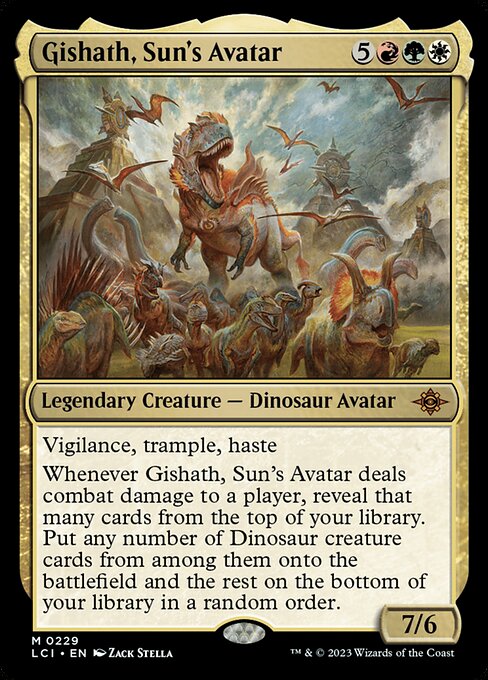
Gishath, Sun’s Avatar is probably one of the best examples.
It’s an enormous Dinosaur with vigilance, trample and haste.
That’s already fairly rude.
Then whenever Gishath deals combat damage to a player, you reveal cards from your library and potentially put a pile of Dinosaurs directly onto the battlefield.
So the reward for successfully attacking with your giant Dinosaur is…
More giant Dinosaurs.
Seems appropriate.
Tokens
White and green are two of the best token colors in Magic.
Red certainly doesn’t hurt.
Naya can create huge numbers of creature tokens and then turn them into actual threats.
Soldiers.
Humans.
Cats.
Beasts.
Saprolings.
Dinosaurs.
Whatever your deck happens to be producing.
Then you add anthem effects, counters, haste or combat triggers.
A collection of harmless 1/1s can stop looking harmless very quickly.
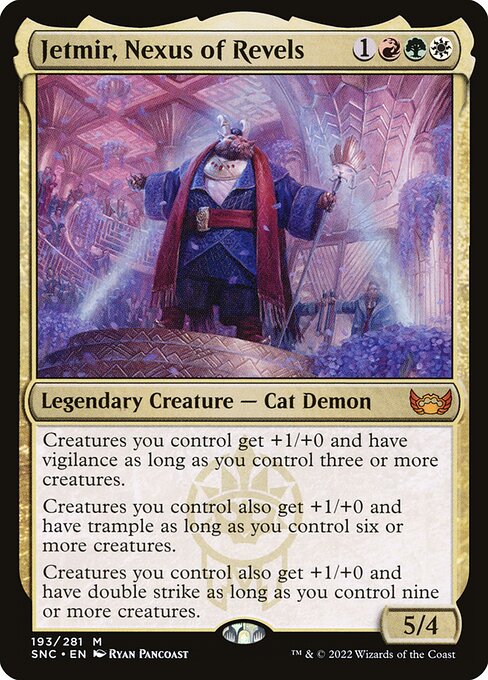
Jetmir, Nexus of Revels demonstrates this perfectly.
At three, six and nine creatures, Jetmir gives your creatures another +1/+0 and another ability. These bonuses stack.
Vigilance.
Then trample.
Then double strike.
Suddenly the ten random tokens you’ve accumulated aren’t random tokens anymore.
They’re a problem.
A fairly immediate one.
Go-Wide
Naya loves going wide.
Create creatures.
Create more creatures.
Make all of them bigger.
Attack.
White and green provide excellent token production and anthem effects.
Red gives you ways to make the attack more explosive.
This strategy can also recover surprisingly quickly.
You don’t necessarily need every creature to be individually powerful.
You just need enough of them.
Although having enough creatures tends to attract board wipes.
We’ll get to that.
+1/+1 Counters
Green and white already make Selesnya excellent at +1/+1 counters.
Red adds aggressive payoffs and ways to turn that power into immediate damage.
Naya counter decks can grow entire armies or concentrate everything onto a few enormous creatures.
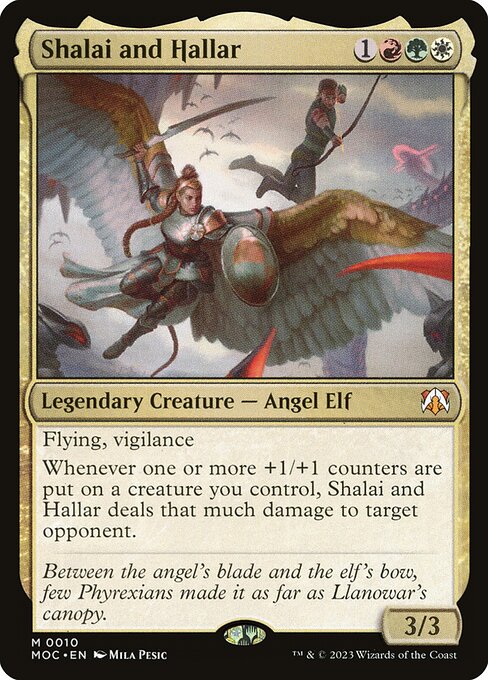
Shalai and Hallar is a great example.
Whenever one or more +1/+1 counters are put on a creature you control, Shalai and Hallar deal that much damage to one target opponent.
Now putting counters on creatures isn’t simply making them larger.
It’s also direct damage.
That’s when apparently innocent counter synergies start becoming slightly less innocent.
Combat
Naya is very good at combat.
Which is useful, because you’re probably going to be doing quite a lot of it.
Trample.
Double strike.
Haste.
Vigilance.
Combat triggers.
Attack triggers.
Extra combat steps.
Power boosts.
Protection.
Naya has plenty of tools for making combat more than simply turning creatures sideways.
And because green gives you large creatures while white and red provide excellent combat support, blocking can become extremely unpleasant for your opponents.
Sometimes the combat math is complicated.
Sometimes it’s just:
“That’s a 17/17 with trample and double strike.”
Both approaches work.
Landfall
Green and red already give Gruul excellent landfall strategies.
White adds more token production and useful landfall payoffs.
Naya can ramp aggressively, trigger landfall several times in one turn and convert those triggers into creatures, counters or damage.
Omnath, Locus of Creation isn’t Naya because it also includes blue, but plenty of Naya commanders can exploit similar land-based engines without needing the fourth color.
Fetch lands become multiple triggers.
Ramp spells become value engines.
Playing a land for the turn becomes considerably more interesting than it normally sounds.
Equipment and Auras
White and red are excellent Equipment colors.
Green adds powerful Aura synergies, creature support and ramp.
That gives Naya several ways to build Voltron or creature-focused decks.
You can make one commander enormous.
Or spread Equipment and Auras across several creatures.
Naya also has good ways to protect the creature you’ve invested all those resources into.
Which is important.
Putting six cards onto one creature is fun.
Watching somebody remove it for two mana is less fun.
Creature Toolbox
Green and white are particularly good at finding creatures and using creatures as answers.
Naya can build decks where the creature base itself acts like a toolbox.
Need artifact removal?
There’s a creature for that.
Need enchantment removal?
Creature.
Need graveyard hate?
Creature.
Need card draw?
Probably a creature.
Need something enormous to punch somebody?
Naya has several thousand candidates.
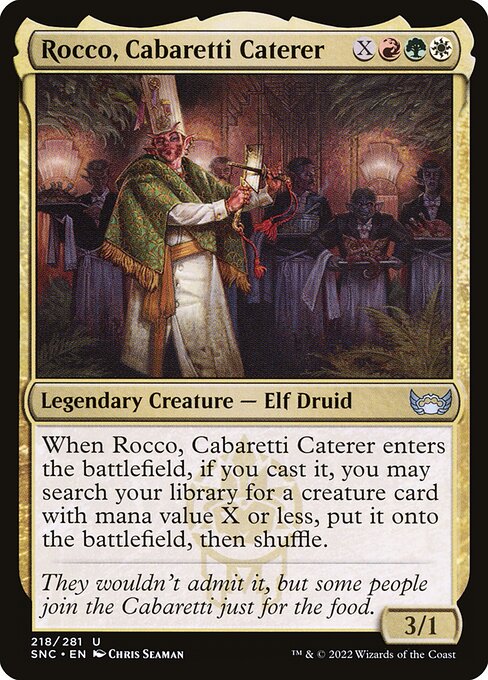
Rocco, Cabaretti Caterer takes this idea very literally.
When Rocco enters the battlefield, if you cast him, you may search your library for a creature card with mana value X or less, put it onto the battlefield, then shuffle. X is the value you chose when casting him.
That means the deck can contain specific creatures for specific situations.
Or combo pieces.
Or just whatever horrible creature you happen to need at the time.
Protection
One advantage Naya has over Gruul is white.
And white is very good at keeping your board alive.
Indestructible.
Protection.
Blink effects.
Phasing.
Protection from specific colors.
Sometimes even bringing things back after they die.
This matters enormously in a creature-heavy strategy.
Because if you’ve spent five turns building a ridiculous battlefield, you should probably expect somebody to cast a board wipe.
Preferably you’re ready for it.
What Is Naya Bad At?
Card draw requires a little more thought than in blue or black.
That doesn’t mean Naya can’t draw cards.
Green has excellent creature-based draw.
White has improved enormously at generating card advantage.
Red has impulse draw and several other options.
But you usually need to build around them.
“Whenever a creature with power 4 or greater enters, draw a card” is excellent when your deck is full of large creatures.
Not so excellent when it isn’t.
Naya can also overextend.
Very easily.
You have mana.
You have creatures.
You keep playing creatures.
Your board looks fantastic.
Then somebody casts Wrath of God.
Now your battlefield looks considerably less impressive.
Learning when to stop adding things to the board is important.
You don’t need to play every creature in your hand simply because you can.
How Does Naya Usually Win?
Combat.
Mostly.
This probably isn’t surprising.
But there are many different versions of combat.
One enormous Voltron commander.
A massive token army.
Dinosaurs.
+1/+1 counters.
Overrun effects.
Extra combat steps.
Landfall creatures.
Trample.
Double strike.
Sometimes you build a huge board over several turns.
Sometimes you create a lot of creatures and suddenly give all of them haste.
Sometimes one creature becomes absurdly large and kills someone by itself.
And yes, Naya has combos too.
Three colors give you access to plenty of them.
But if you chose red, green and white, there’s a reasonable chance you wanted to attack somebody eventually.
What Does a Naya Deck Need?
First, enough mana.
Fortunately, you’re playing green.
Naya can ramp extremely well, and many of its strategies want enough mana to play several creatures or one very expensive threat.
Second, card advantage.
Don’t assume having a strong board means you don’t need cards in hand.
Eventually someone is going to interact with you.
Make sure you can rebuild.
Third, protection.
This is especially important for go-wide decks.
If your entire strategy disappears to one board wipe, include ways to protect it.
And finally, evasion.
Having fifteen creatures doesn’t automatically mean you can actually damage anyone.
Trample is especially important.
Flying helps.
Other forms of evasion work too.
Make sure your giant board can actually connect.
Is Naya for You?
I’d look at Naya if you enjoy winning through the battlefield.
Especially if you like:
- Big creatures
- Tokens
- Go-wide
- +1/+1 counters
- Combat
- Dinosaurs
- Dragons
- Creature tribes
- Landfall
- Equipment
- Auras
- Ramp
- Creature toolbox strategies
- Turning a perfectly normal collection of creatures into something completely unreasonable
- Asking “Any blockers?” while already knowing the answer isn’t going to help much
Naya usually makes its intentions fairly visible.
There’s a giant board.
Everyone can see it.
Everyone knows what it’s probably going to do.
The challenge is making sure they still can’t stop it.
Building Your First Naya Commander Deck
Start with the creatures.
Not necessarily by adding every creature you like.
Decide what those creatures are supposed to accomplish together.
Are you making tokens?
Playing Dinosaurs?
Building around +1/+1 counters?
Using landfall?
Going Voltron?
Playing a creature toolbox?
Once you know that, the rest becomes much easier.
Add ramp so you can actually deploy your threats.
Add card draw that works with what your creatures are doing.
Add removal.
Add protection.
And make sure you have ways to push damage through blockers.
Most importantly, don’t fill the deck with only expensive creatures.
Yes, that seven-mana Dinosaur is fantastic.
So is the eight-mana Dragon.
And the nine-mana Beast.
Unfortunately, somebody still needs to do something during the first four turns.
Build the curve properly.
Ramp.
Develop the board.
Then start playing the ridiculous things.
Because Naya doesn’t usually hide what it’s trying to do.
It puts the problem directly onto the battlefield and asks everyone else if they can deal with it.
Ready to test your Naya deck?
Analyze your list to check whether your ramp, curve, card draw and protection help your creatures build a board that can finish the game.